The cotton grower ( lat. Gossypium ) is a genus of the Malvaceae family , which includes more than 50 species [2] of woody and herbaceous, perennial, biennial and annual plants originating from tropical and subtropical regions of Asia, America, Africa and Australia. Cultural forms on an industrial scale are grown around the world as spinning plants . It is a source of plant fibers for the textile industry - cotton .
| Cotton | |||||||||||||||||||||||
|---|---|---|---|---|---|---|---|---|---|---|---|---|---|---|---|---|---|---|---|---|---|---|---|
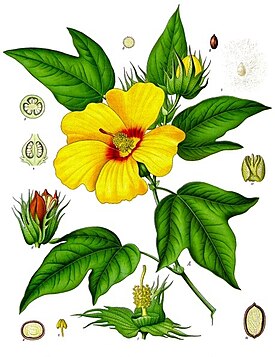 Barbados cotton ( Gossypium barbadense ). Botanical illustration from Köhler's Medizinal-Pflanzen , 1887 | |||||||||||||||||||||||
| Scientific classification | |||||||||||||||||||||||
| |||||||||||||||||||||||
| International scientific name | |||||||||||||||||||||||
Gossypium L. , 1753 | |||||||||||||||||||||||
| Synonyms | |||||||||||||||||||||||
| |||||||||||||||||||||||
| Kinds | |||||||||||||||||||||||
See text ... only 39-40 species | |||||||||||||||||||||||
Content
- 1 Botanical Description
- 2 Origin
- 3 Classification
- 3.1 Species
- 4 Diseases
- 4.1 Pests
- 5 Economic value and application
- 6 Genetic modifications
- 7 notes
- 8 Literature
- 9 References
Botanical Description
Species of the genus Cotton - one-or two-year-old herbaceous plants up to 1-2 m tall with very branched stems. The root system is pivotal, the root goes into the soil to a depth of 30 cm, in some varieties reaches three meters.
Leaves are alternate, with long petioles, usually 3-5 lobed.
Flowers are single, numerous, of various colors. The flower consists of a corolla with three to five wide and fused petals and a double five-toothed green calyx surrounded by a three - bladed wrapper , which is many times longer than the calyx. Numerous stamens fuse into the tube. Flower formula : 
The fruit is a box , sometimes more round, in other cases oval, 3-5-split, cracking along the valves, with numerous dark brown seeds inside it, covered on the surface with soft winding hairs - cotton . Two types of cotton hairs are separated. They can be long and fluffy or short and fleecy - the so-called lint , cotton fluff. Depending on the variety and growing conditions, both types of hairs can be on the seed, and only long ones. Wild species have no long hairs. The seed of cotton, covered with a dense peel, contains a germ consisting of a root and two seed lobes .
Origin
It is customary to distinguish two centers of the emergence of cotton culture. India may be the birthplace of tree-like cotton and herbaceous cotton. Other cultivated species, such as Barbados cotton and common cotton, most likely appeared in America, but then spread widely.
Classification
Due to the variety of species of cotton and the very easy variability and transition of both different species and individual organs to others, when climate and soil change, through cross-pollination, more and more new varieties are obtained. Therefore, all attempts by botanists to classify and subdivide the Gossypium genus according to scientific and strictly defined species have not been successful for a long time. Linnaeus counted only from 3 to 6 species, Parlatore to 7, Decandol to 13. Some numbered already to 42, 52 and even to 88. Others, such as M.J. Watts, recognized only two species: American and Asian, which physiologically cannot mix. The Royale recognized four main species, and its classification has long been considered quite satisfactory.
Genetic studies have shown that the genus of cotton consists of two groups of plants that differ in the number of chromosomes in the cell. Most cotton species are diploid , that is, they have a double set of chromosomes. In another group - tetraploid plants, in non-sex cells of which 52 chromosomes, that is, 4 sets of 13 chromosomes. Triploid and hexaploid samples were also obtained experimentally.
It is interesting that one of the pairs of chromosomes in tetraploid species is Asian, and the second is local, however, when such a crossing occurred, scientists could not establish.
Views
For agriculture, 4 types of cotton play a role:
Diploid species:
- Gossypium herbaceum L. - A cotton grass , or goose , an African-Asian species is very common in India , China , Japan , Central Asia , and Transcaucasia . This is the shortest, most persistent species - it is cultivated farthest in the north, annual. Its stems rarely reach 1.4 m in height, the capsules are round and small, the flower is yellow, with a red spot inside, the seeds are small, round and covered on top with a short, gray color fluff. Fiber (cotton) is white, the shortest and coarsest is woolly, as it is called.
- Gossypium arboreum L. - A cotton tree , or Indochinese , is the tallest, 4.5 to 6 m tall, perennial, with red flowers, with black bare seeds and high-quality yellow fiber. This also probably includes Brazilian and Peruvian varieties; in the latter, black, bare seeds, as if grown together, form a cone-shaped mass. The flowers are yellow. Found only under the tropics.
Tetraploid species:
- Gossypium barbadense L. - Peruvian cotton , or Barbados , coastal, or coastal islands. Perennial with yellow flowers, with black bare seeds and with a long, highest quality fiber, from 1.60 to 2.20 inches. The stems reach 6 to 15 feet. heights. Only recently, less than 100 years ago, through long efforts in America, became an annual. The length of the fibers is 38–44 mm. It is cultivated in very limited sizes in America, it is almost exclusively only on the shores and islands of South Carolina, Georgia and Florida. The long-fiber brown Egyptian cotton belongs to it, but the fiber length is shorter (35–44 mm).
- Gossypium hirsutum L. - Ordinary cotton , or Mexican , or shaggy , or shaggy , or upland (from the English. Upland ); can be called upland (as opposed to seaside). This species, often called the green-seeded or Mexican species, reaches up to 180-210 cm in height - the most important species and the most common in the North. America, and in Central Asia, and in the Caucasus. Annual with white flowers that turn pink in the sun, the seeds are gray, if not greenish, covered with copious fluff. The length of the fiber in different areas is different, on average 5-13 mm.
Of the non-profit species, the following species can be mentioned:
- Gossypium sturtianum ( R.Br. ) JHWillis - Sturt's cotton plant , or Sturt's Desert Rose ( eng. Sturt's Desert Rose ) - bush, grows in Australia , the image of a flower is an emblem of the Northern Territory .
Diseases
During the summer, and in particular, shortly before the start of cotton ripening, various diseases usually appear. In these diseases, mainly two factors are distinguished: physiological, arising from malnutrition of plants, or diseases caused by fungi and bacteria.
- Falling leaves, caused by fungi of the genus Alternaria ( Alternaria ): Alternaria macrospora and Alternaria alternata .
- Cotton anthracnose , caused by a fungus of the species Colletotrichum gossypii .
- Brown rot , pathogen - Thielaviopsis basicola fungus.
- Gommosis caused by the bacteria Xanthomonas campestris pv. malvacearum .
- Fusarium rot of capsules, caused by fungi of the genus Fusarium .
- Phytophthora , called Phytophthora nicotianae var. parasitica .
- White rot caused by the fungus Sclerotinia sclerotiorum .
Pests
- Cotton weevil ( Anthonomus grandis ) is the most serious cotton pest. In the late XIX - early XX centuries, the enormous damage caused by the weevil was the cause of a number of economic downturns in the United States.
- Cotton aphid ( Aphis gossypii ).
- Cotton scoop ( Helicoverpa armigera ) and Helicoverpa punctigera are caterpillars that damage cotton shoots.
- Green horsefly ( Creontiades dilutus ) is a sucking insect.
- Spider mites : common ( Tetranychus urticae ), as well as Tetranychus ludeni and Tetranychus lambi .
- Thrips : Thrips tabaci and Frankliniella schultzei
Economic Significance and Application
Cotton is the raw material for the production of cotton fabrics . Cotton harvesters use cotton harvesters . In addition, a traditional manual method of collection is used.
After processing, cotton seed hairs are used in medicine under the name Vata ( lat. Gossypium ). From the seeds of cotton, semi-drying fatty cottonseed oil ( Oleum Gossypii ) is obtained, consumed as food, less often in pharmacy . To obtain the phenolic compound of gossypol, cake seeds are used and the dried bark of the roots of cultivated species of cotton ( Cortex Gossypii radicis ) collected in the fall, after harvesting raw cotton [4] . Gossypol (1,6,7-trioxy-3-methyl-5-isopropyl-8-naphthaldehyde) is a natural polyphenol with chemotherapeutic activity against various viruses and bacteria . In China, gossypol is used as a male oral contraceptive , the effectiveness of which is comparable to female hormonal pills . However, the frequency of side effects (for example, hypokalemia) during its use is excessively high, and 20% of men develop irreversible infertility . In the form of a 3% liniment, gossypol is used for herpes zoster and vesiculitis , psoriasis , and in the form of a 0.1% solution for herpetic keratitis [4] . The extract from the bark of the roots of cotton has a hemostatic effect.
Cotton fiber is the raw material for the production of gunpowder .
Leaves are used as raw materials for citric and malic acids.
Dry woody stalks of cotton (guzapaya) are used in Central Asia as a fuel.
The plant is a valuable honey plant. Cotton honey is light, and only after crystallization it turns white, has a peculiar aroma and delicate taste. It usually crystallizes quickly and then becomes almost white and fine-grained.
Genetic modifications
The goal of genetic modifications (GM) of cotton is herbicide tolerance (GT): to reduce the negative effects of herbicides that cause significant damage to cultivated plants, as well as to provide more effective control of weeds . GM cotton requires 80% less pesticides than original plants.
The second direction of modifications is entomocidal, or insect-resistant cultures (IU), which are resistant to the negative effects of harmful insects. For 2006, such stability is achieved in the only way - by introducing the gene of the soil bacterium Bacillus thuringiensis (Bt) [5] .
| The dynamics of the introduction of GM cotton in the United States, 1996-2004 | |||||||||
|---|---|---|---|---|---|---|---|---|---|
| 1996 | 1997 | 1998 | 1999 | 2000 | 2001 | 2002 | 2003 | 2004 | |
| GT varieties,% | 2 | eleven | 26 | 42 | 26 | 32 | 36 | 32 | thirty |
| Yiwu variety,% | fifteen | fifteen | 17 | 32 | fifteen | 13 | 13 | fourteen | 16 |
| GT / IU varieties,% | - | - | - | - | twenty | 24 | 22 | 27 | thirty |
| Total under GM varieties,% | 17 | 26 | 43 | 74 | 61 | 69 | 71 | 73 | 76 |
| Total area, million ha | 5.9 | 5,6 | 5,4 | 6.0 | 6.3 | 6.4 | 5,6 | 5,6 | 5.5 |
According to ISAAA ( International Service for the Acquisition of Agri-Biotech Applications ), in 2002, the total global cultivation area of GM cotton was 67,000 km², that is, about 20% of the total area of cotton planted. The share of cotton produced from GM cotton in the United States reached 73% in 2003.
The initial attempt to introduce GM cotton in Australia turned out to be a commercial failure - profits were much lower than anticipated, and plantations were over-pollinated with other varieties of cotton. Nevertheless, the introduction of the second variety of GM cotton led to the fact that the share of GM cotton in Australia increased from 15% in 2003 to 80% in 2004.
Notes
- ↑ For the conventionality of indicating the class of dicotyledons as a superior taxon for the plant group described in this article, see the APG Systems section of the Dicotyledonous article .
- ↑ The Plant List : Gossypium .
- ↑ Andreeva I.I., Rodman L.S. Botanika. - 3rd ed., Revised. and add. - M .: Kolos, 2005 .-- S. 399 .-- 528 p. - ISBN 5-9532-0114-1 .
- ↑ 1 2 Blinova K.F. et al. Botanical-Pharmacognostic Dictionary: Ref. allowance / Ed. K.F. Blinova, G.P. Yakovleva. - M .: Higher. school, 1990. - S. 253. - ISBN 5-06-000085-0 .
- ↑ Melik-Sarkisov S. O. Biotechnology in the US Agricultural Sector: Development Economics. - Ch. 5.
Literature
- Cotton // Brockhaus and Efron Encyclopedic Dictionary : in 86 volumes (82 volumes and 4 additional). - SPb. , 1890-1907.
- Cotton // Great Soviet Encyclopedia : [30 t.] / Ch. ed. A.M. Prokhorov . - 3rd ed. - M .: Soviet Encyclopedia, 1969-1978.
Links
- Cotton - an article from the encyclopedia "Around the World."
- Cotton History
- Shaggy cotton