The T-100 (in some documents also the Product 100 or just 100 ) is an experienced Soviet two-turret heavy tank of the late 1930s. One of the last Soviet tanks multi-tower layout. Together with the characteristics of the experimental double-turret heavy tank SMK and the prototype of the heavy tank KV-1 , the T-100 passed front-line tests in battles on the Mannerheim Line during the Finnish War . According to the results of testing for weapons, the tank was not adopted and was not mass-produced. The T-100 base was used to develop a number of experimental heavy self-propelled guns, in particular the SU-100-Y .
| T-100 | |
|---|---|
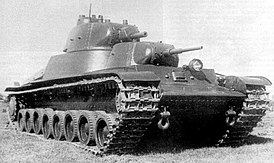 Tank T-100 in trials. NIIBT Test Site in Kubinka, August 1939 | |
| T-100 | |
| Classification | heavy tank |
| Combat weight, t | 58 |
| Layout diagram | classic two-tower |
| Crew | 8 |
| Story | |
| Years of production | 1939 |
| Years of operation | 1939 - 1940 |
| The number of issued, pcs. | 1 experienced |
| Key Operators |  |
| Dimensions | |
| Body length mm | 8495 |
| Width mm | 3400 |
| Height mm | 3430 |
| Clearance mm | 525 |
| Reservation | |
| Type of armor | steel rolled |
| Forehead, mm / city. | 60 |
| Board of the case, mm / city. | 60 |
| Feed housing, mm / city. | 60 |
| Bottom mm | 20-30 |
| Housing roof, mm | twenty |
| Tower forehead, mm / city. | 60 |
| Board towers, mm / city. | 60 |
| The feed of the tower, mm / city. | 60 |
| Roof of the tower, mm | 30 (main), 20 (small) |
| Armament | |
| Caliber and brand of guns | 1 × 76 mm L-10 (L-11) 1 × 45 mm 20K arr. 1934-1938 |
| Gun type | tank |
| Barrel length, calibres | 26 (30) L-10 (L-11) / 44 20K |
| Gun ammunition | 120 × 76 mm 393 × 45 mm |
| Sights | telescopic |
| Machine guns | 3 × 7.62 mm DT |
| Other weapons | no |
| Mobility | |
| Engine type | V-shaped 12- cylinder carburetor four-stroke liquid cooling GAM-34 |
| Engine power, l with. | 850 at 1850 rpm |
| Speed on the highway, km / h | 35.7 |
| Cross country speed, km / h | fifteen |
| Cruising on the highway , km | 160 |
| Cruising cross country, km | 120 |
| Suspension type | individual, with leaf springs |
| Gradeability, city. | 42 ° |
| The overcome wall, m | 1,2 |
| The overcome ditch, m | four |
| Fording , m | 1.25 |
Creation History
In 1938, two Leningrad design bureaus developed very close to each other projects for a new heavy tank with anti-shell armor designed to replace the T-35. The Kirov plant represented by SKB-2 proposed a QMS machine. The second project, called T-100, was developed at the Design Bureau of the Leningrad Experimental Engineering Plant No. 185 named after S. M. Kirov under the leadership of S. A. Ginzburg. The lead designer of the machine was E. Sh. Foley. In general, the T-100 was of the same type as the SMK tank and differed from the latter mainly in the type of suspension and weapons. During 1938, all approvals and reviews in commissions and instances of the QMS and T-100 projects took place simultaneously. Like the SMK, the T-100 was originally designed as a three-turret with the installation of a 76-mm gun in the main tower and two 45-mm tank guns of the 1934 model in two small towers. But with an accepted armor thickness of 60 mm, the mass of the machine should not exceed 55-57 tons, so the number of towers was reduced to two. (There is a legend that the decision to reduce the number of towers was made personally by I.V. Stalin, who removed the back tower from the QMS layout presented to him and said: “There is nothing to turn the tank into an armadillo!” Another option - Stalin asked, removing the tower from the layout: “ How much does such a tower weigh? ”“ Seven tons, ”they answered him.“ So take these seven tons and better strengthen the armor! ”) In January 1939, the T-100 and QMS drawings were transferred to production. In accordance with the decree of the Defense Committee under the Council of People's Commissars of the USSR, the prototype T-100 was to be manufactured by June 1, 1939, but its production was delayed by two months - the prototype was fully assembled only on July 31, 1939 and was accepted by the commission for conducting field tests combined with factory. It was supposed, according to the ABTU RKKA program, to finish the tests on January 3, 1940, but in connection with the beginning of the Soviet-Finnish war, it was decided to conduct further testing of combat and driving qualities in combat conditions, replacing the L-10 tank gun with a more advanced L-11. The tank was sent to the front and took the first battle on December 17, 1939 in the Finnish fortified area Khottinen.
Design Description
By purpose, layout scheme, general design and distinctive features of the T-100 was identical to the QMS and was a two-tower tank of a classic layout with a two-tier arrangement of weapons and anti-ballistic armor. However, in detail, the tank had a number of significant differences from the QMS.
Corps
The hull of the tank had a box shape and was assembled from sheets of rolled armor, connected by welding , riveting and bolts . A massive semi-conical turret box under the main tower was mounted in the central part of the building. The armor protection was somewhat weaker compared to the QMS - 60 mm, which, nevertheless, provided the tank with reliable protection against fire existing at that time anti-tank artillery ( up to 47 mm caliber ) already at a distance of 500 m or more.
Towers
Two cast cone-shaped gun turrets were located one after the other along the longitudinal axis of the tank. Placement of towers, and, accordingly, weapons, two-tier. The first tier was formed by the front small tower with a horizontal rotation angle of 245 degrees. The second tier was occupied by the central main tower of the circular shelling. On the roof of the main tower there was a commander’s cupola (also of circular rotation) with viewing slots along the perimeter and a DT machine gun with the possibility of anti-aircraft fire.
Armament
The main armament of the tank was the 76-mm tank gun L-10 (subsequently L-11 ), which was housed in a mask in front of the main tower. The gun was intended to fight primarily with enemy fortifications and pillboxes, as well as unarmored targets, however, it also had satisfactory armor penetration. Auxiliary artillery weapons consisted of a 20-K 45-mm tank gun mounted in a small tower and designed to combat armored vehicles. Both guns used telescopic sights .
The ammunition load of the guns was 120 rounds for 76 mm guns and 393 for 45 mm guns.
Machine gun weapons included three 7.62 mm DT machine guns , two of which were paired with guns, and the third was located in the commander’s turret on the roof of the main tower and could be used to repel attacks from the air.
The ammunition load of machine guns was 4284 rounds in 68 disk magazines of 63 rounds each.
Engine
The T-100 was equipped with a V-shaped 12- cylinder carburetor four-cycle engine GAM-34 liquid cooling with a capacity of 850 hp at 1850 rpm Ignition - from two magnetos .
Chassis
The suspension of the tank is individual, with leaf springs without shock absorbers.
The chassis for one side consisted of eight gable road wheels with massive tires, five gable rubber support rollers, a rear wheel drive with removable gear rims and a cast guide wheel. The sloth tension mechanism is a screw type, controlled from the control compartment. The engagement is foregrip. Caterpillar tracks - small, with an open hinge, fingers - with circlips.
Communication Devices
For external communications, the tank was equipped with a typical tank radio station 71-TK-3 . For internal communication, there was a TPU intercom for 6 subscribers.
Tests and combat use
By the end of autumn 1939, the T-100 tests were in full swing - the tank passed more than 1000 km. After the start of the war with Finland on November 30, 1939, it was decided to send the SMK , T-100 and KV-1 tanks to the army for combat testing in frontal conditions. Before sending to the front, the T-100 weapons were changed - instead of the 76-mm L-10 gun, a more powerful L-11 gun of the same caliber was installed [1] .
The tanks were consolidated into a separate company of heavy tanks and assigned to the 90th tank battalion of the 20th heavy tank brigade, who fought on the Mannerheim Line.
T-100 crew in the first battle [2] :
- tank commander Lieutenant Astakhov Mikhail Petrovich,
- artilleryman Artamonov,
- artilleryman Kozlov,
- radio operator Smirnov,
- driver Plyukhin Afanasy Dmitrievich,
- spare driver Drozhzhin Vasily Agapovich,
- mechanic Kaplanov Vladimir Ivanovich,
- Kashtanov V.I.
On December 19, 1939, a separate company of heavy tanks, along with the rest of the 90 brn 20 tbr units, went on the offensive in the Summa - Khottinen area. The tanks of the battalion successfully advanced and advanced beyond the line of Finnish bunkers, where the QMS was blown up by a mine. The T-100 crew tried to tow the QMS with the help of their tank, but these attempts were unsuccessful. After that, the T-100, standing next to the QMS and covering it with reinforced artillery and machine-gun fire, ensured the evacuation of the crew from the wrecked tank - the QMS crew moved into the T-100 along the emergency hatches in the bottoms of the vehicles. At the same time, the tank received at least seven hits of 37 mm and 47 mm anti-tank guns from a distance of less than 500 m, but the armor was never pierced [2] .
In the same battle with the T-100, the engine stalled - there was a cut in the thread of the magneto adjustment clutch. However, the tank driver was able, using one magneto instead of two, to start the engine again and continue the task.
After this battle, the T-100 was sent to the rear to repair the engine and returned to the army on February 18, 1940. From that day until the end of hostilities, the T-100 operated as part of the 20th (22.02 - 01.03) and 1st (11.03 - 13.03) tank brigades. During this time, the tank traveled 155 km, received 14 hits by shells of anti-tank guns (6 - to the left side, 3 - to the niche of the main tower, 3 - to the left track and one at a time - to the mask of the 45-mm gun and left sloth). In all cases, the armor was not broken. In total, by April 1, 1940, the T-100 covered 1745 km, of which 315 km - during the battles on the Karelian Isthmus [3] .
After the end of the Finnish War, the T-100 returned to the factory, where the engine was completely replaced and the tank was lightly repaired [4] .
In the summer of 1940, the tank was transferred for storage to Kubinka. After the start of World War II, the car was evacuated first to Kazan, and then to Chelyabinsk, where the T-100 was handed over to the pilot plant number 100. The tank stayed at the plant until the end of the war, and then its tracks are lost. According to some reports, until the mid-1950s, the T-100 stood in the backyard of the Chelyabinsk Tank School, and then, apparently, went into re-melting [5] . However, according to other sources, the tank did not live to the end of the war - at the end of 1943 it, along with the T-29 , KV-7, and a number of other prototypes of armored vehicles, was cut into metal [6] .
Machine rating
In the report on the test site T-100, dated February 22, 1940, it was noted that the T-100 tank is fully consistent with the specified performance characteristics. The disadvantages were the unstable operation of the cooling system, poor reliability of the fan, and the unsuccessful design of the cooling nets. It was also recommended to refine the gearbox control mechanisms and strengthen the design of the on-board friction clutches. As a merit, the presence of a pneumatic tank control system was noted.
Despite the general compliance of the tank with the requirements put forward, the commission found it inappropriate to recommend the T-100 for adoption, since the KV tank exceeded it in terms of basic performance characteristics.
At the same time, the "native" design bureau for the T-100 of plant No. 135 believed that the tank should have been recommended for use as it was a car of a different class compared to the HF. This was partly true - the T-100 was mainly an assault tank and could be used to mount more powerful assault weapons, such as 152-mm and 130-mm guns, while a more multi-functional short-range gun could carry only a 76-mm gun. However, the engineers did not heed the opinion and the T-100 was never adopted.
True, an attempt to strengthen the armament of the T-100 was nevertheless made. In January 1940, the Deputy People’s Commissar of Defense, Commander of the first rank M. Kulik gave the corresponding instruction. It was supposed to install a 152-mm howitzer M-10 on the tank, which was able to effectively deal with the bullets. In March 1940, a new turret with an M-10 howitzer was made for the T-100, which was supposed to be installed on the tank instead of the existing one. The resulting modification was supposed to wear the T-100-Z index. However, instead of this machine, the KV-2 tank was adopted.
In general, the T-100 was a fairly successful machine. The tank, in principle, corresponded to operational tactical views on its use. Reservation of the tank also met the requirements, and the armament allowed massive and maneuverable circular fire simultaneously in different directions. In all respects, the T-100 significantly exceeded the T-35. However, the tank also had such disadvantages typical for multi-turret tanks as the large size, the large number of crew and the difficulty in production. Like the QMS , the T-100 was a necessary step on the way from heavy tanks of a multi-tower layout to heavy tanks of a new type - such as KV-1.
Unrealized T-100 machine designs
- T-100-X - heavy self-propelled guns, armed with a 130-mm naval cannon B-13-IIs in a stationary cabin (in many ways similar to the SU-100-Y ).
- T-100-V - heavy artillery support tank. Armament: 203-mm howitzer gun B-4 in a rotating tower.
- T-100-Z - heavy artillery support tank. Armament: 152 mm M-10T howitzer and 20K 45 mm cannon in two towers.
- Object 0-50 - heavy breakthrough tank. Armament: 76-mm gun L-11 and 45-mm gun 20K in one tower.
- Object 103 - a heavy coastal defense tank with a 130-mm B-13-IIs cannon in a rotating tower.
Notes
- ↑ Kolomiyets, 2000 , p. 65.
- ↑ 1 2 Kolomiets, 2000 , p. 71.
- ↑ Kolomiyets, 2000 , p. 75.
- ↑ Kolomiyets, 2000 , p. 74.
- ↑ Kolomiyets, 2000 , p. 77.
- ↑ Pasholok Yu. In evacuation . LiveJournal (September 17, 2013). Date of appeal September 17, 2013.
Literature
- Kolomiets M. Multi-tower tanks of the Red Army. Part 2. - M .: LLC "Strategy KM", 2000. - 80 p. - (Front-line illustration No. 5-2000). - 1,500 copies - ISBN 5-901266-01-3 .
- Kholyavsky G.L. Encyclopedia of tanks. - Minsk: Harvest, 1998 .-- 576 p. - 5,000 copies.
- Arkhipova M.A. Armored vehicles of the USSR of the Second World War. - Minsk: Harvest, 2005.