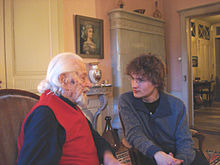
South Ademar Cueno ( fr. Hugues-Adhémar Cuénod ; June 26, 1902 , Corso , canton of Vaud , Switzerland - December 6, 2010 , Vevey , Switzerland) - Swiss singer ( tenor ).
The grandson of the mayor of the town of Corso, in which he was born. From childhood, he had the opportunity to listen to a lot of different music in the fashionable resort town of Vevey in the neighborhood, in particular, according to the memoirs of Cueno himself, he had the opportunity to attend in May 1913 a concert on the birthday of Camille Saint-Saens , during which the birthday boy played together with Ignaz Paderewski repertoire for two pianos [1] . He began to study music in Vevey with pianist Matilda de Ribopierre, then studied at the Basel Conservatory with Willy Reberg and Colette Wiss, and finally in Vienna with Hermina Singer-Burian (a student of Rosa Papyr ). In the 1920s participated in small semi-private concerts in Vienna and then in Paris . He made his debut on stage in 1928 in the Paris production of Ernst Kshenek ’s opera “Johnny plays”, which paved the way for Queno’s further career in France - in particular, for tenor parts in Johann Sebastian Bach’s oratorios with an orchestra conducted by Vincent d'Andy . In 1929 , Cueno participated, in a minor role, in the London premiere of the musical Noel Coward's “Sorrows and Joys” [2] , and then went to New York with a London troupe for a Broadway show; here Cueno recorded several spirituals with his own piano accompaniment.
In the 1930s Cueno divided his life between Paris, the USA and Switzerland, in 1940 - 1946 . taught at the Geneva Conservatory . He participated in concert performances of " Wedding " by Stravinsky , oratorio Igor Markevich "Lost Paradise" and Arthur Onegger "Dance of the Dead." In the same period, Cueno began to take part in the first recordings of the works of Claudio Monteverdi , which was carried out in Paris by Nadia Boulanger ; these records have largely laid the foundation for tradition.
In 1943 , Cueno returned to the stage in the production of "The Bat" by Johann Strauss . The peak of his stage activity came in the 1950s, when Cueno sang in La Scala, Milan (in Wozzeck by Alban Berg ), at the Glyndeborn Festival (from 1954 until 1987 , Cueno performed at the festival for more 470 times [3] ), in the London Covent Garden ( 1954 , 1956 and 1958 ). On September 11, 1951 , in Venice, Cueno sang the part of Sellem at the world premiere of Stravinsky's opera The Adventures of the Hang . Among the most important recordings of Queno related to this period are Bach's “Passion for Matthew” conducted by Ernest Anserme and songs by Gilles Benshua and Guillaume de Masho ; in general, the temporal coverage in the singer’s repertoire is very large, and among other records, Heinrich Schütz , Francesco Cavalli and Francois Couperin also alternate with Dinu Lipatti ; however, according to the critic of The New York Times , “his repertoire is very wide, but obviously excludes almost everything that can be attributed to the mainstream” [4] . In addition, live recordings of a number of opera productions with the participation of Kyueno were distributed - in particular, the Glyndbourne Marriages of Figaro (Cueno in the part of Basilio) and Eugene Onegin (Cueno in the part of Triquet).
Later, Cueno demonstrated phenomenal creative longevity. Throughout the 1970s and 80s he intensively recorded various chamber compositions, especially the vocal works of French composers: Socrates by Eric Satie , songs by Gabriel Foret , Debussy , Roussel , Poulenc and others. In April 1987 , Cueno set a peculiar record: at the age of almost 85 he became the most old performer had ever made her debut at the Metropolitan Opera : Opera in Puccini's "Turandot" staged director Franco Zeffirelli and conductor James Levine , Kyueno went on stage in the role of Emperor Altoum (and over the next sezo and singing in this play 14 more times). The New York Times music columnist John Rockwell noted, reviewing this production, that he had never heard the best performance of this part [5] . The last time he appeared on the scene (at the Zhora Theater ), in the part of Trike from "Eugene Onegin", in 1994 [6] .
At various times, Cueno occasionally taught in Switzerland and other countries; Especially valuable were his joint workshops with Suzanne Danko at the Benjamin Britten and Peter Pierce School in Suffolk [3] .
In 1996 , a collection of conversations with Queno “Easy Voice” was released ( fr. D'une voix légère. Entretiens avec François Hudry ; English translation 1999 ), containing many biographical details.
Experts noted in Kyueno’s singing style “the extraordinary ability to“ pronounce ”the words sung like an actor, with perfect diction and clarity”, “simple and natural style” [3] .
Interesting Facts
- At the end of World War II, the leadership of the Swiss internment camp for Italian citizens turned to Queno with a proposal to work out with a musically gifted young soldier. Cueno gave the young man several lessons, which were mainly to introduce the not-so-educated novice musician to the musical material, then the lessons ceased due to the fact that, as Cueno delicately puts it, the young singer was not inclined to self-discipline. This Italian soldier was Giuseppe di Stefano [4] .
- On January 19, 2007 , after Swiss law allowed civil unions to be entered into between same-sex partners , 104-year-old Cueno officially registered his relationship with 64-year-old Alfred Augustin, a companion of his life over the past more than 20 years [7] .
- Regarding his creative career, Cueno remarked: “I always had a small voice. With such a voice, I liked to sing small parts in big theaters much more than large parts in small theaters ” [8] .
Notes
- ↑ Hugues Cuénod. With a Nimble Voice: Conversations With Francois Hundry . / Translated into English by Albert Fuller. - Pendragon Press, 1999 .-- P. 5.
- ↑ Bitter Sweet. An Operetta by Noel Coward // The Guide to Musical Theater.
- ↑ 1 2 3 Hugues Cuenod: Obituary // The Telegraph , 07 Dec 2010. (eng.)
- ↑ 1 2 Will Crutchfield. Cuenod, at 84, makes peace with Puccini // The New York Times, March 8, 1987.
- ↑ Margalit Fox. Hugues Cuénod Dies at 108; Versatile, Light-Voiced Tenor // The New York Times, December 7, 2010. (eng.)
- ↑ Florence Millioud Henriques. A 106 ans, Hugues Cuenod, le ténor du hors Archived October 10, 2008 on the Wayback Machine // 24 heures (Lausanne), 06/25/2008.
- ↑ Matthew Westphal. The World's Oldest Living Tenor Celebrates His 105th Birthday (And He's a Newlywed, No Less!) // Playbill Arts , 2007-06-27
- ↑ Bradley S. Klapper. Tenor Cuenod, 105, Credits Small Voice // Associated Press , June 25, 2007. (eng.)
Links
- Hugues Cuénod (Tenor) (Short biography and photos of different years)
- Discography on the site of the Medieval Music & Arts Foundation (English)