Brackets are paired characters used in various fields.
| Parentheses | |||||||||||||||||||||||
|---|---|---|---|---|---|---|---|---|---|---|---|---|---|---|---|---|---|---|---|---|---|---|---|
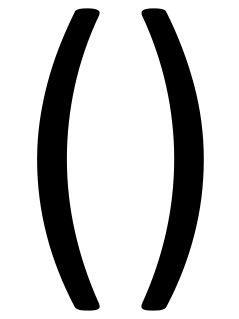
| () | |||||||||||||||||||||||
Picture
| |||||||||||||||||||||||
| |||||||||||||||||||||||
| Characteristics | |||||||||||||||||||||||
| Title | ( : left parenthesis ) : right parenthesis | ||||||||||||||||||||||
| Unicode | ( : U + 0028 ) : U + 0029 | ||||||||||||||||||||||
| HTML code | ( : ( or () : ) or ) | ||||||||||||||||||||||
| Utf-16 | ( : 0x28 ) : 0x29 | ||||||||||||||||||||||
| Url | ( :% 28 ) :% 29 | ||||||||||||||||||||||
Distinguish:
- parentheses ()
- square [] brackets;
- braces {}
- angle ⟨⟩ brackets (or <> in ASCII texts).
Usually the first bracket in a pair is called the opening, and the second - closing. Almost always (with the exception of some mathematical notation), the opening and closing brackets correspond to each other (square - square, etc.).
Brackets are also used in which the opening and closing characters do not differ, for example, oblique brackets / ... / , direct brackets | ... | , double parentheses || ... || .
They are used in mathematics , physics , chemistry and other sciences to set the priority of the operation in formulas.
Various brackets (like other unpaired ASCII characters) are used in emoticons ( emoticons ), for example :-) .
Content
- 1 parentheses
- 2 Square brackets
- 3 braces
- 4 Angle brackets
- 4.1 Typography
- 4.2 ASCII texts
- 5 Brackets
- 6 Straight brackets
- 7 Double brackets
- 8 History
- 9 Computer support
- 9.1 Unicode Codes
- 10 See also
- 11 Notes
- 12 Literature
Parentheses (operator)
Used in mathematics to set the priority of mathematical and logical operations. For example, (2 + 3) · 4 means that you must first add 2 and 3, and then multiply the amount by 4; similar expression 


and matrices :
to record binomial coefficients :
Parentheses in mathematics are also used to highlight function arguments: to indicate an open segment in some other contexts. Sometimes scalar product of vectors is indicated by parentheses:
(here are three different spellings found in the literature) and a mixed (triple scalar) product :
Parentheses in mathematics are also used to indicate an infinitely repeating period of the positional representation of a rational number, for example
In the designation of numerical intervals, parentheses indicate that the numbers that are on the edges of the set are not included in this set - the interval is open on one (half segment) or both sides. For example,
- the interval open on the left (1.3] includes all numbers x such that
- the interval open on the right [1,3) includes all numbers x such that
- the interval (1.3) open on both sides includes all numbers x such that
When compactly recording physical quantities with measurement errors, parentheses are used to indicate absolute error values in units of the last significant digit of the value [1] . For example, writing the value of the Newtonian gravitational constant of 6.67408 (31) · 10 −11 N · m² · kg −2 is equivalent to writing 6.67408 · 10 −11 N · m² · kg −2 ± 0.00031 · 10 −11 N · m² kg −2 .
In chemical formulas, parentheses are used to highlight repeating functional groups, for example, (NH 4 ) 2 CO 3 , Fe 2 (SO 4 ) 3 , (C 2 H 5 ) 2 O. Also, brackets are used in the names of inorganic compounds to indicate the degree of oxidation of an element, for example, iron (II) chloride, potassium hexacyanoferrate (III) .
Brackets (usually round, as in this sentence) are used as punctuation marks in natural languages. In Russian, they are used to highlight an explanatory word or an inserted sentence. For example: the Oryol village (we are talking about the eastern part of the Oryol province) is usually located among the plowed fields, near the ravine, somehow turned into a dirty pond (I. Turgenev). An unpaired closing bracket can be used to number enumeration items, for example: 1) the first item; 2) the second.
Many programming languages use parentheses to highlight constructs. For example, in the Pascal and C languages, the parameters for calling procedures and functions are indicated in brackets, and in Lisp , to describe the list .
Square brackets
In linguistics, they are used to indicate transcription in phonetics or the boundaries of components in the syntax .
The square brackets in quotes specify the author’s text, which clarifies the context of the quote. For example, " There were about 100 of them [hostages] ." In bibliographic records , descriptions and references, square brackets indicate the content of the fields formulated by the compiler of the record based on the analysis of the document, as well as borrowed from sources outside the document; for example: “ Ivanov, I. I. Numerical methods [Text]: textbook. allowance / I. I. Ivanov [and others]; [foreword P.P. Petrova ]. - M.: Fizmatlit, 1995. - 313, [5] p. "
Square brackets in mathematics can indicate:
- The operation of taking the integer part of a number. This notation was introduced by Gauss in his third proof of the quadratic reciprocity law in 1808 [2] . Also used as rounding to the nearest integer.
- To set the priority of operations (similar to round ones) as brackets of the “second level” - it is easier to distinguish between nesting of brackets, for example: .
- Vector product of vectors: .
- Closed segments ; record means that numbers are included in the set . In this case, the pairing rule for parentheses is not observed, for example, the segment closed on the left and open on the right can be designated or .
- Switch and anti-switch although for the latter, curly braces are sometimes used without a subscript.
- Square (less often curly) brackets denote an operator of a special form called Poisson brackets :
- Square brackets can be used as an alternative to parentheses when writing matrices and vectors.
- A single square bracket combines a set of equations or inequalities (for the set to be satisfied, it is enough for any of the conditions to be satisfied, that is, it is the vertical form of the “ or ” operator); eg,
denotes that . - Iverson Notation .
In mathematics, in addition to the usual square brackets, their “gender” modifications are also used. and the "ceiling" to denote the nearest integer not exceeding , and the nearest integer, no less , respectively.
In chemistry, square brackets denote complex anions and cations , for example: Na 2 [Fe (NO) (CN) 5 ] , [Ag (NH 3 ) 2 ] + . In addition, according to the IUPAC nomenclature, the number of atoms in the bridges between two atoms in the name of organic polycyclic compounds is enclosed in square brackets, for example: bicyclo [2.2.2] octane .
In wiki markup, double square brackets are used for internal links, redirects , categories and interwiki , single - for external ones.
In programming, they are most often used to indicate the index of an array element; in Perl, they also form a link to an unnamed array; in BASIC and some other rather old languages are not used.
The POSIX standard defines the test utility, whose synonym is the square bracket character “[”.
Often, square brackets are used to indicate optionalness, for example, command line parameters (see the article Backus-Naura Form for details).
Braces
Curly brackets in some mathematical texts indicate the operation of taking the fractional part , in others they are used to indicate the priority of operations, as the third level of nesting (after parentheses and square brackets). Curly braces are used to indicate sets . A single brace combines systems of equations or inequalities, used to denote a piecewise-defined function . As mentioned above, sometimes curly brackets denote the anticommutator and Poisson brackets.
In wiki markup and in some markup languages of web templates ( Django , Jinja ) double curly brackets {{...}} are used for templates and built-in functions and variables, single in certain cases form tables.
In programming, curly braces are either operator ( C , C ++ , Java , Perl and PHP ), or a comment ( Pascal ), can also serve to form a list (in Mathematica ), an anonymous hash array (in Perl, in other positions to access a hash element), a dictionary (in Python ), or a set ( Setl ).
Angle brackets
In mathematics, angle brackets denote a scalar product in a pre-Hilbert space , for example:
In quantum mechanics, angle brackets are used as the so-called bra and ket (from the English bracket - bracket ) introduced by P. A. M. Dirac to denote quantum states (vectors) and matrix elements. In this case, quantum states are denoted as (ket vector) and (bra-vector), their scalar product as matrix element of operator A in a certain basis as
In addition, in physics, angle brackets denote averaging (over time or another continuous argument), for example, - the average time value of f .
In textology and the publication of literary monuments, angle brackets indicate lacunae in the text - .
In linguistics, graphemes are indicated by angle brackets, for example, “the phoneme / a / is transmitted by the letter ⟨а⟩” [3] .
Typography
In ASCII texts (including HTML / XML and programming ), the pairing signs of the arithmetic relations of the inequality < and > are used to write angle brackets.
In typography, angle brackets are independent characters. From < and > they can be distinguished by a larger angle between the parties - and .
In Τ Ε Χ , the commands \ langle and \ rangle are used to write angle brackets.
In standard punctuation of Chinese, and Korean, several additional types of brackets are used, including chevrons , similar in spelling to angle brackets - for horizontal 〈and〉 or 《and》 (in Japanese, use as a character quotation marks 「」) and traditional vertical printing - ︿ and ﹀ or ︽ and ︾. It should be noted that in modern Japanese print brackets of the European sample () are widely used, as are Arabic numerals. In one of the projects of the reformation of the Japanese language, it was even proposed introduce European brackets instead of traditional ones, however, the project was rejected.
ASCII Texts
In some markup languages , such as HTML, XML, tags are marked with angle brackets.
You can also use HTML markup in wiki markup, for example, comments: <!-- Этот абзац надо расширить --> , which are visible only when editing an article.
In programming, angle brackets are rarely used, so as not to create confusion between them and the relationship signs (" < " and " > "). For example, in C, angle brackets are used in the #include preprocessor directive instead of quotation marks to indicate that the included header file must be searched in one of the standard directories for header files, for example, in the following example:
  #include <stdio.h>
  #include "myheader.h"
the stdio.h file is in the standard directory, and myheader.h is in the current directory (the directory where the program source code is stored).
In addition, angle brackets are used in the programming languages C ++ , Java, and C # when using generalized programming tools: templates and generics.
In some texts, double paired " < " and " > " are used to write quotes like Christmas trees , for example - << quote >> .
Brackets
Appeared on typewriters to save keys.
In C programming and many languages with the same syntax, oblique brackets together with the additional “ * ” sign indicate the beginning and end of the comment:
  /* Comment
    in source code in C * /
In JavaScript, braces indicate a regular expression :
var regular = / [az] + /;
Sometimes in oblique brackets they write the name decrypting the signature. For example: signature ... / Ivanov I.I. /
Brackets
Used in mathematics to denote the module of a number or vector, the determinant of a matrix:
Double brackets
Used in mathematics to denote the norm of an element of linear space : || x ||; sometimes for matrices:
History
Parentheses appeared in 1556 at Tartaglia (for radical expression) and later at Girard . At the same time, Bombelli used a corner in the form of the letter L as the initial bracket, and his inverted form as the final one ( 1550 ); such a record became the progenitor of square brackets. Braces suggested Viet ( 1593 ). Nevertheless, most mathematicians then preferred to emphasize the highlighted expression instead of brackets. Leibniz introduced brackets into general use.
Computer Support
Unicode codes, etc., are assigned not to left and right brackets, but to opening and closing, so when displaying text with brackets in the “right to left” mode, each bracket changes its visual direction to the opposite. So, the combination of ( assigned to the opening parenthesis, which looks like the left ( in the text going from left to right, but like the right ) in the text going from right to left. However, the keys on the keyboard are assigned to the left and right brackets, for example, the key ( attached to the left parenthesis, which, when typing from left to right, is opening and receives the code 40, and from right to left (in layouts designed for languages with spelling words from right to left, for example for Arabic or Hebrew) - is closing and receives code 41.
| Letter direction: | Text in Russian (from left to right). | Hebrew text (from right to left). |
| Sample text: | This is a text in Russian (from left to right). | זה מלל בעברית (מימין לשמאל). A. |
|---|---|---|
| Opening bracket: | The left bracket is typed with a key ( and has a code of 40. | The right bracket is typed with the key ) and has a code of 40. |
| Closing parenthesis: | The right bracket is typed with the key ) and has a code of 41. | The left bracket is typed with a key ( and has code 41. |
Unicode Codes
|
|
|
See also
- Акколада (музыка)
Notes
- ↑ Standard Uncertainty and Relative Standard Uncertainty . CODATA reference . NIST . Дата обращения 16 августа 2018.
- ↑ Lemmermeyer F. Reciprocity Laws: from Euler to Eisenstein (англ.) . — Berlin: Springer, 2000. — С. 10, 23. — ISBN 3-540-66957-4 .
- ↑ Bauer, Laurie. Notational conventions. Brackets // The Linguistics Student's Handbook. — Edinburgh : Edinburgh University Press, 2007. — P. 99.
Literature
- Александрова Н. В. История математических терминов, понятий, обозначений : Словарь-справочник, изд. 3-е. — СПб: ЛКИ, 2008. — 248 с. — ISBN 978-5-382-00839-4 .
- Математика XVII столетия // «История математики» под редакцией А. П. Юшкевича в трёх томах. — М. : Наука, 1970. — Т. 2.
- Кэджори Ф. История элементарной математики / Пер. И. Ю. Тимченко. - 2nd ed., Rev. — Одесса: Mathesis, 1917.