The Ukrainian Soviet Socialist Republic ( Ukrainian SSR , Ukrainian Ukrainian Radyanska Socialist Republic, URSR ) is a Soviet republic proclaimed to be part of the territory of the former Russian Empire, one of the founding states of the Soviet Union (USSR) , a union republic within it. In 1919-1936, the Ukrainian Socialist Soviet Republic was officially named.
| Sovereign State ( 1919 - 1922 ) Union republic within the USSR ( 1922 - 1991 ) | |||||
| Ukrainian Soviet Socialist Republic | |||||
|---|---|---|---|---|---|
| Ukrainian Ukrainian Radyanska Socialist Republic | |||||
| |||||
| Motto : “ Proletarian All-Ukrainian, Come on! " | |||||
Hymn : " The national anthem of the Ukrainian SSR " Ukrainian State Anthem of the Ukrainian Radian Social and Socialist Republic | |||||
 The territory of the Ukrainian SSR at the time of the collapse of the USSR | |||||
←   → →March 10, 1919 - August 24, 1991 | |||||
| Capital |  Kharkov (1919-1934) Kharkov (1919-1934)  Kiev (1934-1991) Kiev (1934-1991) | ||||
| Languages) | Ukrainian - official in 1920-1989, the state language of the republic in 1989-1991 | ||||
| Currency unit | USSR ruble | ||||
| Time Zones | +2 | ||||
| Square | 603.7 thousand km 2 3rd in the USSR | ||||
| Population | 51.7067 million people ( 1989 ) 2nd in the USSR | ||||
| Form of government | soviet republic | ||||
| Telephone code | +3 | ||||
| Heads of state | |||||
| Chairman of the All-Ukrainian CEC | |||||
| • 1919-1938 | Petrovsky, Grigory Ivanovich (first) | ||||
| Chairman of the Supreme Council of the Ukrainian SSR | |||||
| • 1990-1991 | Kravchuk, Leonid Makarovich (last) | ||||

Along with the BSSR, it was sovereign [1] co-founder of the UN in 1945.
On August 24, 1991, the Supreme Council of the Ukrainian SSR adopted the Declaration of Independence and the decree "On the Declaration of Independence of Ukraine" [2] . These documents proclaimed the independence of Ukraine and the creation of an independent state of Ukraine . It was stated that the territory of Ukraine is indivisible and inviolable and henceforth only the Constitution and laws of Ukraine are acting on its territory. The declaration of independence was confirmed at a referendum on December 1, 1991 .
History

To fight the Socialist Revolutionary-Menshevik UNR , proclaimed the III Universal by the Ukrainian Central Council on November 7 (20), 1917 in Kiev and not recognizing the October Revolution in Petrograd, on December 11–12 (24–25), 1917, the Bolsheviks gathered the 1st All-Ukrainian Congress of Soviets , which proclaimed the Ukrainian People's Council of the Republic (the original official name - Ukrainian People's Republic of Soviets of workers, peasants, soldiers and Cossacks' deputies [3] [4] ), established a federated connection UNRS with the RSFSR , elected Provisional Central ny Executive Committee of Soviets [5] , which, in turn, assumed full power in the territory of the UPR [6] and approved the composition of its executive body - the People's Secretariat , which became the first government UTRAN [7] .
On December 19, 1917 ( January 1, 1918 ), the Council of People's Commissars of the RSFSR recognized the People's Secretariat of the UPRS as the only legitimate government in the UPR. In response to this, on January 9 (22), 1918, the IV Universal of the Central Rada proclaimed the state independence of the Ukrainian People’s Republic .
After that, Soviet troops launched an offensive against the Central Council. Kiev was taken on January 26 (February 8), the UPR government fled to the west under the protection of the Austro-German troops, and the territory under its control passed into the hands of the Bolsheviks ( UNRS ).
In December 1917 - February 1918, on the territory of Ukraine, the Bolsheviks also proclaimed the Donetsk-Kryvyi Rih Soviet Republic and the Odessa Soviet Republic . On April 17-19, 1918, at the Second Congress of Soviets, these Soviet republics (DKSR, OSR, UNRS) were merged into the Ukrainian Soviet Republic (USR) with the capital in Kharkov and the revolutionary government - the People’s Secretariat. The Ukrainian Soviet Republic was part of the Russian Soviet Republic, which was proclaimed as a federation of Soviet national republics. However, already in April 1918, under pressure from the Austro-German troops, entered into the territory of the Ukrainian Soviet Republic by agreement with the Central Rada , Soviet troops were forced to leave the territory of the USSR, and the Ukrainian Soviet Republic virtually ceased to exist.
After the defeat of the Central Powers in the First World War , in the winter of 1919 the whole territory of Ukraine was again under the control of the Bolsheviks, including Kiev. Instead of the Ukrainian Soviet Republic, the Bolsheviks first created the Provisional Workers and Peasants Government of Ukraine , and then the Ukrainian Socialist Soviet Republic , which was proclaimed as an independent republic on March 10, 1919 at the III All-Ukrainian Congress of Soviets, which was held on March 6-10, 1919 in Kharkov , which became the capital USSR; Then the first Constitution of the Ukrainian SSR was adopted.
In June 1919 , after the “May military-political crisis” , the leadership of the Ukrainian SSR entered into an agreement with the Russian SFSR on the establishment of a military and economic union. According to this agreement, in the summer of 1919 the Ukrainian Soviet Army was liquidated, and in December 1920 there was a “unification” (actually - liquidation of the Ukrainian) of the People’s Commissariats of the USSR and the RSFSR : military and naval affairs, foreign trade, finance, labor, communications, mail and telegraph, national economy councils.
Throughout 1919-1920, the territory of Ukraine continued to be the scene of clashes between Bolshevik, White Guard, Ukrainian, Polish, anarchist and other military units. By the end of 1920, Soviet power returned for the third time. After that, the Bolsheviks included most of the territory of southern Russia in the Ukrainian SSR.
For a short time, the Bessarabian Soviet Socialist Republic (May – September 1919) and the Galician Socialist Soviet Republic (July – September 1920), which were proclaimed independent autonomies, were actually proclaimed independent autonomies. However, soon (under the Riga Treaty of 1921 ), these territories were outside the Ukrainian SSR.
In December 1920, the Office of the Southern Front of the Red Army was reorganized into the Office of the Commander of the Armed Forces of Ukraine and Crimea (RVSR Order No. 2660/532 of December 3, 1920 ) [8] [9] [10] . The troops of the Southern Front and South-Western Front were included in the troops of the Kiev and Kharkov military districts of the Armed Forces of Ukraine and Crimea. The Armed Forces of Ukraine and Crimea became a territorial association of troops of the Kiev and Kharkov military districts, the Internal Service of Ukraine, as well as the Naval Forces of the Azov and Black Seas .
On December 30, 1922, the Ukrainian SSR signed the Treaty on the Formation of the USSR , which served as the beginning of the creation of a single union state, the USSR, on the territory of the former Russian Empire .
On December 5, 1936, in connection with the adoption of the new Constitution of the USSR, it was renamed the Ukrainian Soviet Socialist Republic . On January 30, 1937, in connection with the adoption of the new Union Constitution, the new Constitution of the Ukrainian SSR was adopted.
The capital of the Ukrainian SSR from 1919 to 1934 was in Kharkov , after which it was moved to Kiev [11] .
Territorial changes
During the existence of the Ukrainian SSR has undergone territorial changes.
- From its composition were transferred:
- the composition of the RSFSR:
- 1919: four northern districts of the Chernihiv province
- 1925: Fedorovsky , Nikolaevsky (with the city of Taganrog ), Matveevo-Kurgan , Sovetsky , Golodaevsky areas and the eastern part of the Catherine district of the Taganrog district , Glubokinsky , Leninsky , Kamensky , Ust-Belokalitvensky , Vladimir , Sulinsky , Shakhtinsky (with the city of Shakhty ) regions and parts of the territory of the Sorokinsky and Alekseevsky districts of the Shakhty district . At the same time, the border between the RSFSR and the Ukrainian SSR was established along the following line: the Sorokinsky district by the Seversky Donets river was divided into two parts, of which the northern part went into the RSFSR, and the southern one remained within the Ukrainian SSR; Further, the border went along the North Donets River until the confluence of the Bolshaya Kamenka River into it; the village of Gundorovskaya, within the established boundaries of land use, went to the RSFSR, and when establishing the external borders of land use of the village of Gundorovskaya, the mines did not enter the internal line and remained for the Ukrainian SSR; further, the border passed along the Boylshaya Kamenka River, with the Nizhny Shevyrev and Pleshakov farms left to the RSFSR, and the Vlasov and Korolev farms remained in the Ukrainian SSR so that the land use of all these farms remained unchanged before land management works; Further, the border passed between the land use of the Krasnaya Mogila state farm (formerly Proval) and the Kovalevo, Platovo and Gukovo farms, from where the border went along the boundary of the village of Krinichny , capturing the Dobrydnev farm, that is, along the border of the Sharapovsky district ; Further, passing through the territory of the Alekseevsky district ( Alekseevka ) and leaving the land use of the village of Astakhova and the farms of N. Efremovsky, N. Alexandrovsky and V. Tuzlovsky within the Ukrainian SSR, the border reached the Taganrog district and, passing along the old district border of the Shakhtinsky and Taganrog districts throughout five miles, went in the direction of the Tuzlovo River along the regional border between the Golodaevsky and Dmitrievsky districts to the Mius River; further, the border went along the Mius river along the land-use boundaries between the villages of Marinovka , Grigoryevka and Golodaevka so that the villages of Marinovka and Grigoryevka remained within the Ukrainian SSR, and the village of Golodaevka went to the RSFSR; passing further along the land-use border of the German colonies of Wischlerovka, Marienheim and Gustav Feld (and these colonies went to the RSFSR), the border ran along the Amvrosi district border to the river Sredny Elanchik ; Further, the border was established for the land use of the village of Pokrovo-Kireevka , the farms of Yekaterinoslavsky, Slyusarevo to the Gruzovsky Yelanchik beam, leaving the northwestern part of the Yekaterinovsky district within the Ukrainian SSR; Further, the border went along the Georgian Yelanchik beam up to the border of Mariupol district [12]
- in the BSSR :
- 1925: the north-western part of the Olevsky district of the Korosten district with the border between the BSSR and the Ukrainian SSR, starting from the border between the USSR and Poland, near the Pogrebishche tract - east to the Pogrebishche tract and further to the Kurgan, Kamenitsa, Ploska and Yasnoye tracts; the northern part of the Olevsky region with the village of Kopische Korostensky district on the border of the tract Krivulki and the island of Kozi Legs; the northern part of the territory of the Slavechansky district of the Korostensky district with the village of Zhidovka and the Plastov farm with the bordering from the tracts of Antonovsky Ostrov and further to the tract Bolshaya Rechitsa, Tolkachi, Brod. Smolkovo, Voronov, Duplikh, Kozhushnitsa and Svinora to the tract Zhidova; the northern part of the territory of the Ovruch district of the Korosten district, lying on the left bank of the Slovechno river , between the villages of Gazhin and Novaya Rudnya [12]
- to the structure of the MSSR :
- 1940: the left-bank part of modern Transnistria
- to Czechoslovakia:
- 1946: the village of Lekarovece with surrounding territory
- to Poland:
- 1951: the city of Ustrzyki with adjacent territory
- the composition of the RSFSR:
- The composition of the Ukrainian SSR over the years included:
- from the RSFSR:
- 1925: Semenov volost of Novozybkovsky district of the Gomel province ; the village of Znob in the Trubchevsky volost of the Pochep district , the villages of Fatevizh , Baranovka , Demyanivka , Muraveynya , Tolstodubovo , Seltso- Nikitskoye , Setnoye , the village of Grudskaya of the Sevsky district of the Bryansk province ; the former Putivl uyezd (with the city of Putivl , with the exception of the former Krupetskaya volost ), the former Krinichevsky volost of the former Sudzhan district , the southern part of the Greyvoron volost of the Greyvoron district and the southern part of the Murom volost of the Belgorod district of the Kursk province ; Trinity volost and part of the Urazovo volost of the Valuysky district of the Voronezh province [12]
- 1944: the village of Daryino-Ermakovka and the village of Koshary [13] of the Krasnogvardeisky district of the Rostov region
- 1954: Crimean region
- from the BSSR:
- 1925: territory under the jurisdiction of the Zosintsovsky village council of the Karolinsky district of the Mozyr district [12]
- from Poland:
- 1939: Western Ukraine ; the western part of the Drohobych region was returned to Poland in 1945 (Birchansky district, Liskovsky district, western part of Peremyshlsky district), 1948 (Medykovsky district) and 1951 ( Nizhne-Oystritsky district , in exchange for part of the territories of the Lublin Voivodeship)
- from Romania:
- 1940: Northern Bukovina , Hertz region
- 1948: Snake Island
- from Bessarabia (disputed territory of the USSR and Romania)
- 1940: Bujak , northern Bessarabia
- from Czechoslovakia:
- 1945: Subcarpathian Russia (Transcarpathian Ukraine); the village of Lekarovec with the adjacent territory was returned to Czechoslovakia in 1946
- 1945: the city of Chop and adjacent 250 km² of Slovakia
- from the RSFSR:
On August 24, 1991, the Supreme Council of the Ukrainian SSR proclaimed the independence of Ukraine and appointed a referendum on December 1, 1991 confirming the declaration of independence [14] [15] , and on September 17 excluded the name “Ukrainian SSR” from the Ukrainian constitution [16] .
According to the results of the All-Ukrainian referendum on December 1, 1991, the majority of voters who voted supported the Act of Independence of Ukraine. Simultaneously with the referendum, the first elections of the President of Ukraine were held.
On December 8, 1991, Ukraine, together with the RSFSR and the Republic of Belarus, signed the Bialowieza Agreement on the termination of the USSR and on the creation of the CIS . On December 10, the Supreme Council of Ukraine ratified this agreement. December 26, the Council of the Republics of the Supreme Soviet of the USSR adopted a declaration on the termination of the USSR. On June 19, 1992, the provisions on the USSR and the Soviet flag of Ukraine of 1949 (Article 167) were completely excluded from the Constitution of Ukraine in 1978 [17] .
Symbols
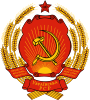
In March 1919, the III All-Ukrainian Congress of Soviets adopted the first Constitution of Soviet Ukraine. In accordance with its 35th article, the “trade, sea and military flag of the US S. S. R. consists of a red (scarlet) color panel, in the upper left corner of which is a flagpole with gold letters“ U. S. S. R. "or the inscription" Ukrainian Socialist Soviet Republic "". On March 10, 1919, the Third All-Ukrainian Congress of Soviets adopted the first Constitution of the Ukrainian SSR and the coat of arms, on the heraldic shield of which the sickle and hammer were depicted in the rays of the rising sun, and the abbreviation “W. S. S. R. " On a red ribbon under a shield in Ukrainian and Russian there was a call: "Workers of all countries, unite!" A shield framed a wreath of wheat ears. In 1949, an image of a five-pointed red star and an inscription on the middle part of the ribbon: “Ukrainian RSR” appear above the coat of arms.
In 1937, an image of a sickle and a hammer appeared on the flag. In 1949, the flag underwent the most changes: it became two-color, its lower part became blue. The blue color of the flag indicates the enormous natural wealth of Ukraine, its excellent climatic conditions, and the fact that it is a sea power (in literature, the blue color is also associated with the color of the banners of Bogdan Khmelnitsky). The flag began to differ in its colors from other union republics, the need to place the abbreviation “U. S. S. R. "(after 1929). Above, above the sickle and hammer, an image of a five-pointed star appeared. The flag of this model lasted until mid-1992.
Guide
The leadership of the Ukrainian SSR was collective. At the highest level, it was carried out by the Politburo of the Central Committee of the Communist Party of Ukraine, the secretariat of the Central Committee of the Communist Party of Ukraine, and the leadership of the Council of Ministers of the Ukrainian SSR.
Armed Forces
The People's Secretariat adopted laws on the creation of the armed forces of Soviet Ukraine. On December 17, 1917 he creates the People’s Secretariat for Military Affairs (People’s Secretary - V. M. Shakhrai , assistant to the People’s Secretary - Yu. M. Kotsyubinsky ). Using the experience of the People’s Commissariat for Military Affairs of the RSFSR, the People’s Secretariat for Military Affairs of the Ukrainian SSR starts building the national armed forces of the republic - the Ukrainian Workers 'and Peasants' Red Army [10] .
On December 18 (31 in a new style), by the decision of the CEC of the Councils of Ukraine, a regional Military Revolutionary Committee was formed to combat counter-revolution. It included the people's secretaries for military and internal affairs, representatives of the Kharkov central headquarters of the Red Guard and the headquarters of the Southern Revolutionary Front to combat the counter-revolution of Russia. The committee directed the activities of the military revolutionary committees in the field, was engaged in armament and training of troops. Much attention was paid to the political education of fighters, their revolutionary training [10] .
In December 1917, the Soviet People's Secretariat was located in Kharkov, and the organs of the petty-bourgeois Central Rada from Kiev, who had military units in the city, continued to work nearby, their chauvinistic newspaper was published [10] .
By a resolution of the People’s Secretariat of December 25 (January 7 in a new style) 1917, the regional revolutionary committee was assigned the organization of the Red Guard on a national scale [18] . At the same time, a decision is being made on the formation of military units of the “Red Cossack” (Red Cossacks). [ten]
Kharkov Red Guards laid the foundation for the creation of the Red Cossacks. The People’s Secretariat decided on the night of December 27 (January 9, according to a new style) on December 28 (January 10, according to a new style) to surround and disarm the 2nd Ukrainian reserve regiment of the armed forces of the Ukrainian People’s Republic , officers and unit by forces of a detachment of Red Guards and revolutionary soldiers whose soldier was hostile to the Bolshevik Soviet power. The plan was developed by Wojciechowski and Sharov. The operation was attended by I. Yu. Kulik and V. M. Primakov [10] [19] .
By dawn, the operation was over. The regiment was disarmed, and a detachment of former soldiers of the 9th and 11th companies of the 2nd Ukrainian reserve regiment of the UPR was walking in the city of Kharkov. On the same day, it was announced the formation of the 1st regiment of Chervony Cossack of party activists of Chernigov and Kharkov, the Red Guards, as well as several dozen soldiers disarmed by the Bolsheviks of the 2nd Ukrainian reserve regiment of troops of the Central Council of the UPR [10] . The first Soviet national military unit in Ukraine - Pershiy Kuroin of the Red Cossack - was formed. Vitaly Markovich Primakov was appointed the Ataman [10] .
Economics
It was the second (after the RSFSR ) economic component of the USSR in importance, significantly surpassing the rest of the republics in production, producing four times more products than the next largest republic in terms of economic potential. On the fertile chernozems of the Ukrainian SSR, a quarter of all agricultural production of the USSR was grown. [20]
Transport
City electric
In 1892, the first tram in the Russian Empire appeared in Kiev [22] [23] .
In 1966, the first trolleybus train [21] of the inventor Vladimir Veklich [26] [27] was introduced into the world practice [24] [25] in Kiev.
December 30, 1978 in Kiev was opened the first in the USSR rapid tram line [22] [28] , built on the initiative of Vladimir Veklich [29] and Vasily Dyakonov [30] .
As of 1991, the metro was in Kiev and Kharkov , as well as metro trams in Krivoy Rog .
Trolleybuses were operated in 42 cities of the Ukrainian SSR [31] .
Territorial division
After 1959, the administrative-territorial division of the Ukrainian SSR practically stabilized. The table shows data on the regions included in the Ukrainian SSR in 1959-1991.
| Unit | Date of formation | Territory , thousand km² | Population , thousand people ( 1966 ) | Population , thousand people ( 1989 ) | Number of cities | Qty | Adm. Centre |
|---|---|---|---|---|---|---|---|
| Vinnytsia region | February 27, 1932 | 26.8 | 2133 | 1920.8 | eight | 27 | Vinnitsa |
| Volyn region | April 4, 1940 [32] | 20,2 | 964 | 1058.4 | ten | 21 | Lutsk |
| Voroshilovgrad region | June 3, 1938 ; March 5, 1958 - January 5, 1970 and from June 19, 1991 - Lugansk [33] | 26.7 | 2764 | 2857.0 | 34 | 98 | Voroshilovgrad |
| Dnipropetrovsk region | February 27, 1932 | 32,0 | 3145 | 3869.9 | nineteen | 56 | Dnepropetrovsk |
| Donetsk region | July 17, 1932 ; June 3, 1938 - November 9, 1961 - Stalin | 26.5 | 4788 | 5311.8 | 45 | 138 | Donetsk |
| Zhytomyr Oblast | January 15, 1938 [34] | 29.9 | 1589 | 1537.6 | eight | 36 | Zhytomyr |
| Transcarpathian region | January 22, 1946 ; included in the Ukrainian SSR June 29, 1945 | 12.8 | 1031 | 1245.6 | 9 | 14 | Uzhhorod |
| Zaporozhye region | May 31, 1939 [35] | 27.0 | 1677 | 2074.0 | ten | 23 | Zaporozhye |
| Ivano-Frankivsk region | April 4, 1940 [32] ; until November 9, 1962 - Stanislavskaya | 13.9 | 1207 | 1413.2 | 13 | 26 | Ivano-Frankivsk |
| Kiev region | February 27, 1932 | 28.9 | 3184 | 4506.6 | 13 | 34 | Kiev |
| Kirovograd region | May 31, 1939 [35] | 24.3 | 1268 | 1228.1 | eleven | 21 | Kirovograd |
| Crimean region | April 26, 1954 [36] ; from June 19, 1991 - ASSR [33] | 25.6 | 1565 | 2430.5 | 13 | 35 | Simferopol |
| Lviv region | April 4, 1940 [32] | 21.8 | 2357 | 2727.4 | 36 | 36 | Lviv |
| Nikolaevkskaya area | January 15, 1938 [34] | 24.8 | 1092 | 1328.3 | 7 | eleven | Nikolaev |
| Odessa region | February 27, 1932 | 33,2 | 2228 | 2624.2 | 13 | 26 | Odessa |
| Poltava region | January 15, 1938 [34] | 28.6 | 1677 | 1748.7 | 12 | 18 | Poltava |
| Rovenskaya region | April 4, 1940 [32] | 20,0 | 1012 | 1164.2 | 9 | sixteen | Smooth |
| Sumy region | May 31, 1939 [35] | 23.8 | 1516 | 1427.5 | 15 | 18 | Sumy |
| Ternopil region | April 4, 1940 [32] ; until August 9, 1944 - Tarnopol | 13.9 | 1149 | 1164.0 | 14 | 15 | Ternopil |
| Kharkov region | February 27, 1932 | 31.6 | 2672 | 3174.7 | 15 | 58 | Kharkov |
| Kherson region | March 30, 1944 | 27.1 | 958 | 1236.9 | eight | 24 | Kherson |
| Khmelnitsky region | January 15, 1938 [34] ; until April 26, 1954 - Kamenetz-Podolskaya [36] | 20.7 | 1620 | 1521.6 | ten | 21 | Khmelnitsky |
| Cherkasy region | April 26, 1954 [36] | 21.0 | 1506 | 1527.3 | 15 | nineteen | Cherkasy |
| Chernihiv region | October 15, 1932 | 31.9 | 1586 | 1412.8 | 13 | 32 | Chernihiv |
| Chernivtsi region | August 7, 1940 [37] | 8.0 | 828 | 940.8 | 9 | 6 | Chernivtsi |
| USSR | 601.0 | 45 516 | 51,451.9 | 370 | 829 | Kiev |
In addition, for the entire existence of the Ukrainian SSR, it included the following areas:
- Drohobych - from April 4, 1940 [32] to May 21, 1959, is included in the Lviv region
- Izmail - from August 7, 1940 [37] to April 26, 1954 [36] (until March 1, 1941 - Akkerman [38] ), is included in the Odessa region
See also
- History of Ukraine
Notes
- ↑ According to Art. 14-15 of the Constitution of the USSR of 1936, the formally declared sovereignty of the Union republics was limited on a number of issues submitted to the all-Union jurisdiction. Article 20 established the supremacy of union laws over republican laws. However, this did not affect the possibility of independent international representation of the republics, which was separately emphasized by article 18a in the 1944 edition.
- ↑ About the reverberation of the independence of Ukraine vid 24.08.1991 No. 1427-XII
- ↑ To the Day of the State Flag of Ukraine August 23, 2010 // Website of the Central State Electronic Archive of Ukraine © (tsdea.archives.gov.ua) Retrieved August 7, 2012.
- ↑ State symbols of Ukraine. Page 4 // Historyweb.ru History for all © (www.historyabout.ru) Retrieved August 7, 2012.
- ↑ Soldatenko Valery . Donetsk-Kryvyi Rih Republic. Illusions and the practice of national nihilism (Rus.) // Mirror of the week . - 2004, December 4-10. - Vol. 49 (524) . Archived July 3, 2012.
- ↑ Telegram of the Central Executive Committee of the Councils of Ukraine to the Council of People's Commissars on the unity of interests of the Ukrainian and Russian peoples. December 26 (13), 1917 Archived on February 19, 2015.
- ↑ Triumphal procession of Soviet power. TSB
- ↑ Central State Archive of the Soviet Army. In two volumes. Volume 1. Guide. 1991. Fronts, armies, groups of troops
- ↑ Military Encyclopedic Dictionary. 1984.
- ↑ 1 2 3 4 5 6 7 8 Red Banner Kiev. 1979.
- ↑ First capital . ATN, December 19, 2002 (Retrieved September 1, 2011)
- ↑ 1 2 3 4 s: Decree of the Presidium of the CEC of the USSR of 10.16.1925 On the Settlement of the Borders of the Ukrainian SSR with the RSFSR and the BSSR
- ↑ Map of the Red Army of the South of Russia, 1941
- ↑ s: Decree of the Supreme Soviet of the Ukrainian SSR of 08.24.1991 No. 1427-XII
- ↑ About the reverberation of the independence of Ukraine | Vid 08.24.1991 No. 1427-XII
- ↑ About the introduction of the amendment and supplement to the Constitution (the Main ... | vid 17.09.1991 No. 1554-XII
- ↑ s: Law of Ukraine of June 19, 1992 No. 2480-XII
- ↑ The Great October Socialist Revolution in Ukraine, vol. 3.
- ↑ The Truth, December 30, 1917
- ↑ Forbes Magazine
- ↑ 1 2 The article “What Kiev invention predetermined the development of urban transport for several decades” on the website “www.autoconsulting.com.ua” . Date of treatment September 11, 2015. Archived on September 14, 2015.
- ↑ 1 2 V.F. Veklich , L.V. Zbarsky Problems and Prospects for the Development of Tram Transport in the Ukrainian SSR - K.: The Knowledge Society of the Ukrainian SSR, 1980
- ↑ V. K. Dyakonov, M. A. Olshansky, I. M. Skakovsky, V. F. Veklich and others. The first in Russia. Kiev Tram 75 years - K .: Budivelnik, 1967 - 144 p., Ill.
- ↑ Bramskiy K. A. The world's first trolleybus train // Municipal Economy of Ukraine. - 2013. - No. 4. - Page 30-31. - ISSN 0130-1284 (Ukrainian)
- ↑ Bramskiy K. A. The trolleybus train of Vladimir Veklich // newspaper "All-Ukrainian Technical Newspaper", December 11, 2003 (Ukrainian)
- ↑ Encyclopedia of modern Ukraine : in 25 volumes / Ed. I. M. Dziuba et al. - Kiev: 2005. - V. 4. - P. 187 - ISBN 966-02-3354-X (Ukrainian)
- ↑ Krat V. I. Vladimir Fillipovich Veklich // Communal services of cities. Kiev: Technique - 1998. - No. 17. - Page 3-9. - ISSN 0869-1231 (Ukrainian)
- ↑ Ukrainian Soviet Encyclopedia / Ed. O.K. Antonov et al. - K .: The main edition of the Ukrainian Soviet Encyclopedia, 1984. - T. 11. - Prince. 1 - S. 225, ill. - 50,170 copies.
- ↑ Article “How the first light rail line in the USSR appeared in Kiev. Historical photos. " On the website "www.autoconsulting.ua" . Date of treatment December 25, 2015. Archived December 25, 2015.
- ↑ Article “First in the USSR: The Most Interesting Facts for the 37th Anniversary of the Kiev Light Rail”. On the website of the magazine "New time" . Date of treatment December 30, 2015. Archived December 31, 2015.
- ↑ Ukrainian Soviet Encyclopedia / Ed. O.K. Antonov et al. - K .: The main edition of the Ukrainian Soviet Encyclopedia, 1984. - T. 11. - Prince. 1 - S. 262, ill. - 50,170 copies.
- ↑ 1 2 3 4 5 6 s: Law of the USSR of 04.04.1940 on supplementing the Constitution (Basic Law) of the USSR with articles 29-a and 29-b and on amending and supplementing articles 22, 23, 27, 28, 29 and 77
- ↑ 1 2 s: Law of the Ukrainian SSR of June 19, 1991 No. 1213-XII
- ↑ 1 2 3 4 s: Law of the USSR of January 15, 1938 on amending and supplementing Art. 22, 23, 26, 28, 29, 49, 77, 70, 78 and 83 of the Constitution (Basic Law) of the USSR
- ↑ 1 2 3 s: Law of the USSR of 05.31.1939 on amending and supplementing Articles 22, 23, 77, 78 and 83 of the Constitution (Basic Law) of the USSR
- ↑ 1 2 3 4 s: Law of the USSR of April 26, 1954 On the Approval of Decrees of the Presidium of the Supreme Council of the USSR
- ↑ 1 2 s: Law of the USSR of 08/08/1940 on amending and supplementing Articles 13, 23 and 48 of the Constitution (Basic Law) of the USSR
- ↑ s: Law of the USSR dated 01.03.1941 on amending and supplementing Articles 23, 78 and 83 of the Constitution (Basic Law) of the USSR
Literature
- Chorniy S. National warehouse of the population of Ukraine in the XXth century: Dovidnik. Seriya "Ukraine between the thousands." - K .: DNVP Kartografiya, 2001. - ISBN 966-631-111-9 (Ukrainian) .
- Military Encyclopedic Dictionary . - M .: Military Publishing , 1984. - 863 p .; ill., 30 l. (ill.) - S. 161, 763.
- Red Banner Kiev. Essays on the history of the Red Banner Kiev Military District (1919-1979). Ed. 2nd, rev. and add. - Kiev: Publishing House of Political Literature of Ukraine, 1979. - S. 12, 13.
- Civil war and military intervention in the USSR. Encyclopedia. - M.: Soviet Encyclopedia , 1983.
- The Great October Socialist Revolution in Ukraine. T. 3. - Kiev: State Political Publishing House of the Ukrainian SSR, 1957. - S. 45–46.
- The newspaper Pravda , December 30, 1917
- Bogatskaya A. S. Zmievsky district of the Kharkov region of the Ukrainian SSR during the years of Soviet modernization (1928-1941) // Zmievsky local history. - 2015. - No. 1. - S. 65-79.
Links
- Economics of the Ukrainian SSR .
- Central State Archive of the Soviet Army. In 2 t. T. 1. Guide. 1991. Fronts, armies, groups of troops .
- Vadim Zolotaryov. The head warehouse of the NKVS USRR near the mid-30s rr.
- Istoriya Mist and Strel Ukrainian RSR (first view) .
- History of cities and villages of the Ukrainian SSR (second edition) .