Bukovina (literally beech country ; Ukrainian Bukovyna , room Bucovina ) is a historical region in Eastern Europe .
| Bucovina | ||||||||||
|---|---|---|---|---|---|---|---|---|---|---|
 Bukovina on the maps of Ukraine and Romania | ||||||||||
| Geographical region | Eastern Europe | |||||||||
| Period | middle of the seventeenth century - the beginning of the XX century. | |||||||||
| Localization | In Ukraine: Chernivtsi region without Khotinsky, Kelmenetsky, Sokiryansky, Novoselitsky and Gertsayevsky districts. In Romania: South Bucovina - Suceava County. | |||||||||
| Population | Ukrainians, Russians, Moldovans | |||||||||
| States in the territory | ||||||||||
| ||||||||||
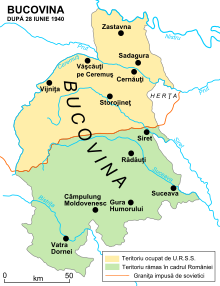
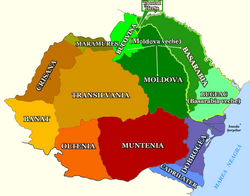
Currently, its northern part ( Northern Bukovina ) is the Chernivtsi region of Ukraine without the Khotyn , Kelmenetsky , Sokiryansky , Novoselitsky and Gertsayevsky districts, and the Southern Bukovina is Suceava Romania .
Ethnic communities of Chernivtsi region according to the 2001 census: Ukrainians (75.0%), Romanians (2.7%), Moldovans (17.3%), Russians (4.1%), Poles (0.3%), Belarusians (0.2%) and Jews (0.2%). [1] Most of Bukovina is covered with spurs of the Carpathian Mountains , reaching heights of 1190–2180 meters.
The Bukovina rivers belong to the Black Sea basin . Some rivers are shallow in summer, but in spring and after heavy rains they overflow and produce severe havoc. Prut and, to a lesser extent, the Dniester concern the borders of Bukovina; Siret and Suceava take their beginning in it.
The climate is temperate continental. The location in the zone of steppes and forest-steppe makes it quite arid. The proximity of the mountains on the one hand (due to the dominance in these latitudes of the western transport ) affects as an obstacle to the penetration of a large amount of precipitation, on the other hand it is a factor in a significant decrease in winter temperatures. Soils - chernozems on flat areas and gray forest, brown and ashed in the mountains. Farming is developed on the flat areas. Highlands with their meadows are used for pastures .
Etymology
The name officially came into use in 1775, with the annexation of the territory of the Hapsburg Empire . The name comes from the Slavic word " beech ". Unlike the Old Believers, already known as Lipovans, Orthodox residents usually settled in beech forests. But for the first time the word Bukovina was introduced into circulation in 1392 in the Moldavian principality and meant beech forests. [2] [3] .
Middle Ages
For a long time, Eastern Slavic tribes of Tiverts and streets lived in Northern Bukovina. In the X — XI centuries it was part of the Ancient Russian state ; in the XII — XIII centuries (first half of the XIV) - as part of the Galician , subsequently Galician-Volyn principality and included the cities of Vasilyev , Gorodok , Suceava , Onut , Kitsman , Repuzhyntsy and others. After the Tatar invasion (and the decline of the Galician-Volyn principality), Bukovina’s ties with the Galician-Volyn lands weakened, and at the beginning of the 14th century, the self- governed Shipinskaya land was formed with the center in the town of Shipintsy , which (like the Bolokhovskaya land ) recognized the rule of the Golden Horde khans. [4] In the 1340s – 1350s, the Bukovina lands were ruled by Hungary , and from the 1360s they were part of the Principality of Moldova , which at the beginning of the 16th century fell under the rule of the Ottoman Empire .
South Bukovina - the historical name of the territory, which is part of the region of Suceava . In the past, it was partly part of the Roman province of Dacia . The indigenous peoples of Bukovina were those tribes of Moldova, which later became one of the constituent elements of the Moldavian nation. However, Slavs lived in Bukovina South (starting from the 6th century), their influence reflected in the culture and language of the local population. During the 10th-11th centuries, small Wallachian principalities developed in Bukovina. After the Mongol-Tatar invasion in the XIV century, Bukovina became the core of the association of the Wallachian lands and subsequently formed the Moldavian principality .
In Southern Bukovina there is the ancient capital of the Moldavian principality of the 14th - early 16th centuries - Suceava , the Putna Monastery with the tombs of the princes and a number of other ancient monasteries of Moldova .
In the Austro-Hungarian Empire
At the end of the Russian-Turkish war of 1768-1774, Austria-Hungary , which did not take part in hostilities , invaded the northern part of Moldova, notifying the Russian command of this. Russia chose not to intervene in the conflict, which allowed Austrian diplomacy to declare the Habsburg rights to the territory of Bukovina on the assumption that northern Moldova belonged earlier to Pokutty , and according to the convention on the division of Poland, Pokut'e and Galicia were ceded to Austria. Turks who were not interested in deteriorating relations with Austria-Hungary had to admit this fact. On May 7, 1775, the Convention was signed on this matter in Constantinople .
After joining Austria-Hungary, Bukovina became the Chernivtsi district of the kingdom of Galicia and Lodomeria , but in 1849 it became a separate duchy .
In 1849–1918, Bukowina had the status of duchy in the Cistilatan part of the Austro-Hungarian monarchy, bordering on the north Galicia , on the west with Hungary and Transylvania , and on the south and east - with Romania and Bessarabia .
In 1887, the number of inhabitants in the country reached 627,786 people (313,076 men and 314,715 women) constituting a population of 4 cities, 6 townships and 325 villages, whereas at the time of joining Austria ( 1774 ) the population was 75,000. By origin: 42% of Ruthenians , 29.3% of Moldovans, 12% of Jews , 8% of Germans , 3.2% of Romanians, 3% of Poles , 1.7% of Hungarians , 0.5% of Armenians and 0.3% of Czechs [5 ] . By religion - Orthodox 61% (1911). In Chernivtsi there was an archbishop presiding over the Greek Orthodox Church Council (consisting of 24 ecclesiastical and 24 secular members). From representatives of other religions: 11% - Roman Catholics , 2.3% - Greek Catholics , 13.3% - evangelical confession and ancient Orthodoxy (Old Believers) and 12% - Judaic. Productive soil accounts for about 96.8% of the entire surface of the country, of which 44.6% should be counted on forests. The agriculture , which goes best in areas located in the northeastern part of Bukovina, between the Dniester and Prut , delivers annually an average of 2250000 hl of grain bread. (42% maize, 21% oats, 15% barley, 14% rye, 6% wheat, the rest. Millet, etc.), then 12000 hl. string beans, 16 5 000 hl. potatoes, 20,000 hl. turnips. In addition, clover , tobacco , canola , hemp and flax are cultivated . The number of livestock according to the 1880s extended to 52,715 horses, a 268389 goal. horned cattle, 156945 sheep, 127034 pigs, 24889 bee hives. Mining delivered in 1887 35,323 centners of manganese peroxide (in Yakobeni) and 2,6358 tons of salt (in Kachik); total cost - 89751 fl. Factory industry was still at the beginning of development; most importantly while distillation and timber processing. Later, the first hydroelectric dams on mountain rivers, the exploration and production of oil and natural gas, appeared. Trade was limited almost exclusively to raw foods, such as bread, vegetables and fruits, wine, slaughter cattle, woods, furniture, raw leather, wool and potash . The most important was the border trade with Moldova and Bessarabia , and transit trade. Public education at a low level. In 1880, 47% were illiterate in the male population and 72.5% in the female. In Bukovyna there was an Orthodox Theological School in Chernivtsi , Belokrinitskaya Seminary of the Old Orthodox Church, 3 gymnasiums, 2 real schools, one Teachers' Seminary , 3 vocational schools and 264 national schools. In 1875, the University was opened in Chernivtsi, in which instruction was conducted in German .
Device and control
The Bukowina Sejm consisted (according to the decree of February 20, 1861 ) of 31 members, namely: from the Archbishop, 10 deputies from large landowners, 5 deputies from cities, 2 deputies from chambers of commerce and industry, and 12 deputies from rural communities to whom since 1875 another university rector has joined. In the meeting of the General Austrian Sejm Bukovina sent nine representatives. Administratively, Bukovina was a separate entity, while in court it was subordinated to Oberlandsgericht in Lviv , and likewise the military administration was subordinated to Lemberg Commandant-General. The duchy was divided into 8 districts, not counting the independent district of the main city; It has 16 district courts and two courts of the second degree.
As part of Romania
Bucovina became a province of the Romanian kingdom in 1919. Its area was 10 442 km ², population - 812 thousand (in 1920). The provincial center was the city of Chernivtsi (in 1925 - 95 thousand inhabitants). Composition of the population, according to Romanian official data : Ruthenians - 38%, Romanians - 34%, Jews - 13%, Germans - 8%, Poles - 4%. Also Hungarians, Great Russians (Old Believers, Lipovans ), Slovaks, Armenians, Gypsies lived in small numbers.
Joining Romania
The national composition in Bukovina was not in favor of the Romanians. Before the outbreak of the First World War, with a population of 800 thousand people in the province, the number of Romanians here was about 300 thousand, a little more were Ruthenians. The Germans, Poles, Hungarians, Armenians and others made up about 200 thousand people. Secondly, during the war years, the territory of Bukovina was engaged three times by Russian troops and the same number of times by the Austro-Hungarian army. The restrained and sometimes friendly attitude of the Ukrainian population towards the tsarist troops led to repressive actions by the Austro-Hungarian authorities. There was no unity among the Romanian political elite, the majority of its representatives were in favor of unification with Romania, and a small part - led by A. Onchul - suggested negotiating with the Ukrainian leaders in order to divide this province between Romania and Ukraine [6] .
The revolution in Russia , negotiations on a separate peace, the course of military operations in the west and in the center of Europe accelerated the process of preparing projects for the reorganization of the Austro-Hungarian Empire. The delegation of the Ukrainian Central Rada at the talks in Brest-Litovsk demanded the unification of Galicia, Bukovina and the Transcarpathian region into a single unit in the composition of Austria-Hungary. The central powers in exchange for the supply of grain agreed to some territorial concessions in favor of Ukraine. In the “Manifesto to my loyal subjects” of October 3 (16), 1918, Emperor Charles I proclaimed the federalization of the Austro-Hungarian Empire through the creation of six states: Austrian, Hungarian, Czech, Yugoslav, Polish and Ukrainian. The Romanians of Transylvania and Bukovina were not even mentioned.
At a meeting of Romanian emigrants from Austria-Hungary, held on 6 (19) October 1918 in Iasi , a Declaration was adopted on rejecting the idea of federalizing the empire, which was regarded as a “desperate attempt to condemn the disintegration of the empire”. A few days later, in the first issue of the newspaper Glasul Bukovina (The Voice of Bukovina), an editorial was published by S. Pushkariu, entitled “What We Want,” which became the program of struggle between the Romanians of Bukovina and Transylvania. On October 14, 1918, the National Assembly of the Romanians of Bukovina was held in Chernivtsi, at which a Resolution was adopted on proclaiming this meeting constituent, on the election of a 50-member National Council and an Executive Committee headed by Janka Flondor.
After the collapse of Austria-Hungary and the proclamation of the Western Ukrainian People's Republic ( ZUNR ), Bukovina was included in its composition. The power passed to the Ukrainian Territorial Committee formed on October 25, 1918, which organized on November 3, 1918 a large popular assembly in Chernivtsi, which decided to enter Bukovina into a single Ukrainian state. On November 6, 1918, the Ukrainian government was established on those lands of Bukovina, which were populated mainly by Rusyns. Emelyan Popovich was proclaimed president of the region.
In the circumstances, the Romanian National Council appealed to the Romanian government for military assistance. The eighth Romanian division under the command of General J. Zadik on November 11/24, 1918 occupied Chernivtsi. After that, on November 15/28, 1918, the General Congress of Bukovina was held in the palace of the Metropolis, in which 74 delegates from the Romanian National Council participated, 13 from the Ukrainian, 7 from the German and 6 from the Polish population. The Bessarabian delegation was also present, which included P. Halipa , I. Pelivan, I. Buzdugan, G. Kazakliu, and Transylvanian as part of G. Krashan, V. Deleu, V. Osvade. In the Declaration adopted unanimously by the Congress on the integration of Bukovina with Romania.
Telegrams were sent to the governments of the Entente countries. They were informed about the decision to unite Bukovina with Romania. The delegation headed by J. Flondor left for Iasi to present the text of the Decision on Unification to King Ferdinand.
Interwar War Romanization
Both Constitutions of Romania (1923 and 1938) declared the equality of citizens of all nationalities. In Bukovina, there were two Ukrainian parties that collaborated with the Romanian authorities - the Ukrainian People’s Party (since 1921) and the Ukrainian National Party (since 1927) [7] . Soon after the annexation of Bukovina to Romania, Romanization began in the province. Already on July 21, 1919, a decree on renaming settlements was issued, in 1922 the use of the Ukrainian language in legal proceedings was prohibited, in 1927, a special decree was required to duplicate all signs and advertisements in Romanian [8] . Already in the years 1919-1921, out of 168 primary schools in Bukovina, 93 were translated into the Romanian language of instruction [8] . In 1925–1927, Ukrainian schools were liquidated, including three gymnasiums [9] . In December 1925, the new law introduced the romanization of private education - in private schools, compulsory teaching of the Romanian language and the study of a number of subjects were prescribed [9] . In Chernivtsi University in 1923, the departments of Ukrainistics created under the Austrian authorities were closed [9] . The proportion of Ukrainians among university students declined and amounted to 4.8% in the 1933/34 school year and only 2.9% in the 1938/39 school year [9] .
The Ukrainian nationalist movement emerged in Bukovina, albeit a weaker one than in neighboring Galicia . In 1930, the Legion of Ukrainian Nationalists (LUR) headed by O. Zubachinsky appeared in Chernivtsi, in 1932 the group “Avengers of Ukraine” (“Mesniki Ukrainy”) was created. The organizations established contacts with the OUN and since 1934 Zubachinsky became the regional leader of the OUN in Bukovyna, in Bessarabia and Maramures [10] .
In the late 1930s, the policy of Romanization was strengthened. The new Constitution of 1938 prohibited the naturalized Romanians from acquiring property in rural areas, and only the Romanian in the 3rd generation could become a minister [11] . True, at the same time concessions were made to national minorities, including Bukovina. In April 1940, the teaching of the Ukrainian language in schools and Chernivtsi University was permitted, and an inspector position was introduced to supervise the instruction in the Ukrainian language (he was supposed to be Ukrainian by birth) [12] .
Joining of Northern Bukovina to the USSR
In 1940, Northern Bukovina, together with Bessarabia, became part of the USSR . Советской стороной планировалось военное вторжение в Румынию , но, за несколько часов до начала операции, король Румынии Кароль II принял ультимативную ноту советской стороны и передал Бессарабию и Северную Буковину СССР. Операция по занятию территории советскими войсками продлилась 6 дней [13] .
После восстановления советской власти в Буковине снова начались массовые репреcсии против местного населения, была проведена коллективизация сельского хозяйства, которая преимущественно завершилась в 1949 году. Наряду с этим продолжались позитивные изменения в экономическом, культурном и образовательном развитии региона.
In art
- « Белая птица с чёрной отметиной » — художественный фильм Юрия Ильенко .
- Ian Oliver feat. Shantel — Bucovina (Markus Gardeweg Rmx).
- Румынская фолк-метал группа Bucovina [14] .
See also
- Северная Буковина
- Южная Буковина
- Буковинская митрополия
- Русины
- История Буковины
- Демократическая крестьянская партия
Notes
- ↑ Буковина: этнический состав
- ↑ Adrian Room. Country Names: Capitals, Territories, Cities and Historic Sites , McFarland, 2003
- ↑ Charnock, Richard Stephen . Local Etymology: A Derivative Dictionary of Geographical Names . — London: Houlston and Wright, 1859. — P. 50.
- ↑ Довідник з історії України. За ред. І. Підкови та Р. Шуста. — К.: Генеза, 1993. (укр.)
- ↑ Буковина // Энциклопедический словарь Брокгауза и Ефрона : в 86 т. (82 т. и 4 доп.). - SPb. , 1890-1907.
- ↑ Аурел Ончул. Румынский вопрос на Буковине
- ↑ Борисенок Е. Ю. Концепции «украинизации» и их реализация в национальной политике в государствах восточноевропейского региона (1918‒1941 гг.). Диссертация на соискание ученой степени доктора исторических наук. — М., 2015. — С. 381. Режим доступа: http://www.inslav.ru/sobytiya/zashhity-dissertaczij/2181-2015-borisenok
- ↑ 1 2 Борисенок Е. Ю. Концепции «украинизации» и их реализация в национальной политике в государствах восточноевропейского региона (1918‒1941 гг.). Диссертация на соискание ученой степени доктора исторических наук. — М., 2015. — С. 382. Режим доступа: http://www.inslav.ru/sobytiya/zashhity-dissertaczij/2181-2015-borisenok
- ↑ 1 2 3 4 Борисенок Е. Ю. Концепции «украинизации» и их реализация в национальной политике в государствах восточноевропейского региона (1918‒1941 гг.). Диссертация на соискание ученой степени доктора исторических наук. — М., 2015. — С. 383. Режим доступа: http://www.inslav.ru/sobytiya/zashhity-dissertaczij/2181-2015-borisenok
- ↑ Борисенок Е. Ю. Концепции «украинизации» и их реализация в национальной политике в государствах восточноевропейского региона (1918‒1941 гг.). Диссертация на соискание учёной степени доктора исторических наук. — М., 2015. — С. 384. Режим доступа: http://www.inslav.ru/sobytiya/zashhity-dissertaczij/2181-2015-borisenok
- ↑ Борисенок Е. Ю. Концепции «украинизации» и их реализация в национальной политике в государствах восточноевропейского региона (1918‒1941 гг.). Диссертация на соискание учёной степени доктора исторических наук. — М., 2015. — С. 679. Режим доступа: http://www.inslav.ru/sobytiya/zashhity-dissertaczij/2181-2015-borisenok
- ↑ Борисенок Е. Ю. Концепции «украинизации» и их реализация в национальной политике в государствах восточноевропейского региона (1918‒1941 гг.). Диссертация на соискание учёной степени доктора исторических наук. — М., 2015. — С. 680—681. Режим доступа: http://www.inslav.ru/sobytiya/zashhity-dissertaczij/2181-2015-borisenok
- ↑ Прутский поход 1940 года // Хронос.
- ↑ Bucovina - Encyclopaedia Metallum: The Metal Archives . www.metal-archives.com. The appeal date is May 11, 2018.
Literature
- «Heimatskunde der В.» ( Черновицы , 1872 )
- Буковина // Энциклопедический словарь Брокгауза и Ефрона : в 86 т. (82 т. и 4 доп.). - SPb. , 1890-1907.
- К. Шмедес , «Географическое и статистическое обозрение Галиции и Буковины» (изд. 2, пер. Н. Фельдмана, СПб., 1870 )
- Влад. Мордвинов , « Православная церковь в Буковине» (СПб., 1874 )
- Г. Купчанко , «Некоторые историко-географические сведения о Буковине» ( Киев , 1875 )
- Г. Купчанко , «Буковина и еи русски жителиъ». Вена,1895
- А. Кн. , «Буковина и Русины» («Вестник Европы», 1887 , № 1).
- Prof. Bidermann, «Die Bukowina unter österreichischer Verwaltung 1775—1875» (Львов, 1876)
- Dr. I. Nistor, «Der nationale Kampf in der Bukowina» (Bucuresti, 1918)
- Семиряга М. И. Тайны сталинской дипломатии. 1939—1941 . — М. : Высшая школа, 1992.