Atta ( Leaf-cutting ants, umbrella ants, English Leaf-cutting Ants, Parasol Ants ) - the genus of ants of the tribe of the fungi Attini from the Myrmicinae subfamily. Leaf cutter ants are also called representatives of the genus Acromyrmex .
| Leaf Cutter Ants |

Atta cephalotes |
| Scientific classification |
|---|
| No rank : | Bilateral symmetrical |
| Subtype : | Tracheo-breathing |
| Infraclass : | Winged insects |
| Treasure : | Fully Transformed Insects |
|
| International scientific name |
|---|
Atta Fabricius , 1804 |
| Synonyms |
|---|
Archeatta Gonçalves, 1942
Epiatta Borgmeier, 1950
Neoatta Gonçalves, 1942
Oecodoma Latreille, 1818
Palaeatta Borgmeier, 1950 |
| Kinds |
|---|
See article |
|
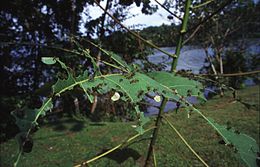
Working ants of
A. columbica cut all leaves from a young tree

Leaf cutters
A. cephalotes at work

Leaf cutting ants carrying cut leaves
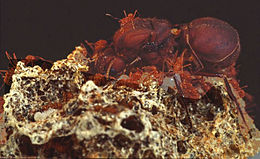
Uterus
A. columbica with workers
Content
The genus is characteristic exclusively of the New World and is found only in the Neotropics (from Texas, the USA to Argentina).
Leaf-cutting ants are considered one of the most evolutionarily advanced organisms [1] , which (along with humans, termites and bark beetles ) are capable of agricultural activity [2] . Characterized by their close symbiosis with Basidiomycota mushrooms grown in anthills based on leaf chewed mass. Approximately 20% of foliage in South America is cut and disposed of by leaf cutting ants. These ants grow basidiomycetes fungi of the species Leucocoprinus gonglylophorus from the family Agaricaceae ( Lepiotaceae ). The stalk between the breast and the abdomen consists of two segments: the petiolus and postpetiolus (the latter is clearly separated from the abdomen), the sting is developed, pupae are naked (without cocoon). The genus Atta is characterized by polymorphism of working individuals. In the anthill there are both small (gardeners, mushroom growers) and medium-sized workers (foragers and builders), and large large-headed workers ( soldiers ). Small workers are 700 times lighter than their uterus .
Ants of this genus build the largest anthills in the world, with a diameter of up to 10 meters and a depth of 6 meters. The family has about 5-8 million working ants and 1 uterus. For example, A. cephalotes families contain an average of 651,000 ants (Lewis et al. 1974), A. vollenweideri families - from 4 to 7 million (Jonkman 1980), and estimates by Martin et al. (1967) and Weber (1982) [3] showed that in the nests of A. colombica there can be from 2.5 to 5 million ants [4] .
Atta opaciceps nesting wastes (containing many organic substances) increase the biomass and plant diversity during the growth of herbaceous species in disturbed communities and thereby accelerate ecosystem regeneration [5] . During a field experiment in northeast Brazil, it was revealed that the nesting waste of Atta sexdens leaf-cutting ants (high in calcium) are mineralized and decompose faster (about twice) than leaf fragments (high in phosphorus, organic carbon, lignin and cellulose) [6] .
Genome of the species Atta cephalotes : 0.31 pg (C value). [7] [8] Diploid set of chromosomes 2n = 22. [9]
Among the parasites of these ants, forid flies of the species Neodohrniphora curvinervis ( Diptera : Phoridae ) were noted. [ten]
The genus includes more than 15 species, including:
- Atta bisphaerica Forel , 1908
- Atta capiguara Gonçalves, 1944
- Atta cephalotes ( Linnaeus , 1758)
- Atta colombica Guérin-Méneville , 1844
- Atta cubana Fontenla Rizo, 1995
- Atta goiana Gonçalves, 1942
- Atta insularis Guérin-Méneville , 1845
- Atta laevigata ( F. Smith , 1858)
- Atta mexicana (Smith, 1858)
- Atta opaciceps Borgmeier , 1939
- Atta pilosa (Buckley, 1866)
- Atta robusta Borgmeier, 1939
- Atta saltensis Forel, 1913
- Atta sexdens (Linnaeus, 1758)
- Atta tardigrada (Buckley, 1866)
- Atta texana ( Buckley , 1860)
- Atta vollenweideri Forel , 1893
In the animated film " The Adventures of Flick " ( Eng. A Bug's Life ; Pixar, 1998 ), the princess of the ant hill was called Atta . There is a French rock band with the name of the same name: " Atta Sexden " (founded 1989) [11]
- List of Leaf Cutter Ants
- List of Ant Births
- ↑ Hölldobler, Wilson, 1990 , pp. 143-179.
- ↑ Ants began to grow mushrooms 50 million years ago (Russian) . Lenta.ru (March 25, 2008). Date of treatment June 12, 2016.
- ↑ Weber NA Fungus ants // Social Insects. Vol 4. / HR Hermann (Editor). - London: Academic Press, 1982. - S. 255-363.
- ↑ Cherrett JM Chapter 27 - Leaf-Cutting Ants // Tropical Rain Forest Ecosystems. Biogeographical and Ecological Studies / Lieth H. and MJA Werger (Eds.). - Amsterdam — Oxford — New York — Tokyo: Elsevier , 1989 .-- S. 473–488. - (Ecosystems of the World 14B). - ISBN 978-0-444-42755-7 . - DOI : 10.1016 / B978-0-444-42755-7.50033-X .
- ↑ Rafaella Santana Santos, Hosana Haum Barros Mecenas, Leandro Sousa-Souto. Nest refuse of Atta opaciceps (Hymenoptera: Formicidae) increases plant biomass and diversity during the regrowth of herbaceous species (Eng.) // Applied Soil Ecology: Journal. - 2019 .-- Vol. 133. - P. 160-165. - DOI : 10.1016 / j.apsoil.2018.10.002 .
- ↑ Leandro Sousa-Souto, Marcelo Braga BuenoGuerra, Bianca G. Ambrogi, Edenir R. Pereira-Filho. Nest refuse of leaf-cutting ants mineralize faster than leaf fragments: Results from a field experiment in Northeast Brazil (Eng.) // Applied Soil Ecology: Journal. - 2012. - Vol. 61. - P. 131-136. - DOI : 10.1016 / j.apsoil.2012.05.005 .
- ↑ Database of animal genome sizes.
- ↑ Tsutsui, ND, AV Suarez, JC Spagna, and JS Johnston (2008). The evolution of genome size in ants. BMC Evolutionary Biology 8: 64.
- ↑ Lorite P. & Palomeque T. Karyotype evolution in ants (Hymenoptera: Formicidae) with a review of the known ant chromosome numbers. - Myrmecologische Nachrichten (Wien). - 2010. Volume 13, Pages 89-102. (Retrieved December 12, 2010)
- ↑ Feener, DH, Jr. & BV Brown. 1993. Oviposition behavior of an ant-decapitating fly, Neodohrniphora curvinervis (Diptera: Phoridae) and defense behavior by its leaf-cutting ant host, Atta cephalotes (Hymenoptera: Formicidae). Journal of Insect Behavior. 6: 675-688.
- ↑ Rock band website www.attasexden.com Archived on September 24, 2009.
- Bacci, M., jr .; Solomon, SE; Mueller, UG; Martins, VG; Carvalho, AOR; Vieira, LGE; Silva-Pinhati, ACO 2009 : Phylogeny of leafcutter ants in the genus Atta Fabricius (Formicidae: Attini) based on mitochondrial and nuclear DNA sequences. Molecular phylogenetics and evolution, 51: 427-437.
- Bolton B. A new general catalog of the ants of the world , Harvard University Press, Cambridge, MA, 1995.
- Hölldobler B. , Wilson EO The Ants. - Harvard University Press, 1990 .-- 732 p. - ISBN 0674040759 .
- Maykon Passos Cristiano, Danon Clemes Cardoso, Tânia Maria Fernandes-Salomão. Cytogenetic and Molecular Analyses Reveal a Divergence between Acromyrmex striatus (Roger, 1863) and Other Congeneric Species: Taxonomic Implications (English) // PLoS ONE. - 2013 .-- Vol. 8 , no. 3 (e59784) . doi: 10.1371 / journal.pone.0059784
Links


