Yason (also Iazon, Yason ; ancient Greek Ἰάσων ) - in ancient Greek mythology the son of tsar Iolk Eson and Polimedes (or Alkimeda [1] ).
| Jason | |
|---|---|
| Ἰάσων | |
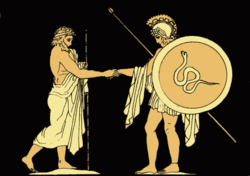 Pelias sends Jason on a rune trip | |
| Mythology | Ancient greek mythology |
| Name in other languages | English Jason |
| Floor | |
| Father | Eson |
| Mother | Polymed (or Alkimed) |
| Brother | Slip |
| Spouse | Medea |
| Children | Medea , Eriopida, Mermer , Feret, Thessal , Alkimen, Tisander |
The hero , a participant in the Calydon hunting [2] , the leader of the Argonauts who set off on the ship " Argo " to Colchis for the Golden Fleece . This task was given to him by the half-brother of his father, Pelias , in order to destroy him. Mentioned in the Iliad and Odyssey (XII 72).
Content
Start
When Pelius overthrew his brother Aeson from the throne, he, fearing the usurper's intrigues, gave Jason to raise Chiron , the centaur who lived on Mount Pelion [3] , who taught him the art of healing (an etiological myth explaining the name Jason, meaning "healer", from Greek ιάομαι - heal, heal).
According to Pindar , Jason, when he was 20 years old, returned to Iolk. Crossing over the river Anavr , Jason lost his sandal with his left foot. Either Hera on the river Even turned into an old woman and asked to be moved, and Jason helped her [4] . For this, Hera helped Jason in the future. Euripides described the Aetolian warriors, who embarked on a campaign shod only on the right foot. Aristotle, on the other hand, claimed that it was the Aetolian footwear that was the left foot [5] , according to Thucydides [6] .
When Pelias saw Jason, he was frightened, because he was predicted that a man who had come to him in one sandal would destroy him. When asked about his origin, Jason replied to Pelius that he was the son of the ousted king Aeson, and came to return to his father the legitimate authority. Pelias promised to return the kingdom to Jason, but said that before (in order to atone for a curse over the Eolidian family), it was necessary to appease the shadow of Frix and return the golden fleece from Colchis to Iolk. According to a later version, Jason himself asked Pelius what he would do to a man who, as predicted, would bring him death, replied that he would have demanded that he deliver the golden fleece from Colchis. Then Pelias ordered Jason to accomplish this feat. According to Diodorus, Jason went on a campaign not by any order, but out of a thirst for glory [7] .
Jason's Rune's Journey
To help Jason get the Golden Fleece, gathered heroes from all over Hellas . A ship was built, named after its builder “Argo”, and the participants of the march became known as Argonauts. When the Argonauts, led by Jason [8] , arrived on the island of Lemnos , ruled by women during their campaign for the Golden Fleece, the Queen of Gipsipila wanted to attack them with a weapon, but she was persuaded to accept them in peace. In honor of the arrival of the heroes, Gipsipil established pentatlon competitions. Argonauts entered into contact with local women. Later, Gipsipila gave birth to Jason, the sons of Eubnay and Nebrophon.
Having experienced many adventures, the Argonauts, with the help of the patrons of Hera and Athens, reached Colchis, where King Eet ruled. The king agreed to give the Golden Fleece, if Jason harnessed huge bulls spewing the flames of the copper bugs (a gift from Hephaestus ), plowing the field and sowing him with dragon's teeth war against Brother Persian ). The god of love, Eros, at the request of Athena and Hera, instilled in the heart of the daughter Eeta the sorceress Medea love of the hero. Jason promised Medea to marry her and with her help fulfilled all the requirements. Medea gave him an ointment that saved bulls from the fire [9] (it was made from a flower that grew in the Caucasus from the blood of Prometheus [10] ). According to one of the interpretations, the bulls were not fire-breathing, but simply wild and ferocious [11] .
Although Jason managed to sow the field with the dragon's teeth and kill the warriors who grew out of them, Eet did not give the rune, but plotted to burn Argo and kill the Argonauts. However, Medea put the dragon guarding the golden fleece to sleep and helped to steal the fleece. Medea, with her brother Apsirth and the Argonauts, fled from Colchis. By way of detaining the pursuers, Medea killed her brother and scattered pieces of his body over the sea. Overwhelmed with grief, Eet stopped chasing in order to collect parts of his son’s body and deliver them to burial. When Jason and Medea sailed to the island of fakov, where Alkina reigned, they were overtaken by their pursuers. On the advice of Alkinoi ’s wife Areta , Jason and Medea were hastily married, so that the feiacs had no reason to return Medea to his father. According to Timonact, Jason married Medea while still in Colchis ; in Ee, Medea's terem and Jason's sanctuary were shown [12] . According to the version, he lived in Colchis for 4 years [13] .
Jason made sacrifices to 12 gods on the Asian shore of the Bosporus , which is why this place is called Hieron [14] . Erection of the sanctuary of Hera of Argives near Levkania in southern Italy [15] (archeologists date it from the middle of the 7th century BC. [16] ). Raise the Temple of Heracles on Ephalia (Elba) [17] .
Return to Yolk and later life
Returning to Yolk, Jason found out that during his absence, Pelias killed his father and all his relatives. Thanks to Medea’s cunning, which convinced Pelius’s daughters that in order to return his father to his youth, he should be cut into pieces, Jason cruelly avenged the abuser. Jason, a participant in the funerary games of Pelius, fought in the fight [18] .
According to Hesiod, he had a son, Medea, from the wife of Medea [19] . According to Kinefon's poem, Jason and Medea had a son Medea and a daughter Eriopid [20] . According to the poem Navpaktiya, after the death of Pelius, he moved from Iolk to Corcyra, his son Mermer was torn apart by a lioness in the hunt, and Feret was not mentioned [20] . According to Diodorus, they had three sons: Thessal , Alkimen, and Tisander [21]
There is a version that he again went to the Kolkhs with Medea and conquered a number of countries, temples were erected for him [22] . The Calibans had an acropolis of Jasonius [23] . His descendants are Albanians [24] . It is assumed that the story of Azone , the legendary character of ancient Georgian history, is associated with the myth of Jason.
According to the most common version, Jason and Medea were expelled from Iolk and settled in Corinth with King Creon , where they lived happily for 10 years (in earlier versions, Jason was named king of Corinth [25] or ruler of his harbor Lehei [26] ). They had two sons, Mermer and Feret [27] . When Jason decided to marry the daughter of King Creon with Glaucca (the other is Kreusa), Medea, outraged by betrayal, sent a poisoned robe as a gift to the newlywed, and she died in terrible agony. Meason killed her young sons from Jason Mermer and Fereth before his eyes, while she herself was carried away in a chariot drawn by winged horses (dragons).
Jason committed suicide [28] by hanging himself, or he died with Glavka [29] , or was killed in the sanctuary of Hera in Argos, according to another version, he lived to old age and died under the rubble of the dilapidated "Argo", falling asleep in his shadow [30] .
In art
In the visual art of New Time, Jason's story is not very popular. It is found in the paintings of the Italian Cassone . The episodes are depicted: Jason, who is about to set off and say goodbye to his uncle; ship passing between the rocks; Eet meets the Argonauts; Jason's acquaintance with Medea; Jason takes the Golden Fleece from the tree; fire bulls; Jason standing in front of a tree with armor [31] .
Theater
The protagonist of the tragedies "Medea" by Euripides , Seneca and Jean Anouille .
Notes
- ↑ Apollonius of Rhodes. Argonavtika I 45 below; Hyginus. Myths 3; 13
- ↑ Pseudo-Apollodor. Mythological library I 8, 2 below; Ovid. Metamorphosis VIII 302; Hyginus. Myths 173
- ↑ Hesiod. The list of women, fr.40 M.-U.
- ↑ Hyginus. Myths 13; 22, in Gigin's “shoe”
- ↑ Comment D. O. Torshilova in the book. Hyginus. Myths. St. Petersburg, 2000. P.20
- ↑ Thucydides. History III 22
- ↑ Diodorus Sicilian. Historical Library IV 40, 2
- ↑ Apollonius of Rhodes. Argonavtika I 9-18; Pseudo-Apollodor. Mythological library I 9, 16; Hyginus. Myths 14 (p.22)
- ↑ Pindar. Pythian Songs IV 222
- ↑ Sophocles Kolkhidyanki, fr.340 Radt (?); Apollonius of Rhodes. Argonavtika III 840-852
- ↑ Heraclitus-allegorist. About the incredible 17
- ↑ Scholii to Apollonius of Rhodes. Argonavtika IV 1217 // Bulletin of ancient history. 1947. № 3. S.296
- ↑ Dragons. Medea 340
- ↑ Polybius. Universal history IV 39, 6
- ↑ Strabo. Geography VI 1, 1 (p.251); Pliny the Elder. Natural History III 70
- ↑ Notes A.A. Taronian in the book. Pliny the Elder. About art. M., 1994. P.845
- ↑ Lycophron. Alexandra 871
- ↑ Pausanias. Description of Hellas V 17, 10
- ↑ Hesiod. Theogony 999-1002
- ↑ 1 2 Pausanias. Description of Hellas II 3, 9
- ↑ Diodorus Sicilian. Historical Library IV 54, 1
- ↑ Justin. Epitoma Pompey Trog XLII 2, 12 - 3, 5; Tacitus Annals VI 34
- ↑ Pseudo-Skilak. Peripl 88 // Herald of ancient history. 1947. № 3. С.243
- ↑ Solin 15, 5
- ↑ Eumel Corinthian, fr.20 West = Pausanias. Description of Hellas II 3, 10
- ↑ Simonides, fr.40 Paige = scholi to Euripides. Medea. nineteen
- ↑ Pseudo-Apollodor. Mythological Library
- ↑ Diodorus Sicilian. Historical Library IV 55, 1
- ↑ Dragons. Medea 521
- ↑ Scholii to Euripides. Medea 1386 // Comment V.N. Yarkho in the book. Dracons. Mythological poems. M., 2001. P.118
- ↑ Hall, James. Dictionary of plots and characters in art = James Hall; introduction by Kenneth Clark . Dictionary of Subjects and Symbols in Art / Per. from English and introductory article by A. Maykapar . - M .: “Kron-press”, 1996. - 656 p. - 15 000 copies - ISBN 5-323-01078-6 .
Literature
- Jason / M.N. Botvinnik // Myths of the Nations of the World : Entsikl. in 2 t. / Ch. ed. S.A. Tokarev . - 2nd ed. - M .: Soviet Encyclopedia , 1988. - T. 2: K — I. - p. 687.
- Obnorsky N.P. Jason, in mythology // Encyclopedic Dictionary of Brockhaus and Efron : in 86 tons (82 tons and 4 extras). - SPb. , 1904. - T. XLI.
- Argonautae // Real Dictionary of Classical Antiquities / ed.-comp. F. Lubker ; Edited by members of the Society of Classical Philology and Pedagogy F. Gelbke , L. Georgievsky , F. Zelinsky , V. Kansky , M. Kutorgi and P. Nikitin . - SPb. 1885.
- Dimitris Michalopoulos, Les Argonautes, Paris: Dualpha, 2013 (ISBN 9782353742516)