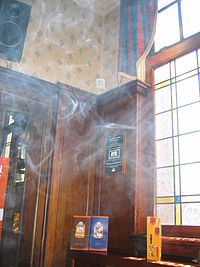
Passive smoking - inhalation of the surrounding air with the tobacco products contained in it by other people. Scientific studies show that second-hand smoke increases the risk of developing diseases, the onset of disability and death. [1] [2] [3] [4]
The harm of second-hand smoke is a key reason for introducing a restriction policy on smoking and tobacco products. Since the early 1970s the tobacco industry was preoccupied with the discussion about the dangers of secondhand smoke, viewing it as a serious threat to its commercial interests, [5] since harm to “involuntary smokers” was seen as the basis for introducing more stringent tobacco restrictions. Despite the fact that information about the dangers of secondhand smoke appeared rather early, the tobacco industry has consistently tried to sow doubt in order to prevent the restriction of its products. There is currently consensus in the scientific community regarding the harm of second-hand smoke, and its harm is a key reason for banning smoking in workplaces, in enclosed spaces, including restaurants, bars, nightclubs, flights of stairs and landings.
Content
Effects on the body
A large body of scientific research shows that second-hand tobacco smoke leads to the development of many diseases, including cardiovascular diseases , lung cancer, and respiratory system diseases . [2] [3] [4]
The result of secondhand smoke:
- Cancer :
- Passive smoking increases the risk of cancer [6] . A review of the evidence gathered by the International Agency for Research on Cancer in a worldwide research database in 2004 showed that “involuntary smoking (exposure to second-hand smoke) is carcinogenic to humans.” [4]
- Lung cancer : The effects of secondhand smoke on lung cancer are well established. A number of studies in the United States, [7] [8] [9] [10] Great Britain, [11] [12] Australia [13] and other countries [14] have clearly shown a significant increase in the incidence of passive smokers. [15]
- Breast Cancer : The California Environmental Protection Agency in 2005 concluded that second-hand smoke increased the risk of developing breast cancer among young women who did not reach menopause by 70%. [3] The US chief surgeon concluded that this study “provides food for thought,” but does not show unambiguously the presence of a causal relationship. [2] International Agency for Research on Cancer in 2004 However, the International Agency for Research on Cancer, on the contrary, concluded that there was sufficient evidence of a causal relationship between secondhand smoke and breast cancer among women who never smoked. " [4]
- Renal cell carcinoma : A recent study showed an increased risk of developing renal cell carcinoma among never-smokers exposed to the combined effects of second-hand smoke at home and at work. [sixteen]
- There is insufficient evidence that passive smoking and pancreatic cancer are related. [17]
- Brain cancer : The risk of developing brain cancer in children increases significantly as a result of exposure to tobacco smoke, even if the mother of the child does not smoke. [18]
- Diseases of the ear, throat and nose : the risk of inflammation of the middle ear increases. [nineteen]
- Circulatory system: increased risk of cardiovascular disease, [20] decreased heart rate variability, increased heart rate. [21]
- Epidemiological studies have shown that both active and passive smoking increase the likelihood of developing atherosclerosis . [22]
- Respiratory system diseases :
- Asthma [23]
- Mental Disorders and Dementia : Exposure to second-hand smoke may increase the risk of impaired mental activity and dementia among people 50 years of age and older. [24]
- Effect on the fetus:
- Low birth weight. [3],. [25]
- The birth of premature babies , [3] (although a causal relationship between was described as presumptive in a 2006 report by the US Surgeon General [26] )
- Harm to the body:
- Worsening symptoms of asthma, allergies, and other complications. [27]
- Harm to children: [28]
- Sudden Infant Death Syndrome , SIDS. [29] [30] A 2006 report by the US Surgeon General said: “There is enough evidence to conclude a causal relationship between exposure to second-hand smoke and the sudden death of infants.” [31]
- Asthma [32] [33]
- Pulmonary infections. [34] [35] [36] [37]
- A more severe course of bronchitis , and an increase in the likelihood of complications. [38]
- Increased risk of contracting tuberculosis if the caretaker smokes. [39]
- Allergies.
- Crohn's disease . [40]
- Learning difficulties, developmental delay, and neurobehavioral consequences. [41] [42] Animal studies suggest that neurobehavioral problems may be due to nicotine and carbon monoxide (II) . [37]
- An increased risk of dental caries in children (as well as associated biomarkers in saliva) is associated with passive smoking. [43]
- Increased risk of middle ear inflammation. [44]
- Increased risk of death. In the United States, second-hand smoke kills 53,000 non-smokers annually, making second-hand smoke the third most important preventable factor in mortality among adults [45] [46] and children. [47]
- Passive smoker receives 20% of the harmful substances from what an active smoker receives
Impact mechanisms
In 2004, a study by the World Health Organization's International Agency for Research on Cancer concluded that non-smokers who are passive smokers are exposed to the same carcinogens as active smokers. Sidestream smoke contains more than 4,000 chemicals , including 69 proven carcinogens. Particularly dangerous are the well-known strong carcinogens such as polycyclic aromatic hydrocarbons , tobacco-specific N- nitrosamines and aromatic polyesters such as 4- aminobiphenyl . Although the smoke inhaled during smoking, the sidestream smoke and the smoke inhaled during second-hand smoke generally contain the same components, the concentration of these substances in different types of tobacco smoke varies. [4] Studies by the tobacco companies themselves have shown that several known carcinogens are present in the sidestream smoke at higher concentrations than smoke inhaled by smoking. [48]
Notes
- ↑ WHO Framework Convention on Tobacco Control (PDF). World Health Organization (February 27, 2005). ““ Scientific evidence unequivocally confirms that tobacco use and exposure to tobacco smoke are the cause of death, illness and disability. ” Date of treatment April 4, 2010. Archived March 16, 2012.
- ↑ 1 2 3 The Health Consequences of Involuntary Exposure to Tobacco Smoke: A Report of the Surgeon General (link not available) . Surgeon General of the United States (June 27, 2006). - "Secondhand smoke exposure causes disease and premature death in children and adults who do not smoke." Date of treatment January 12, 2009. Archived March 16, 2012.
- ↑ 1 2 3 4 5 Proposed Identification of Environmental Tobacco Smoke as a Toxic Air Contaminant . California Environmental Protection Agency (June 24, 2005). Date of treatment January 12, 2009. Archived March 16, 2012.
- ↑ 1 2 3 4 5 Tobacco Smoke and Involuntary Smoking (PDF). International Agency for Research on Cancer (2004). - "There is sufficient evidence that involuntary smoking (exposure to secondhand or 'environmental' tobacco smoke) causes lung cancer in humans." Date of treatment January 12, 2009. Archived March 16, 2012.
- ↑ Diethelm P, McKee M. Lifting the smokescreen: Tobacco industry strategy to defeat smoke free policies and legislation (link not available) . European Respiratory Society and Institut National du Cancer (February 2006). “The industry quickly realized that if it wants to continue to flourish, it is imperative that research does not show that second-hand smoke is a dangerous air pollutant. This idea has been the cornerstone of tobacco policy regarding second-hand smoke since the early 1970s. until now, ". Date of treatment April 18, 2010. Archived March 16, 2012.
- ↑ The Health Consequences of Involuntary Exposure to Tobacco Smoke: A Report of the Surgeon General. 2006, pp 30-46 .
- ↑ 1986 Surgeon General's report: the health consequences of involuntary smoking (English) // MMWR Morb. Mortal. Wkly. Rep. : journal. - 1986. - Vol. 35 , no. 50 . - P. 769-770 . - PMID 3097495 .
- ↑ National Research Council. Environmental tobacco smoke: measuring exposures and assessing health effects, NRC, Washington, DC (1986).
- ↑ US Environmental Protection Agency. Respiratory health effects of passive smoking: Lung cancer and other disorders PDF
- ↑ Health effects of exposure to environmental tobacco smoke. California Environmental Protection Agency (English) // Tob Control : journal. - 1997. - Vol. 6 , no. 4 . - P. 346-353 . - DOI : 10.1136 / tc.6.4.346 . - PMID 9583639 .
- ↑ Report of the Scientific Committee on Tobacco and Health to the Chief Medical Officer, Part II . Date of treatment July 26, 2006. Archived March 16, 2012.
- ↑ Hackshaw AK Lung cancer and passive smoking (neopr.) // Stat Methods Med Res . - 1998. - T. 7 , No. 2 . - S. 119-136 . - DOI : 10.1191 / 096228098675091404 . - PMID 9654638 .
- ↑ National Health and Medical Research Council. The health effects of passive smoking, Australian Government Publishing Service, Canberra (1997).
- ↑ Brennan P., Buffler P., Reynolds P., Wu A., Wichmann H., Agudo A., Pershagen G., Jöckel K., Benhamou S., Greenberg R., Merletti F., Winck C., Fontham E., Kreuzer M., Darby S., Forastiere F., Simonato L., Boffetta P. Secondhand smoke exposure in adulthood and risk of lung cancer among never smokers: a pooled analysis of two large studies (Eng.) // Int . J. Cancer : journal. - 2004. - Vol. 109 , no. 1 . - P. 125-131 . - DOI : 10.1002 / ijc.11682 . - PMID 14735478 .
- ↑ Alberg AJ, Samet JM Epidemiology of lung cancer (neopr.) // Chest. - 2003. - T. 123 , No. 1 Suppl . - S. 21S — 49S . - DOI : 10.1378 / chest.123.1_suppl.21S . - PMID 12527563 .
- ↑ Theis RP, Dolwick Grieb SM, Burr D., Siddiqui T., Asal NR Smoking, environmental tobacco smoke, and risk of renal cell cancer: a population-based case-control study (Eng.) // BMC Cancer : journal. - 2008. - Vol. 8 . - P. 387 . - DOI : 10.1186 / 1471-2407-8-387 . - PMID 19108730 .
- ↑ Hassan MM, Abbruzzese JL, Bondy ML, et al. Passive smoking and the use of noncigarette tobacco products in association with risk for pancreatic cancer: a case-control study (Eng.) // Cancer : journal. - Wiley-Blackwell 2007. - Vol. 109 , no. 12 . - P. 2547-2556 . - DOI : 10.1002 / cncr.22724 . - PMID 17492688 .
- ↑ Filippini G., Farinotti M., Lovicu G., Maisonneuve P., Boyle P. Mothers' active and passive smoking during pregnancy and risk of brain tumors in children ( Int. ) // Int. J. Cancer : journal. - 1994 .-- June ( vol. 57 , no. 6 ). - P. 769-774 . - PMID 8206670 .
- ↑ Bull, PD Diseases of the Ear, Nose and Throat. - Blackwell Science, 1996. - ISBN 0-86542-634-1 .
- ↑ Surgeon General, 2006 , Ch. eight
- ↑ Dietrich DF, Schwartz J., Schindler C., et al. Effects of passive smoking on heart rate variability, heart rate and blood pressure: an observational study (English) // Int J Epidemiol : journal. - 2007. - Vol. 36 , no. 4 . - P. 834-840 . - DOI : 10.1093 / ije / dym031 . - PMID 17440032 .
- ↑ Zou N., Hong J., Dai QY Passive cigarette smoking induces inflammatory injury in human arterial walls (English) // Chin. Med. J. : journal. - 2009 .-- February ( vol. 122 , no. 4 ). - P. 444-448 . - PMID 19302752 .
- ↑ Surgeon General, 2006 , pp. 555–8
- ↑ Llewellyn DJ, Lang IA, Langa KM, Naughton F., Matthews FE Exposure to secondhand smoke and cognitive impairment in non-smokers: national cross sectional study with cotinine measurement (English) // BMJ : journal. - 2009. - Vol. 338 . - P. b462 . - DOI : 10.1136 / bmj.b462 . - PMID 19213767 .
- ↑ Surgeon General, 2006 , pp. 198–205
- ↑ Surgeon General, 2006 , pp. 194–7
- ↑ Janson C. The effect of passive smoking on respiratory health in children and adults. (English) // Int J Tuberc Lung Dis: journal. - 2004. - Vol. 8 , no. 5 . - P. 510-516 . - PMID 15137524 .
- ↑ Parents warned not to smoke at home . The Guardian . Date of treatment June 24, 2007. Archived March 16, 2012.
- ↑ McMartin KI, Platt MS, Hackman R., Klein J., Smialek JE, Vigorito R., Koren G. Lung tissue concentration of nicotine in sudden infant death syndrome (SIDS ) // J. Pediatr. : journal. - 2002. - Vol. 140 , no. 2 . - P. 205-209 . - PMID 11865272 .
- ↑ Milerad J., Vege A., Opdal SH, Rognum TO Objective measurements of nicotine exposure in victims of sudden infant death syndrome and in other unexpected child deaths (English) // J. Pediatr. : journal. - 1999. - Vol. 135 , no. 1 . - P. 132-133 . - PMID 9709711 .
- ↑ Surgeon General, 2006 , p. 194
- ↑ Surgeon General, 2006 , pp. 311–9
- ↑ Vork KL, Broadwin RL, Blaisdell RJ Developing asthma in childhood from exposure to secondhand tobacco smoke: insights from a meta-regression (Eng.) // Environ. Health Perspect. : journal. - 2007. - Vol. 115 , no. 10 . - P. 1394-1400 . - DOI : 10.1289 / ehp.10155 . - PMID 17938726 .
- ↑ Spencer N., Coe C. Parent reported longstanding health problems in early childhood: a cohort study (Eng.) // Arch. Dis. Child : journal. - 2003. - Vol. 88 , no. 7 . - P. 570-573 . - DOI : 10.1136 / adc.88.7.570 . - PMID 12818898 .
- ↑ de Jongste JC, Shields MD Cough. 2: Chronic cough in children (neopr.) // Thorax. - 2003. - T. 58 , No. 11 . - S. 998-1003 . - DOI : 10.1136 / thorax . 58.11.998 . - PMID 14586058 .
- ↑ Dybing E., Sanner T. Passive smoking, sudden infant death syndrome (SIDS) and childhood infections (English) // Hum Exp Toxicol : journal. - 1999. - Vol. 18 , no. 4 . - P. 202-205 . - DOI : 10.1191 / 096032799678839914 . - PMID 10333302 .
- ↑ 1 2 DiFranza JR, Aligne CA, Weitzman M. Prenatal and postnatal environmental tobacco smoke exposure and children's health (Eng.) // Pediatrics : journal. - American Academy of Pediatrics 2004. - Vol. 113 , no. 4 Suppl . - P. 1007-1015 . - DOI : 10.1542 / peds.113.4.S1.1007 . - PMID 15060193 .
- ↑ Chatzimichael A., Tsalkidis A., Cassimos D., et al. The role of breastfeeding and passive smoking on the development of severe bronchiolitis in infants // Minerva Pediatr. : journal. - 2007. - Vol. 59 , no. 3 . - P. 199-1206 . - PMID 17519864 .
- ↑ den Boon S., Verver S., Marais BJ, et al. Association between passive smoking and infection with Mycobacterium tuberculosis in children (English) // Pediatrics : journal. - American Academy of Pediatrics 2007. - Vol. 119 , no. 4 . - P. 734-739 . - DOI : 10.1542 / peds.2006-1796 . - PMID 17403844 .
- ↑ Mahid SS, Minor KS, Stromberg AJ, Galandiuk S. Active and passive smoking in childhood is related to the development of inflammatory bowel disease (Eng.) // Inflamm. Bowel Dis. : journal. - 2007. - Vol. 13 , no. 4 . - P. 431-438 . - DOI : 10.1002 / ibd.20070 . - PMID 17206676 .
- ↑ Richards GA, Terblanche AP, Theron AJ, et al. Health effects of passive smoking in adolescent children (English) // S. Afr. Med. J. : journal. - 1996. - Vol. 86 , no. 2 . - P. 143-147 . - PMID 8619139 .
- ↑ Scientific Consensus Statement on Environmental Agents Associated with Neurodevelopmental Disorders , The Collaborative on Health and the Environment's Learning and Developmental Disabilities Initiative, November 7, 2007
- ↑ Avşar A., Darka O., Topaloğlu B., Bek Y. Association of passive smoking with caries and related salivary biomarkers in young children (Eng.) // Arch. Oral Biol. : journal. - 2008 .-- October ( vol. 53 , no. 10 ). - P. 969–974 . - DOI : 10.1016 / j.archoralbio.2008.05.007 . - PMID 18672230 .
- ↑ Ear Infections In Children Linked To Passive Smoking . Date of treatment April 18, 2010. Archived March 16, 2012.
- ↑ Glantz SA, Parmley WW Passive smoking and heart disease. Epidemiology, physiology, and biochemistry (English) // Circulation : journal. - Lippincott Williams & Wilkins 1991. - Vol. 83 , no. 1 . - P. 1-12 . - PMID 1984876 .
- ↑ Taylor AE, Johnson DC, Kazemi H. Environmental tobacco smoke and cardiovascular disease. A position paper from the Council on Cardiopulmonary and Critical Care, American Heart Association (Eng.) // Circulation : journal. - Lippincott Williams & Wilkins 1992. - Vol. 86 , no. 2 . - P. 699–702 . - PMID 1638735 .
- ↑ Surgeon General, 2006 , pp. 376-380
- ↑ Schick S., Glantz S. Philip Morris toxicological experiments with fresh sidestream smoke: more toxic than mainstream smoke. (English) // Tob Control. : journal. - 2005. - Vol. 14 , no. 6 . - P. 396-404 . - DOI : 10.1136 / tc.2005.011288 . - PMID 16319363 .
Links
- US Dept. of Health and Human Services; Centers for Disease Control and Prevention; Coordinating Center for Health Promotion; National Center for Chronic Disease Prevention and Health Promotion; Office on Smoking and Health. The Health Consequences of Involuntary Exposure to Tobacco Smoke: A Report of the Surgeon General ( journal ) : journal. - Atlanta, Ga.: Surgeon General of the United States , 2006. - June 27.