Fryxell ( eng. Lake Fryxell ) is a drainless lake in the vicinity of Victoria Land , Antarctica . Located in the Taylor Valley of the Trans-Antarctic Range between Canada Glacier and Commonwealth Glacier . The length of the lake is 4.5 km, the area is 7 km². Located at an altitude of 15 m above sea level, has a depth of 19 m.
| Lake Fryxell | |
|---|---|
| English Lake fryxell | |
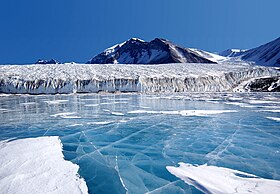 The blue ice covering the lake comes in the form of melt water from the Canada glacier, which then freezes, closing the salt water below. | |
| Morphometry | |
| Dimensions | 4.5 × 1.5 km |
| Square | 7 km² |
| Deepest | 19.2 m |
| Location | |
| Continent |
|
| Region | East Antarctica |
| Area | Victoria Land |


The lake is constantly covered with ice about 5 m thick. The water in it is salty, close in composition to the sea. Below 9.5 m high concentrations of methane and hydrogen sulfide are found . The water temperature in summer ranges from 0.5 to 2.5 ° C.
Lake Fryxell was mapped by the British Antarctic Expedition led by Robert Scott in 1910-13 . In 1957 - 58 years during the American operation Deep Freeze the lake was investigated by Professor T. L. Peve, who named it in honor of the famous glaciologist Fridiof M. Fryxella ( Fritiof M. Fryxell ).
Expedition of the Institute of Microbiology RAS 1995 - 96 headed by Corresponding Member of the Russian Academy of Sciences Valery Fedorovich Galchenko, examined the lake for the presence of life in the form of bacteria .
Links
- Lake Fryxell : Wikimedia Commons
- V.F. Galchenko || Methanotrophic bacteria || Chapter 7
- USGS GNIS: Lake Fryxell (English)
- MJF Lawrence, CH Hendy. Water column and sediment characteristics of Lake Fryxell, Taylor Valley, Australia // New Zealand Journal of Geology and Geophysics. - The Royal Society of New Zealand, Feb 1958. - T. 28 . - p . 543-552 .