Kiev Fortress , Kiev-Pechersk Fortress [1] [2] or New Pechersk Fortress ( Ukrainian: Kiev Fortress ) - fortifications (1st class fortress ) of the 19th century in the provincial city of Kiev , which belonged to the Western Russian line of fortifications of the Russian Empire .
| Fortress | |
| New Pechersk Fortress (Kiev fortress) | |
|---|---|
| Kiev fortress | |
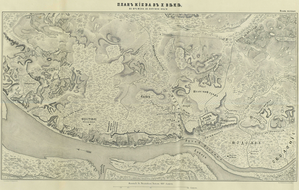
 Plan of the Kiev fortress . “Atlas of Fortresses of the Russian Empire” - St. Petersburg. , 1830s. | |
| A country |  Ukraine Ukraine |
| City | Kiev |
| Established | XIX century |
| Status | Monument Museum |
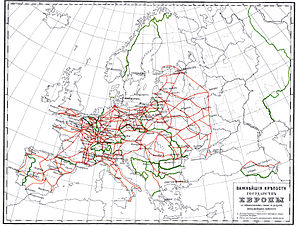

The fortress was intended to protect the territory of Russia, in accordance with the state defense plans by the serf method (fortress lines [3] or strongholds ). Under the Kiev fortress, it is worth distinguishing between the construction ( fortification ) and the formation of the Russian army . Since 1886, the fortress was transferred to the 3rd class, and on April 25, 1897, with the loss of strategic importance for defense, it was transformed into a warehouse fortress [4] . It was abolished in 1918, and the formation was disbanded.
Content
History
Kiev, founded according to legend in the V century BC, under the first historical prince Oleg was the capital city of the Russian principality . According to Nestor , the capital of the principality in the 9th century was surrounded by an earthen rampart , which made up a closed fence , up to 600 fathoms in length, that the rampart was also reinforced with a wooden fence at the top is not known [4] .
Later, Yaroslav the Wise, for a more reliable defense of the city, which was very upset, from enemy attacks, built in 1037 a new, already stone fence, which, covering the outskirts of Kiev, adjoined with its extremities to the old earthen fence. Under Svyatopolk II (1083 - 1113), the city’s fence was expanded by the construction of a new rampart that covered the Mikhailovsky Monastery . During the possession of the city by Prince Vladimir Olgerdovich (at the end of the XIV century), a fortified castle was built on Mount Kiselevka.
In the period from 1676 to 1680, on the occasion of the war with Turkey, the Old Kiev fortifications were corrected by garrison archers and city Cossacks , at the same time a ship bridge was also built across the Dnieper ("on plows and anchors"). In 1698, by order of the hetman I. Mazepa-Kolensky, the stone fence of the Kiev Pechersk Lavra was restored.
July 4, 1706 [5] Tsar Peter I arrives in Kiev to watch the troops prepare the fortress-city and the oldest monastery in Russia [6] ( Desert-Nikolsky ) for defense in the event of a Swedish intervention [7] . After reconnaissance, he chose a new location for the fortress in connection with the overgrown city, in the area of the Kiev-Pechersky Monastery , surrounded for protection , in 1698 - 1700, with fortified walls with towers . On August 15, 1706, in the presence of the tsar, according to his design, the Pechersk fortress was laid down [2] , after the troops of the army erected Count Sheremetyev and the Zaporozhye Cherkasy fortifications and fortifications, was completed in 1724 (later became the citadel of the Kiev fortress ). The fortress became the most fortified strong point in the south of Russia. In 1722, the post of Director General over all fortresses was established in the Armed Forces of the empire , subordinate to the general-feldzeichmeister . Magdeburg law of the city caused certain difficulties in maintaining the old fortress [8] , until the redemption of Kiev from the Poles.
During the reign of Catherine II , in 1764, the “Regulation on the Kiev Arsenal Team” was published. In the XVIII - XIX centuries, the arsenal of the Kiev fortress serves and repairs weapons, including artillery.
As time went on, military affairs developed and the Kiev fortifications no longer met the measures to protect the city from enemies, due to the significant expansion of the city’s borders, the destruction of ramparts under the influence of natural and human (the local administration contributed to their destruction and poor maintenance) factors.
“Was completely neglected and barely stood out from the townsfolk surrounding it, a retransmission line, built another gr. "She settled, she grew overgrown with grass, and her ditches showered."
- Researcher D. Menshov, Kiev-Pechersk Fortress in 1810.
In connection with the complication of the international situation in the world, on March 7, 1810, Emperor Alexander I issued an order stating the following: “transfer the fortification of Pechersk Mountain to the Engineering Department and keep it in good condition, together with the fortress”
After visiting Kiev, the future Emperor Nicholas I ordered to develop a master plan for the new fortress, called the New Pechersk Fortress , the author of the plan was an outstanding military engineer , Lieutenant General Karl Opperman . After the plan was approved, in March 1830, under the leadership of Lieutenant General O. O. Freiman, construction began with the erection of modern defensive structures, which continued between 1831 and 1851 [2] (some fortifications were completed until 1872, an additional fort was built on Lysaya grief). In the 1860s and 1880s, a sapper camp, a sapper highway, an army camp on Syrets, and a military district court were built. Lines of the city railway (1906) and a tram line (1915) were built, city streets were expanded, a fraternal military cemetery was built (1915). Since 1886, the fortress was transferred to the 3rd class, on April 25, 1897, with the loss of strategic importance - to the fortress-warehouse. It was abolished in 1918.
Kiev fortress was built in the Pechersk district under the name New Pechersk fortress . Old and New Pechersk fortresses began to make up a complex of the Kiev fortress. Today, some buildings and structures are restored and contain a museum of the Kiev fortress, some are still used as military depots or by commercial enterprises. Having lost its strategic importance at the end of the 19th century , the Kiev fortress was used for the needs of the army ( headquarters , warehouses, barracks ), and also as a place of detention for criminals.
The historical and architectural monument (now a monument museum) “Kiev Fortress” was founded in 1927 as a branch of the Museum of the History of Kiev . The main fund of the museum is 17 thousand exhibits. An integral part of the hospital fortification of the Kiev fortress - Oblique caponier - was built in 1844 as a defensive structure of the Hospital fortification in the system of the New Pechersk Fortress.
Also, the Lysogorsky fort, built in 1872 according to the project of E.I. Totleben, was part of the Kiev fortress. Lysogorsky fort is a complex system of bastions , ravelins , lunettes . Currently, much has been destroyed for housing.
Feature
Fortress characteristic:
- It was designed for 1,180 guns and 3,833 guns (by the number of embrasures );
- powder depots contained 45,000 pounds of gunpowder (737.1 tons);
- the artillery arsenal included weapons for 100,000 troops;
- casemates (defense) were 1,021 units;
- the permanent garrison was 7,093 personnel;
- the hospital is designed for 1,500 personnel;
- during the construction period of the fortress, 1,180 houses and structures were demolished, which interfered with the esplanade (the enemy could not go unnoticed and the space was shot through);
- food warehouses contained an annual supply of provisions for 20,000 people.
Composition
Construction
The structure of the structure included:
- Kiev-Pechersk Citadel;
- Arsenal;
- Hospital;
- Fort Bald Mountain.
- other.
Formation
The composition of the formation, in a different period of time, included:
- Commandant Command:
- fortress headquarters ( parade ground major , parade ground adjutant and major from the gate ):
- Departments: commandant, inspector and general staff;
- serf management:
- engineering;
- Departments: Inspection, Technical and Economic and Artificial;
- artillery (serf artillery);
- Departments: personnel and general management of artillery units of the fortress, economy of serf artillery weapons, educational, technical and mobilization.
- quartermaster;
- military sanitary, with the serf headquarters consisted of a serf priest with a clergy , serf gendarme command and serf fire brigade ;
- economic committee.
- engineering;
In 1846, the number of serf garrison for the defense of the fortress was determined at 16,700 personnel. Normal weapons - 670 guns [4] .
Images
Guns on the shaft of the second training ground of the Kiev fortress Hospital strengthening.
The parade ground and the bridge in front of the Main gate of the Hospital fortification.
Val and the Main gate of the Hospital fortification of the Kiev fortress (view from the east).
Fortifications.
Val and the Main gate of the Hospital fortification of the Kiev fortress (view from the west).
Oblique caponier of the Kiev fortress.
See also
- A. I. Altesti
- M. I. Zheleznyak
Notes
- ↑ Runivers, cartography, Laskovsky Fyodor Fedorovich Maps, plans and drawings for the III part of materials for the history of engineering in Russia, Kiev-Pechersk fortress.
- ↑ 1 2 3 All directories> Federal Archives> Russian State Military Historical Archive (RGVIA)> Russian State Military Historical Archive. Guide. Volume 1. 2006, Fortresses. (inaccessible link) . Date of treatment February 3, 2018. Archived on October 6, 2016.
- ↑ Not to be confused with the defensive lines of the fortresses themselves.
- ↑ 1 2 3 Kiev // Military Encyclopedia : [in 18 vol.] / Ed. V.F. Novitsky [et al.]. - SPb. ; [ M. ]: Type. t-va I. D. Sytin , 1911-1915.
- ↑ “The History of the Reign of Peter the Great.” Volume Four. Part I. Page 487
- ↑ Karl Opperman, Major General Engineer, “Judgment of the fortresses of the Russian State by their current condition,” 1816.
- ↑ New Pechersk Fortress, Arsenal. Kiev, Pechersk. Architecture and history of structures.
- ↑ Instruction given by the nobles of the Kiev Voivodeship to the deputies sent by them to the Sejm; it, by the way, instructs deputies to demand the bringing in order of the fortresses located in the Kiev Voivodeship and compensation for the losses to the nobles of the Voivodeship caused by the Cossacks and high-handed people, on August 29, 1738. Archive of Southwest Russia. Part 3. Volume III. Page 421.
Literature
- Karl Opperman , Engineer-Major General , “Judgment of the fortresses of the Russian State by their current condition”, 1816.
- “History of the reign of Peter the Great.” Volume Four. Part I. Page 487
- D.P. Menshov , the Old Kiev and Pechersk fortresses. Kiev, 1913.
- Kiev // Military Encyclopedia : [in 18 vol.] / Ed. V.F. Novitsky [et al.]. - SPb. ; [ M. ]: Type. t-va I. D. Sytin , 1911-1915.
- Igor Anatolyevich Kolyada , V. I. Milko , A. Yu. Kiriyenko , “Mysteries of History. Patriotic war of 1812. ", Publishing house" Folio ", 2007.
- The instruction given by the nobles of the Kiev region to the deputies sent by them to the Sejm; it, by the way, instructs deputies to demand the bringing in order of the fortresses located in the Kiev Voivodeship and compensation for losses to the nobles of the Voivodeship caused by the Cossacks and high-handed people. August 29, 1738. Archive of Southwest Russia. Part 3. Volume III. Page 421.
Links
- All Directories> Federal Archives> Russian State Military Historical Archive (RGVIA)> Russian State Military Historical Archive. Guide. Volume 1. 2006, Fortresses.
- New Pechersk fortress, Arsenal. Kiev, Pechersk. Architecture and history of structures.
- New Kiev-Pechersk fortress.
- Runivers, cartography, Laskovsky Fedor Fedorovich Maps, plans and drawings for the III part of materials for the history of engineering in Russia, Kiev-Pechersk fortress.
- Museum "Kiev Fortress" received land for permanent use
- Museum "Kiev Fortress" (official site)
- Place for a walk in the city "Kiev Fortress" (with 3D-tour)
- Kiev fortress . Encyclopedia. Kiev.