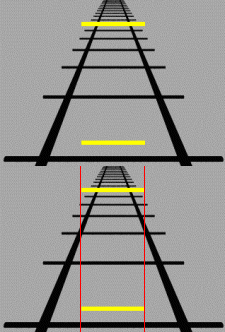
The Ponzo Illusion is an optical illusion first demonstrated by the Italian psychologist Mario Ponzo (1882-1960) in 1913 . He suggested that the human brain determines the size of an object by its background. Ponzo drew two identical segments against the background of two converging lines, like a railway going into the distance. The upper segment seems larger because the brain interprets the converging lines as a perspective (as two parallel lines converging at a distance). Therefore, we think that the upper segment is located further, and we believe that its size is larger. In addition to converging lines, a decreasing distance between intermediate horizontal segments adds strength to the effect.
Some researchers [ who? ] believe that the moon illusion is an example of the Ponzo illusion [1] , in which trees, houses and other landscape details play the role of converging lines. Foreground objects make our brain think that the moon is bigger than it really is.
This type of visual illusion also occurs when using a sensory substitution device. However, for his perception, a similar visual experience is necessary, since people with congenital blindness are not sensitive to it.
Notes
Links
- Renier L, Laloyaux C, Collignon O, Tranduy D, Vanlierde A, Bruyer R, De Volder AG (2005). " The Ponzo illusion using auditory substitution of vision in sighted and early blind subjects ." Perception, 34 : 857-867 .