Blu-ray Disc , BD ( eng. Blue ray - blue ray and disc - disc; spelling blu instead of blue - intentional ) - an optical media format used for recording with high storage density of digital data, including high-definition video . The Blu-ray standard was jointly developed by the international consortium BDA . The first prototype of the new media was introduced in October 2000 . The modern version was presented at the Consumer Electronics Show (CES), which was held in January 2006 . The commercial launch of the Blu-ray format took place in the spring of 2006.
| Blu-ray Disc | |
|---|---|
 | |
 Optical storage medium. Information is recorded and read by a laser | |
| Media type | optical disc |
| Content format | different |
| Capacity | 25 GB (single layer) 50 GB (dual layer) 100/128 GB (BDXL) |
| Block size | 64 kb ECC |
| Reading mechanism | laser, wavelength - 405 nm (violet), 36 Mb / s (1 ×) |
| International standard | Blu-ray Disc Association |
| The size | diameter 120 mm, thickness 1.2 mm |
| Application | storage of audio, video and data |
| Year of issue | 2006 |
| Work with optical discs | |
|---|---|
| |
| Types of Optical Discs | |
| |
| Formats | |
| |
| Protection technology | |
|
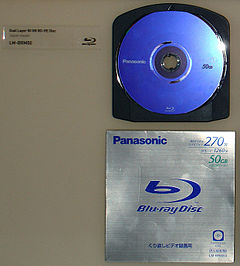
Blu-ray (lit. "blue ray") got its name from the use for recording and reading short-wave (405 nm ) "blue" (actually purple) laser . The letter “ e ” was deliberately excluded from the word “blue” in order to be able to register a trademark, as the expression “blue ray” is often used and cannot be registered as a trademark .
From the inception of the format in 2006 to the beginning of 2008, Blu-ray has been a serious competitor - an alternative format for HD DVD . Over the course of two years, many of the largest film studios that initially supported HD DVD gradually switched to Blu-ray. Warner Brothers , the latest company to release its products in both formats, abandoned the use of HD DVD in January 2008. On February 19 of that year, Toshiba, the creator of the format, stopped developing in the field of HD DVD. This event put an end to the next “format war" [1] .
Content
- 1 Variations and sizes
- 2 Technical Features
- 2.1 Laser and optics
- 2.2 Write Speed
- 2.3 Hard coating technology
- 2.4 Codecs
- 2.5 Compatibility
- 2.6 Region Codes
- 2.7 Anti-Copy Systems
- 2.8 file system
- 3 Technologies
- 3.1 BD-Live
- 3.2 LTH Type
- 3.3 BD DL
- 3.4 BDXL
- 3.5 IH-BD
- 3.6 Differences in Blu-ray Disc Specifications
- 3.7 Blu-ray 3D
- 3.8 Ultra HD Blu-ray (4K Ultra HD)
- 4 See also
- 5 notes
- 6 Literature
- 7 References
Variations and Dimensions
A single-layer Blu-ray disc (BD) can store 23.3 GiB (25 GB), a two-layer disk can hold 46.6 GiB (50 GB), a three-layer disk can hold 100 GB, and a four-layer disk can hold 128 GB. At the end of 2008, the Japanese company Pioneer demonstrated 16- and 20-layer disks with 400 and 500 GB capable of working with the same 405-nm laser as conventional BD players. Pioneer Electronics has already introduced the BDR-206MBK, which supports a three-layer 100 GB drive and a four-layer 128 GB drive. Disks are indexed by BD-R XL [2] .
On October 5, 2009, the Japanese TDK Corporation announced the creation of a recordable Blu-ray disc with a capacity of 320 gigabytes. “The new ten-layer media is fully compatible with existing drives,” TechOn reports [3] .
Currently available discs are BD-R (one-time recording), BD-RE (multiple recording), BD-RE DL (multiple recording) with a capacity of up to 46.6 GiB (50 GB), the BD-ROM format is under development. BD-R discs can also be of LTH type. In addition to standard 120 mm discs, 80 mm disc options have been released for use in 14.5 GiB (15.6 GB) digital cameras and camcorders .
| Type of | Physical size | Single layer capacity | Double layer capacity |
|---|---|---|---|
| Standard disc | 12 cm | 25 GB / 23866 MiB / 25025314816 B | 50 GB / 47732 MiB / 50050629632 B |
| Minidisk | 8 cm | 7.8 GB / 7430 MiB / 7791181824 B | 15.6 GB / 14860 MiB / 15582363648 B |
See also Mini-CD , Mini-DVD .
Technical Features
Laser and Optics
Blu-ray technology uses a 405 nm violet laser for reading and writing. Conventional DVDs and CDs use red and infrared lasers with wavelengths of 650 nm and 780 nm, respectively (635 nm for DVD-R for Authoring ).
This decrease made it possible to narrow the track by half compared to DVD (to 0.32 microns) and increase the data recording density.
The shorter wavelength of the violet laser allows you to store more information on 12-cm discs of the same size as CD / DVD . The effective “spot size” on which the laser can focus is limited by diffraction and depends on the wavelength of light and the numerical aperture of the lens used to focus it. Reducing the wavelength, using a numerical aperture (0.85, compared to 0.6 for DVD ), a high-quality two-lens system, and also reducing the thickness of the protective layer by six times (0.1 mm instead of 0.6 mm) made it possible to conduct more high-quality and correct flow of read / write operations. This made it possible to write information to smaller points on the disk, which means to store more information in the physical area of the disk, as well as increase the read speed to 432 Mbit / s .
Write Speed
| Drive speed | Data rate | Blu-ray disc recording time (min) | ||
|---|---|---|---|---|
| Mbps | MB / s | Single layer | Double layer | |
| 1X | 36 | 4,5 | 90 | 180 |
| 2X | 72 | 9 | 45 | 90 |
| 4X | 144 | eighteen | 22.5 | 45 |
| 6X | 216 | 27 | fifteen | thirty |
| 8X | 288 | 36 | 11.25 | 22.5 |
| 10X | 360 | 45 | 9 | eighteen |
| 12X | 432 | 54 | 7.5 | fifteen |
| 14X | 504 | 63 | 6.5 | 13 |
| 16X | 576 | 72 | 5.7 | 11.5 |
Hard coating technology
Due to the fact that the data on Blu-ray discs is too close to the surface, the first versions of the discs were extremely sensitive to scratches and other external mechanical influences, which is why they were enclosed in plastic cartridges. This flaw raised serious doubts as to whether the Blu-ray format would be able to withstand HD DVD , the standard that at that time was seen as the main competitor to Blu-ray. HD DVD , in addition to its lower cost, could function normally without cartridges, as well as the CD and DVD formats , which made it more convenient for customers, as well as more interesting for manufacturers and distributors who were not interested in incurring additional manufacturing costs cartridges.
The solution to this problem appeared in January 2004 with the advent of a new polymer coating, which gave the discs better protection against scratches and dust. This coating, developed by TDK , is called Durabis. It allows you to clean BD with paper towels, which can damage CDs and DVDs . The HD DVD format has the same drawbacks as these discs are based on older optical media.
Codecs
The codec is used to convert the video and audio stream and determines the size that the video will occupy on disk. Almost all video discs that first appeared will use the MPEG-2 codec.
Currently, the BD-ROM format specification includes support for three codecs : MPEG-2 , which is also standard for DVDs ; MPEG-4 H.264 / AVC codec and VC-1 - a new fast-growing codec, created on the basis of Microsoft Windows Media 9. Using the first codec on one layer it is possible to record about two hours of high-definition video, the other two more modern codecs allow you to record up to four hours of video per layer.
For sound, BD-ROM supports linear (uncompressed) PCM , Dolby Digital , Dolby Digital Plus , DTS , Dolby TrueHD , DTS-HD Master Audio and Dolby Lossless ( lossless data compression format, also known as Meridian Lossless Packing ( MLP ).
Compatibility
Although the Blu-ray Disc Association does not oblige player manufacturers, it strongly recommends that they allow Blu-ray disc devices to play DVDs for backward compatibility.
Moreover, JVC has developed a technology that allows you to apply on the same disc as the physical area for DVD and BD, thus obtaining a combined BD / DVD. Prototypes of such discs were shown at the international consumer electronics exhibition CES , held in January 2006. At the moment, buyers have the opportunity to buy a disc that can be played both in DVD-players and in BD-players, but getting a picture of different quality.
Region Codes
Blu-ray videos have region codes other than DVD . There are 3 regions [4] :
| The code | Region |
|---|---|
| 1 or A | America , East and Southeast Asia (exceptions: China ), Taiwan |
| 2 or B | Europe , Oceania , Africa , the Middle East , overseas possessions of France , Greenland |
| 3 or C | Central and South Asia , Mongolia , Russia , Continental China |
Anti-Copy Systems
In the Blu-ray format, an experimental copy protection element called BD + is used, which allows you to dynamically change the encryption scheme. Once an encryption scheme is cracked, manufacturers can update it, and all subsequent copies will be protected by a new scheme. Thus, a single hacking of a cipher will not allow compromising the entire specification for the entire period of its life. Mandatory Managed Copy technology will also be used, which allows users to make legal copies of video information in a secure format, this technology was developed by Hewlett-Packard and required its inclusion in the format. It was the lack of the ability to dynamically change the encryption scheme that allowed the creation of the DeCSS program.
The next level of protection that discs have is ROM-Mark digital watermarking technology . It will be firmly “flashed” into the ROM of the drives during production, which will not allow the player to play content without a special hidden mark, which, according to the Association, will be impossible to fake. Thus, through strict regulation and licensing of plants, disc manufacturers will be selected to whom special equipment will be supplied.
In addition to this, all Blu-ray players can deliver a full-fledged video signal only through an encrypted interface or an unprotected analog interface.
Blu-ray protection was hacked on January 20, 2007 [5] . In response, the BDA accelerated the release time of BD-Plus (Blu-Disc +), which was hacked in September 2008 [6]
File System
Blu-ray with AVCHD uses the Universal Disk Format ( UDF ) 2.50 or 2.60.
Technology
BD-Live
BD-Live (Blu-ray Disc - Live) - Sony technology used in Blu-ray discs to implement interactive functions.
The BD-Live function provides access to the world of interactive entertainment: online games, contests and other online services. After activating BD-Live, it is also possible to download additional materials about the film that are not on the disc, for example, exclusive videos or interviews with actors and the director. To access these materials, you need to visit a special page dedicated to the film and download the necessary information.
LTH Type
LTH (Low To High) is a technology that simplifies and reduces the cost of producing recordable BD-R discs (discs) on the current equipment of manufacturers of DVD-R discs. Organic material is used, as in CD / DVD discs. In LTH Type stores, discs are positioned as BD-R for data recording, but, of course, are suitable for recording any content. The problem is that not all Blu-ray devices (mainly video players) can write and read this format - they do not recognize LTH disks, but most devices work with them after updating their firmware (firmware).
See, for example, Verbatim BD-R LTH Type Compatibility [7] [8] .
In fact, the LTH format loses as a recording (the organic layer of these discs versus the inorganic layer in conventional BD-Rs) and currently lags behind in technical properties - it is difficult to increase the read and write speed of such discs. The format was conceived as an alternative, in order to simplify the mass production of discs and, as a result, reduce the final cost of the BD-R "LTH Type" for the consumer.
Organic recordable layer is used in all CD and DVD discs. The inorganic layer assumes a significantly more reliable recording and is used in conventional BD-R discs, as well as M-ARC discs. [9]
Interestingly, HD DVD-R format blanks also had an organic recordable layer. So, the working surface of the BD-R “LTH Type” and HD DVD-R has a golden yellow color, in contrast to conventional BD-R discs.
BD DL
The volume is increased to 50 GB (2-layer drive).
BDXL
Further development of the BD format. The volume is increased to 100 GB (3-layer BD TL drives) and 128 GB (4-layer BD QL drives) [10] .
BDXL discs cannot be read on BD drives, but BDXL drives can read BD discs.
The creation of BDXL discs was announced by Sony , Sharp , TDK , Verbatim, Panasonic .
IH-BD
A two-layer hybrid of layers of the BD-ROM and BD-RE format. Contains one 25 GB layer for one-time recording and another 25 GB layer for read only.
Drives are not compatible with existing drives.
Blu-ray Disc Specification Differences
| Single layer | Double layer | Three layer | Four layer | |
|---|---|---|---|---|
| Disk type | R, RE or ROM | R or RE | R | |
| Capacity | 25 GB | 50 GB | 100 GB | 128 GB |
| Layer capacity | 25 GB | 33.4 GB | 32 GB | |
| Minimum pit length | 0.149 μm | 0.112 μm | 0.117 μm | |
| Track wobble | 0.32 μm | |||
| Modulation | 17PP | |||
| Error correction | Reed - Solomon code with subcode for detecting BIS packet errors | |||
| Sector / Block Size | 2 kB / 64 kB | |||
| Read mode | - | Reverse read mode | ||
| Data writing speed | RE: 1x [11] , 2x R: 1x. 2x 4x (optional), 6x (optional) | RE: 2x R: 2x, 4x | RE: 2x R: 2x, 4x | |
| Speed | 36-216 Mb / s | 72—144 Mb / s | one hundred-? Mb / s | |
Blu-ray 3D
The Blu-Ray Disc Association (BDA) organized a working group of representatives from the film industry, IT and consumer electronics manufacturers to determine the standards for placing 3D films on Blu-Ray discs [12] . On December 17, 2009, the BDA officially announced the 3D specification for Blu-ray discs, which claims backward compatibility with existing conventional players [13] . The BDA explains:
“Blu-ray 3D specifications describe 3D video encoding using the“ Stereo High ”profile (defined by Multiview Video Coding (MVC)) - an extension to the AVC codec (ITU-T H.264 Advanced Video Coding) already implemented in all disc players Blu-ray Disc. MPEG4-MVC compresses both footage (for the left and right eye) so that the stream is usually 50% larger than the equivalent 2D stream; at 1080p, the standard can provide full backward compatibility with current 2D Blu-ray players. ” [14]
This means that the MVC (3D) stream is backward compatible with the H.264 / AVC (2D) stream, so older 2D devices and programs can decode stereoscopic video streams (with the exception of additional information for the second video sequence).
Sony added support for Blu-Ray 3D to the PlayStation 3 game console with a firmware update dated September 21, 2010 [15] . Three-dimensional video games became available on the same console with an update on April 21, 2010 [16] . Starting with software version 3.70 (updated on August 9, 2011), the PlayStation 3 can play DTS-HD Master Audio and DTS-HD High Resolution Audio audio streams while playing 3D Blu-Ray [17] . Dolby TrueHD is used on a small number of discs, and audio output as a digital stream is implemented only in “thin” PlayStation 3 models (original “thick” models decode audio and send an analog LPCM stream) [18] .
Ultra HD Blu-ray (4K Ultra HD)
See also
- M-DISC
Notes
- ↑ Blu-ray and HD DVD . Lenta.ru .
- ↑ Pioneer releases BDXL-ready Blu-ray writer in the US | TechConnect Magazine
- ↑ TDK Announces 320GB Blu-ray Disc
- ↑ Blu-ray Disc for Video
- ↑ Blu-ray and AACS - Doom9's Forum
- ↑ Finally handling BD + (?) - Doom9's Forum
- ↑ Blu ray Media - BD-R LTH Discs
- ↑ BD-R 2x LTH Type Burner Compatibility
- ↑ Millenniata Permanent Optical Archive Storage - Home
- ↑ White Paper Blu-ray Disc Rewritable Format (BDXL)
- ↑ Standard speed 1x = 36 Mb / s
- ↑ Blu-ray brains create 3D taskforce unspecified . reghardware.co.uk (May 20, 2009). Date of treatment May 23, 2009.
- ↑ Chabot, Jeff 3D specifications finalized for Blu-ray, to hit market next year . HD Report (December 17, 2009). Date of treatment December 17, 2009.
- ↑ Blu-ray Disc Association Announces Final 3D Specification . Business Wire (December 17, 2009). Date of treatment December 18, 2009.
- ↑ PS3 System Software Update (ver 3.50) . Date of appeal September 21, 2010.
- ↑ Lempel, Eric PS3 goes 3D on 10 June [2010 ] . PlayStation Blog (April 21, 2010). Date of treatment June 14, 2011.
- ↑ Lempel, Eric PS3 System Software Update (v3.70) unspecified . PlayStation.Blog (August 9, 2011). Date of treatment November 2, 2011.
- ↑ So, The PS3 Slim Can Bitstream Dolby TrueHD and DTS-HD Master Audio After All? . Gizmodo (August 21, 2009). Date of treatment June 28, 2012.
Literature
- Taylor, J., Zink, M., Crawford, C. & Armbrust, C. Blu-ray Disc Demystified . McGraw-Hill Education, 2008, ISBN 9780071590938