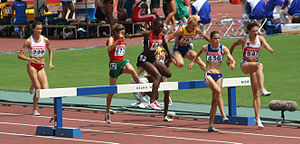
Running 3,000 meters with obstacles , or steeplechase [1] ( eng. Steeplechase - racing with obstacles), is a discipline related to the average distance of a running athletics program . It includes the following elements: running between obstacles, overcoming obstacles and overcoming a pit with water. It requires endurance from athletes, mastery of the technique of overcoming obstacles and tactical thinking. It is carried out only in summer stadiums (without the use of water pits they can also be carried out indoors, but usually only in competitions of a small rank). It is an Olympic track and field discipline for men since 1920 , for women - since 2008 .
Content
- 1 Rules
- 2 Tactics
- 3 History
- 4 Interesting Facts
- 5 records
- 6 notes
- 7 References
Rules
3000 meters hurdles run at a specially profiled distance. In this case, the obstacle (pit with water) is placed on a special turn, so the start of the distance is given from a separate mark, which differs from the start of smooth 3000 meters. The distance includes overcoming a total of 35 obstacles (including 7 water pits), 5 on each lap.
The height of the barriers in men is 914 mm (36 inches ) and in women 762 mm (30 inches). The length of the pit with water is 3.66 meters (12 feet ). The depth of the pit varies from 700 millimeters at the barrier to zero at the edge of the pit. All barriers are fixed, and it is impossible to shift or overturn them.
Tactics
The athlete must distribute the forces over the distance according to the same principles as at medium distances, but taking into account the fact that it is necessary to leave reserves for overcoming obstacles. Depending on the individual characteristics of the training, the athlete can overcome the obstacle with a “barrier step”, that is, without touching the barrier (this is faster, but more energy intensive), or by stepping his foot on the barrier.
History
Like many other running disciplines, the steeplechase comes from England. The first officially recorded results of the distance of 2 miles in the cross-country with obstacles (3218 meters) of athletes from the University of Oxford are referred to the middle of the XIX century [2] .
The 3000 meters hurdle race was first included in the Olympic Games program in 1920 . Until the 1960s, European athletes dominated this discipline. From the 1970s to the present, African runners have taken the lead in this discipline. In the program of the World Cup , women's 3000m hurdling has been included since 2005 . At the Beijing Olympics, women first played medals in this discipline at the Olympics.
Currently, the strongest runners in the 3,000 m hurdles for men are athletes from Kenya , women are athletes from the United States and Kenya.
Interesting Facts
Runners in the steeple chase use special studs that differ from running shoes in other running styles. They are designed to release water that collects after overcoming the water pit [3] .
Records
| Record | Time | Athlete | A country | date of | A place | |
|---|---|---|---|---|---|---|
| Men | World | 7: 53.63 | Saif Saeed Shahin | Qatar | September 3, 2004 | Brussels , Belgium |
| Olympic | 8: 03.28 | Conceslus Kipruto | Kenya | August 17, 2016 | Rio de Janeiro , Brazil | |
| Women | World | 8: 52.78 | Ruth Jebet | Bahrain | August 27, 2016 | Saint Denis , France |
| Olympic | 8: 58.81 | Gulnara Galkina-Samitova | Russia | August 17, 2008 | Beijing China | |
Notes
- ↑ RusAthletics - Russian Athletics
- ↑ A History of the Steeplechase (1849-2004) Archived August 21, 2008 at Wayback Machine URL retrieved at 7/26/2008
- ↑ steeplechase spikes Archived on June 29, 2008. URL retrieved 06/26/2008