The Ile-Alatau State National Natural Park ( Kaz.Ile Alatau memmekett ұlttyқ tabiғi parkі ) was established by a decree of the Government of the Republic of Kazakhstan on February 22, 1996 on the basis of the Kaskelen, Suburban and Turgen forestries within the Karasai , Talgar and Enbekshikazakh districts of Almaty , its purpose preservation of unique landscapes, flora and fauna, improvement of conditions for tourism and recreation, development and implementation of scientific methods of conservation of natural complexes in conditions s recreational use.
| Ile Alatau National Park | |
|---|---|
| kaz. Іле Alatauy ұlttyқ parkі | |
 Big Almaty Lake | |
| IUCN Category II ( National Park ) | |
| basic information | |
| Square | 198 669 ha |
| Established | February 22, 1996 |
| Management organization | Committee for Forestry and Wildlife of the Ministry of Agriculture of the Republic of Kazakhstan |
| Location | |
| A country |
|
| Region | Alma-Ata's region |
| Areas | Karasai district , Talgar district , Enbekshikazakh district , Almaty |
| Nearest town | Almaty |

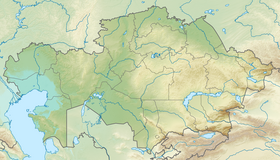


The area of the national park is 198,669 hectares [1] , it is located south of the city of Alma-Ata on the northern slope of the Zailiysky Alatau ( Tien Shan ). The length of its territory from the Chemolgan River in the west to the Turgen River in the east is 120 km, and its width is 30–35 km.
History
The history of the park begins with the creation of the Almaty State Reserve in Zailiysky Alatau in 1931 . Initially, it occupied an area of 15 thousand hectares in the valley of the Malaya Almatinka River , in 1935 after increasing the area to 40 thousand hectares, and then to 856.7 thousand hectares, it became known as Alma-Ata, covering the entire Zailiysky Alatau ridge. Regular scientific research on vegetation cover, forest typology, birds and mammals began to be carried out in this territory [2] .
The first scientific substantiation of the organization of Zailiysky National Park on behalf of the Council of Ministers of the Kazakh SSR of January 3, 1985 was developed in accordance with the program of the Academy of Sciences “Development of conservation in Kazakhstan”. Academicians E. V. Gvozdev and B. A. Bykov were the supervisors [2] .
In 1987, the Department of Biosphere and Ecology Problems of the Kazakhstan Committee for the UNESCO Program “ Man and the Biosphere ” at the Academy of Sciences of the Kazakh SSR, in the framework of the program “Development of conservation in Kazakhstan”, prepared a scientific justification for the “General scheme for the development and placement of objects of the nature reserve fund of the Kazakh SSR until 2005. " This document proposed the creation of the Zaili State National Natural Park on an area of 280 thousand hectares. According to this scheme, the creation of the park was planned in 1995 . In 1990, a feasibility study was developed for the organization of the park [2] . February 22, 1996 by a government decree on the territory of 202,292 hectares Ile-Alatau National Park was created [3] .
Geography
The territory of the park occupies the central part of Zailiysky Alatau with a very difficult terrain. From under the mountain valleys it is seen that many second-order crests departing from the main dividing ridge, separating the main river basins. The last ridges branch and create a system of spurs of smaller orders. This morphological structure determines the direction of the main rivers flowing from the northern slope. They belong to the river basin. Or . However, most of them, having entered the plain, are soon lost in sediment, and the bulk of the runoff is spent by a person on communal, technical, and agricultural needs.
Climate
The climate in the national park is diverse and differentiated by high-altitude climatic zones. Summer is warm, winter is mild due to a pronounced inversion of air temperature . In the foothills, the average January temperature is −7.4 ° C, July + 23 ° C, the frost-free period is 181 days, 560 mm of precipitation falls annually . In the Maloalmatinsky Gorge ( Medeu tract ) at an altitude of 1530 m, the temperature of January is −4.3 ° C, July + 18.1 ° C, the frost-free period is 145 days, 843 mm of precipitation falls annually. At an altitude of 3035 m (Mynzhilki tract), in conditions of eternal snows and glaciers, the average January temperature is −11.3 ° C, July + 7 ° C, the frost-free period is 53 days, 734 mm of precipitation falls annually. In the highland part of Zailiysky Alatau at an altitude of 3750 m, the climate is harsh, there is a lot of rainfall - 800–1300 mm, mainly in the form of snow . The warm period is very short - the average air temperature on glaciers in summer does not exceed + 2.8 ° C [4] .
According to long-term observations, snow cover in the foothills (850 m) is established on December 6, in the middle mountains (1200–2500 m) - a month earlier, in the high mountains (3000 m) - on October 21. In spring, snow melts at different heights and in different mountains from March 10 to May 22. The number of days with snow cover at different heights varies from 111 to 236. The height of the snow cover in the foothills is about 30 cm, in the middle and high mountains it can reach 100 cm [4] .
Zailiysky Alatau stands as a high forward barrier to the path of northern and northwestern moisture-bearing air masses that freely penetrate deep into the mountains in the main valleys, causing a clear differentiation of natural landscapes at altitude. The territory of the park covers low-mountain, mid-mountain and high-mountain landscapes that reflect the tier structure of the mountains.
Relief
The national park is located in the altitude range from 600 to 4540 m above sea level. The highest peak is the peak of the Constitution (4540 m), the second largest - the peak of 25 years of Kazakhstan (4494 m). A few dozen peaks exceed four-kilometer height.
Hydrology
Eternal snows and glaciers are confined to the highest elevations. In the Left Talgar gorge is the Dmitriev Glacier - the largest on the northern slope of the Zailiysky Alatau, its area is 17 km². The Constitution Glacier, the longest (5.7 km) and one of the park’s lowest glaciers, descends to an altitude of 3270 m. At the head of the Malaya Almatinka River is the Tuyuksu Glacier - one of the most studied glaciers in the world. It has been researched since 1902. The glacier moraine is mudflow hazardous; large glacial mudflows of 1956 and 1973 formed on it.
In total, there are 265 large and small glaciers in the Zailiysky Alatau, a significant part of which are located in the park. Many of them give rise to rivers that form an extensive hydrographic network - the Turgen, Issyk , Talgar , Malaya and Bolshaya Almatinki rivers, Karagalinka, Aksai, Kaskelen and their numerous tributaries (Remizovka, Pryamukha, Kotyrbulak, Belbulak, Kamenka, Rakhatka, etc.). The main rivers flow in rapid gushing streams in deep gorges. They have snow-ice nutrition with spring and summer floods. Both rivers and most of their tributaries are mudflow hazardous. The water in them is clean most of the year, but in the summer during the flood period it becomes cloudy, with a large amount of bottom sediment. At the source of all major rivers there are moraine lakes, which begin to fill in June, and by the beginning of winter, the water in them disappears. At an altitude of 2500 m, there is a large permanent reservoir - the Big Almaty Lake . Its hollow is of tectonic origin and is replenished with the runoff of the Ozernaya River and a number of small tributaries. The area of the lake is about one square kilometer, the depth is reached 39.3 m.
In the zones of underground faults, thermal springs come to the surface. The spring waters belong to two balneological types: radon and siliceous-thermal. The first includes the Almaarasan sources located in the basin of the Bolshaya Almatinka river, on the basis of which the resort was created, and the second - the Gorelnikovsky and Tauturgen sources.
The soil cover is mainly represented by soils of mountain slopes, only in the lowlands, mainly in their middle and lower parts, in some places there are small island masses of chernozems. Soils in violation of the vegetation cover are easily susceptible to erosion and landslide processes.
Flora
The flora of the natural park has more than 1000 species , most of which falls on the flora of the forest mid-mountain zone. More than 500 are concentrated in deciduous forests, and more than 400 species of higher plants in spruce forests. 36 species are listed in the Red Book .
In the lowlands there are Ostrovsky tulip , Mushketov’s hen , Alberta iris , Sivers apple tree , Altai gymnosperm ; in the midlands - orange jaundice , Corydalis Semenov , Almaty ostracodus, Semenov's cortus ; in the highlands - Falconer’s liverwort , Tien Shan Siberian , Kumbelskaya hawk , Shvangtangia nigra , Sossurea wrapped . Mosses listed in the Red Book need special protection - large-leaved pachyphydens and smoothed ortotrichum . In the Kok-Zhailau tract you can meet the Red Book saffron Alatau ( Crocus alatavicus ).
Of the many useful plants, a group of fodder plants (more than 80 species) is of great interest: hairy cobresia , narrow-leaved sedge , Krylova fescue , Alpine bluegrass and meadow bluegrass , Tien Shan fescue , hedgehog combined , pinnate short-legged , types of regeneration, clover , rank , pea .
Of the tannins, the most valuable are different types of sorrel , highlander, and rhubarb. Of essential oils - angelica , junipers , wormwood . As natural dyes, cuffs, bedstraws , macrotonium , etc. can be used.
Medicinal plants are widespread: tansy , yarrow , coltsfoot , dogrose , joster , valerian , juniper , dandelion , plantain , etc.
From food, they are especially valuable: apricot , apple tree , raspberry , currant , wild strawberry , bony , blackberry , barberry , sea buckthorn , mountain ash , hawthorn , dog rose .
Ornamental plants are numerous: primroses , watersheds , tulips , irises , small petals , bluebells , gentians , violets , various types of trees and shrubs.
Fauna
The wildlife of the park is rich and diverse. The invertebrate fauna has not yet been fully studied. However, to date, more than 2000 species from 8 classes are already known.
Partially revealed the composition of some units of the class of insects. So, from the order of beetles 252 species of ground beetles were studied, 180 - staphylinids, 102 - leaf beetles; from the order of Lepidoptera, or butterflies - 145 species of diurnal butterflies; from the order of hymenoptera - 110 species of bee, 97 - digging wasps, 33 - ants and 30 riders. Of all this diversity, only 24 species are included in the Red Book of Kazakhstan, among which 3 species of mollusks ( bradyben senestorza , pseudonapeus Shnitkova and Turkomilax Tsvetkova ). The rest belong to the class of insects: a noticeable mace , a beauty girl (dragonfly squad), a small-winged bolivaria (praying mantis), a steppe hawk , dyeing Semyonov , Yershov 's yellowness , hipromilius , and patrician .
The vertebrate fauna is represented by 245 species. In mountain rivers and streams, 8 species of fish are found: naked and scaly ottoman, marinka , minnow , and in the Turgen river - acclimatized rainbow trout .
There are 4 species of amphibians, two of which ( Danatian toad and Central Asian frog ) are listed in the Red Book of Kazakhstan.
Of the eight species of reptiles, lizards ( Alai hologlaz and multi-colored foot- and -mouth disease ) are common, as well as snakes - ordinary and water snakes, multi-colored and patterned snakes. Poisonous snakes are more rare - the steppe viper and the muzzle .
A variety of natural conditions determines the species richness of birds. In total, 178 species were recorded in the national park. By the nature of their stay, they are divided into three groups: nesting - 105 species, arriving for wintering - 18, migratory - 55 species. 11 species are included in the Red Book ( black stork , dwarf eagle , golden eagle , kumai , shahin , sickle-beak , eagle owl , saker - flying; peregrine falcon , and large lentils - wintering).
Mammals 47 species. Typically mountainous include: Tien Shan shrew , rock shrew , red pika , gray groundhog , Tien Shan mousy , silver vole , stone marten , snow leopard , mountain goat .
Along with typical mountains, the park also has species common to other ecosystems: wolf, fox, bear, roe deer , red deer , wild boar , tolai hare , etc. There are 7 species of the Red Book group: brown Tien Shan bear, snow leopard , stone marten , Central Asian river otter , manul , Turkestan lynx and Indian porcupine .
Attractions
On the territory of the park, burial mounds of the Early Iron Age were preserved on the Assy plateau and near the Turgen Gorge, Saki burials along the banks of the Issyk River.
On the right bank of the Turgen River, traces of a strong earthquake that occurred here more than 10 thousand years ago were discovered. This clastic stratum in the form of bizarre rocks and various colors is a real natural monument.
Relict moss Chinturgen spruce forests are also a natural monument, where permafrost islands with an ice thickness of 2-3 m are preserved under moss cover at a depth of 30-40 cm. Permafrost massifs located at such a low height are not found anywhere else in Zailiysky Alatau. The mountain landscape is unique, reminiscent of the cold desert of the Inner Tien Shan, which is located on the axial part of the ridge on the Pass Pass.
Park Area
Despite the conservation status of the national park, conservation lands were alienated from the territory originally assigned to it, which significantly reduced its area.
- The park area at the time of establishment by the Decree of the Government of the Republic of Kazakhstan No. 228 dated February 22, 1996 was 202,292 ha [5] .
- According to the Decree of the Government of the Republic of Kazakhstan No. 1074 dated November 10, 2006, the park area decreased and amounted to 199,703 ha [6] [7] .
- According to the Decree of the Government of the Republic of Kazakhstan dated November 10, 2012 No. 1408, 29.4597 ha were alienated from the park to the reserve land of the Almaty region from the category of land of specially protected natural territories to the category of reserve land. The area of the park in connection with the disposal amounted to 199673.5 ha [8] .
- According to the website of the Committee for Forestry and Hunting of the Ministry of Agriculture of the Republic of Kazakhstan for 2010, the park area is 170 920 ha [9] .
- In November 2013, it became known that the RSI "Ile-Alatau State National Natural Park" issued for private long-term use of the land of the national park for the construction of tourist and recreational activities. So, 75 hectares of land located in the Kokbastau forestry of the Talgar branch of the park went to KazMunaiGas - Processing and Marketing JSC, 48 hectares of land went to Ben Lux LLP, about 21 hectares of land in the Kaskelen forestry of the Aksai branch of the park went to Timur farm. Ustyurt LLP got 15 hectares of land in the Big Almaty Forestry of the Medeu branch of the park, Zolotaya Payza LLP (3 hectares of land for building a guest house), Taimas-777 LLP (2 hectares of land for building a guest house), LLP EnergoStroyTekhMontazh »(1 g а земли для строительства гостевого дома), ТОО «Asia Vega Nour» (0,7 га земли для строительства гостевого дома) и ТОО «Алатау Маралы» (3 га земли под туристический комплекс) [10] .
- In 2014, it became known about plans to transfer 1002 [11] hectares of reserved lands of the Ile-Alatau National Park (Kok-Zhailau tract) to the category of “reserve land” with the aim of building a new ski resort Kok-Zhailau on them . However, during the construction phase, damage to existing green spaces, mainly from Schrenka spruce , in the development sites of the resort center and resort villages is inevitable . The area of forested lands falling into the development zone is 21.5 hectares, of which 2.3 hectares of natural plantations, 19.2 hectares of artificial ones. In connection with the construction, 22,644 trees fall under felling [12] .
- In December 2014, the lands of the specially protected natural areas of the Ile-Alatau State National Natural Park Republican State Agency were transferred with a total area of 1002.0 hectares to the category of reserve lands of the Medeu district of Almaty for the construction of the Kok-Zhailau resort, in accordance with the decree of the Government of the Republic Kazakhstan dated December 2, 2014 No. 1267 [13] .
Kok-Zhailau tract
The Kok-Zhailau tract, which is one of the most accessible and favorite vacation spots of Almaty residents, is on the verge of destruction. 1002 hectares of nature-protected lands were expelled from the Kok-Zhailau tract located on the territory of the Ile-Alatau park, where the city akimat planned the construction of a ski resort with many hotels and infrastructure. The actions of the officials caused public outrage [14] , 16,500 signatures were collected against the construction of the tract, but the authorities did not abandon their plans.
See also
- Alma Arasan Gorge
- Massacre in Ile-Alatau National Park
Notes
- ↑ On approval of the list of specially protected natural territories of republican significance
- ↑ 1 2 3 Ile-Alatau State National Natural Park. - Almaty, 2015 .-- S. 17-21. - 208 p. - ISBN 978-6017059-70-5 .
- ↑ Decree of the Government of the Republic of Kazakhstan dated February 22, 1996 No. 228 “On the Creation of the Ile-Alatau State National Natural Park in the Almaty Region”
- ↑ 1 2 Ile-Alatau State National Natural Park. - Almaty, 2015 .-- S. 25-26. - 208 p. - ISBN 978-6017059-70-5 .
- ↑ Ivashchenko A.A. Nature reserves and national parks of Kazakhstan. - Almaty: Almatytap, 2006. - S. 216—223. - 281 p. - ISBN 9965-24-755-2 .
- ↑ Satimbekov Rysbai. Biology textbook for 11th grade .. - Almaty: "Mektep", 2007. - S. 192—193. - 224 p. - 40,000 copies. - ISBN 9965-36-180-0 .
- ↑ On approval of the list of specially protected natural territories of republican significance dated November 10, 2006 N 1074 . Archived October 12, 2013.
- ↑ On the transfer of certain land plots of specially protected natural territories to the lands of the reserve of the Almaty region dated November 10, 2012 No. 1408 . Archived October 12, 2013.
- ↑ Minors of the district visited Ile-Alatau Park . Archived on October 9, 2013.
- ↑ Who got the lands of the Ile-Alatau National Park? . Archived December 19, 2013.
- ↑ Sergey SKLYARENKO: Putting into stock 1002 specially protected hectares for the construction of the Kok-Zhailau resort (Unavailable link) . Archived on April 19, 2014.
- ↑ Defend Kok-Zhailau, one of the most popular places in the Ile-Alatau National Park! . Archived March 11, 2014.
- ↑ Resolution On the transfer of certain land plots of specially protected natural territories to the lands of the reserve city of Almaty for the construction and operation of a tourism object (inaccessible link) . Date of treatment February 20, 2015. Archived on February 20, 2015.
- ↑ OPINIONS OF LEADING EXPERTS: KOK-JAYLAIU SHOULD BE DEFINED unopened (inaccessible link) . Archived March 3, 2018.
Literature
- Ivashchenko Anna Andreevna . Nature reserves and national parks of Kazakhstan. - Publishing house "Almatykitap", 2006. - 281 p. - ISBN 9965-24-755-2 .
- Satimbekov Rysbai . Biology, a textbook for 11 classes. - Publishing house "Mektep", 2007. - 224 p. - ISBN 9965-36-180-0 .