English sweat , or English sweating fever ( Latin sudor anglicus , English sweating sickness ) is an infectious disease of unclear etiology with a very high mortality rate, which visited Europe several times (primarily Tudor England ) in 1485-1551.
| English sweat | |
|---|---|
| ICD-9 | 078.2 |
| Mesh | D018614 |
Content
- 1 epidemics
- 2 High-ranking victims
- 3 Symptoms and course
- 4 reasons
- 5 notes
- 6 Literature
Epidemics
The "English sweat" was most likely of non-English origin and came to England with the Tudor dynasty. In August 1485, Heinrich Tudor, who lived in Brittany , Earl of Richmond , landed in Wales , defeated the Battle of Bosworth, Richard III , entered London and became King Henry VII. Behind his army, consisting mainly of French and Breton mercenaries, the disease was on the heels. In the two weeks between the landing of Henry on August 7 and the battle of Bosworth on August 22, she had already managed to manifest. In London, over a month (September - October), several thousand people died from it. Then the epidemic subsided. The people took it as a bad omen for Henry VII: “he was destined to rule in agony, a sign of this was a sweating illness at the beginning of his reign” [1] .
In 1492, the disease came to Ireland as an English plague ( Irl. Pláigh allais ), although a number of researchers claim (referring to the absence of indications of sweat as a symptom in the sources) that it was typhoid .
In 1507 and 1517, the disease flared up again throughout the country: half of the population died at university Oxford and Cambridge . Around the same time, English sweat penetrated the continent, in Calais (then English possession) and Antwerp , but so far these were only local outbreaks.
In May 1528, the disease appeared in London for the fourth time and was rampant throughout the country; Henry VIII himself was forced to dissolve the courtyard and leave the capital, often changing his residence. This time, the disease seriously spread to the continent, first appearing in Hamburg , then reaching Switzerland south, and through the Holy Roman Empire east to Poland , the Grand Duchy of Lithuania and the Grand Duchy of Moscow ( Novgorod ), and to the north to Norway and Sweden . Usually everywhere an epidemic lasted no more than two weeks. France and Italy remained untouched by it. By the end of the year, she disappeared everywhere except in the east of Switzerland, where she stayed until next year.
The last outbreak occurred in England in 1551. The famous physician John Keyes (Latinizing his last name Keys as Caius - Guy) as a witness described it in a special book: A Boke or Counseill Against the Disease Commonly Called the Sweate, or Sweatyng Sicknesse .
In the eighteenth and nineteenth centuries a similar disease appeared in France, known as the "Picardian sweat," but it was still a different disease, because, unlike the English sweat, it was accompanied by a rash .
Senior Victims
Among the victims of the first outbreak in 1485 were two Lord Mayors of London , six aldermen and three sheriffs .
Several times the disease struck people close to the Tudor royal family. Arthur, Prince of Wales , the eldest son of Henry VII, died in 1502 from her . It is believed that the future (at that time) wife of Henry VIII Anna Boleyn survived the "English sweat" and recovered during the epidemic in 1528 .
During the last outbreak in the summer of 1551, promising 16-year-old and 14-year-old boys, children of Charles Brandon , 1st Duke of Suffolk , who was married to Henry VII's daughter and Henry VIII's sister , died from her, promising 16-year-old and 14-year-old boys. Maria Tudor (they were not born from her, but from a marriage with Katherine Willoughby ). At the same time, Charles Brandon, Jr., who survived his elder brother for an hour, during this hour was a peer (3rd Duke of Suffolk).
Symptoms and course
The disease began with severe chills , dizziness and headache , as well as severe pain in the neck, shoulders and limbs. After three hours of this stage, fever and intense sweat , thirst , increased heart rate, delirium , heart pain began. There were no rashes on the skin. A characteristic sign of the disease was severe drowsiness , often preceding the onset of death after an exhausting sweat: it was believed that if a person was allowed to fall asleep, he would no longer wake up.
Once having suffered from sweating fever, a person did not develop immunity and could die from the next attack.
Francis Bacon in the "History of the reign of Henry VII" describes the disease as follows:
Around this time in the fall, at the end of September, in London and other parts of the kingdom an epidemic of an unknown disease spread, which, by its manifestations, was called a "sweating ailment." This disease was transient both in each individual case of the disease, and in the sense of the duration of the disaster as a whole. If the sick person did not die within twenty-four hours, then a successful outcome was considered almost ensured. As for the time that elapsed before the disease ceased to rage, its spread began around September 21, and ceased before the end of October - it, therefore, did not interfere with the coronation that took place in the last days of this month, nor (what else more important) a parliamentary meeting that began only seven days after that. It was a plague, but apparently not carried by blood or juice throughout the body, for the disease was not accompanied by carbuncles, purple or bluish spots, and the like manifestations of infection of the whole body; it all boiled down to the fact that corrupting fumes reached the heart and hit the vital centers, and this prompted nature to efforts aimed at removing these fumes through increased sweating. Experience has shown that the severity of this disease is associated more with the suddenness of the lesion than with the intractability of treatment, if the latter was timely. For if the patient was kept at a constant temperature, making sure that clothes, hearth, and drink were moderately warm and supported by heart means, so that neither nature encourages warmth to excessive work, nor suppresses it with cold, then he usually was recovering. But countless people died from her suddenly before treatment and care methods were found. This disease was considered not contagious, but caused by harmful impurities in the composition of the air, the effect of which was enhanced due to seasonal predisposition; its rapid cessation also spoke of the same [1] .
Reasons
The reasons for the "English sweat" remain mysterious. Contemporaries (including Thomas More ) and the closest descendants (see the quote from Bacon above) associated it with dirt and some harmful substances in nature. Sometimes it is identified with relapsing fever , which is carried by ticks and lice , but sources do not mention the characteristic traces of insect bites and the resulting irritation. Other authors bring the disease closer to hantavirus , which causes hemorrhagic fevers and pulmonary syndrome , similar to "English sweat", but it is rarely transmitted from person to person, and this identification is also not universally recognized.
Notes
- ↑ 1 2 Bacon. History of Henry VII
Literature
- Bacon F. History of the reign of King Henry VII / Francis Bacon; Article and commonly ed. M.A. Barga ; Per. V. R. Rokityansky , N. A. Fedorov, A. E. Yavrumyan ; Comment V.R. Rokityansky. - M .: Nauka , 1990 .-- 328 p. - ( Monuments of historical thought ). - 25,000 copies. - ISBN 5-02-008973-7 .
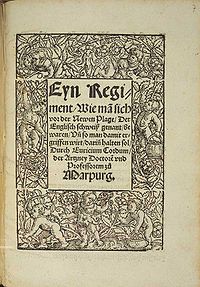
- Karl Sudhoff: Ein Regiment gegen den “Englischen Schweiß” (sudor anglicus). Fliegendes Blatt aus dem Schweißsuchtjahr 1529, in: ArchGeschMed 1, 1907, S. 72
- Gunter Mann: Euricius Cordus. Der Englische Schweiß. 1529 hrsg. und mit einem Nachwort von G. Mann, Marburg, 1967
- G. Thwaites, M. Taviner, V. Gant: The English Sweating Sickness, 1485 to 1551. In: The New England Journal of Medicine, 336.1997; S. 580-582
- E. Bridson - “The English 'sweate' (Sudor Anglicus) and Hantavirus pulmonary syndrome” in Br J Biomed Sci. 2001; 58 (1): 1-6.