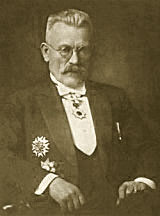
Gustav Jon Ramstedt , ( Swede Gustaf John Ramstedt ; October 22, 1873 , Ekenes - November 25, 1950 , Helsinki ) - Finnish linguist and diplomat, specialist in historical linguistics of the Ural , Altai , Korean and Japanese languages. The founder of the comparative historical Mongolian and modern Altai linguistics. Swede by birth.
| Gustav Jon Ramstedt | |
|---|---|
| Swede. Gustaf john ramstedt | |
 | |
| Date of Birth | October 22, 1873 |
| Place of Birth | Ekenes |
| Date of death | November 25, 1950 (aged 77) |
| Place of death | Helsinki |
| A country | Russian Empire , Finland |
| Scientific field | philology , altaistics , mongolistics |
| Place of work | University of Helsinki , Tokyo University |
| Alma mater | University of Helsinki |
| supervisor | Setalia, Emil Nestor |
| Famous students | Aalto, Pentti |
| Known as | Mongolist , Japanese , Korean historian , one of the founders of comparative historical linguistics |
Biography
He graduated from the University of Helsinki, after which he taught at a gymnasium in the city of Turku. He studied Finno-Ugric languages at the University of Helsinki under the guidance of E.N. Setyal. Later he became interested in Altai languages and went on an expedition to Mongolia to study them. Later he became an extraordinary professor of Altai languages at the same university.
In 1904, together with Mongolist Andrei Rudnev, he traveled to the Kalmyk steppes as part of an expedition organized by the Russian Committee to study Central and East Asia.
During expeditions to Mongolia, Ramstedt made friends with the Buryat Aghvan Dorzhiev , the plenipotentiary of the Dalai Lama XIII . For this reason, Ramstedt was one of the few foreigners granted the right to visit Lhasa , but further events prevented his trip to Tibet . In 1911, the Mongolian delegation in St. Petersburg asked Ramstedt to mediate in negotiations with the tsarist government to grant Mongolia autonomy within China . Ramstedt managed to convince the Russian government of the good intentions of the Mongols, as a result of which 15,000 modern rifles were delivered to Mongolia to support the Mongolian national liberation movement against China.
In 1912 , when Ramstedt was in Urga , influential Mongol leaders Da Da Lama , Handdorj Chinwan and Khaysan -gun turned to him for help in negotiations with Russian representatives who opposed the intentions of the Mongolian administration to unite Outer Mongolia , Uryanhai , Inner Mongolia and Buryatia into a single Mongolian state. In response, Ramstedt recommended that the Mongols apply for international recognition of the Mongol state to countries such as Japan , Britain , Germany , the United States and France . Ramstedt was not aware of the secret agreement between Russia and Japan , where the parties agreed that Inner Mongolia would remain part of China.
After the declaration of independence of Finland, he became the first ambassador of Finland to Japan in the rank of “charge d'affaires” from 1920 to 1929 , and during this period he repeatedly lectured at Tokyo University . He influenced such Japanese linguists as Kunio Yanagita , Izuru Shimura , Kyosuke Kindaichi and Simpei Ogura . He also led the Finnish Esperanto Society.
Scientific activity
In 1902 he defended his thesis "On the conjugation of the Khalkha-Mongolian language." From 1898 to 1912, he made a number of linguistic expeditions, during which he collected material on the Mountain Mari language, the dialects of the Lower Volga Kalmyks, visited Afghanistan and Chinese Turkestan . He studied the ancient Turkic and Mongolian dialects. He taught at the University of Helsinki from 1917 to 1919 and from 1930 to 1934.
Since 1943, he served as First Vice President of the Finno-Ugric Society.
Ramstedt is the author of fundamental works on Altai linguistics . Having criticized the hypothesis of the Ural-Altai genetic kinship , Ramstedt included Korean and Japanese in the circle of Altai languages . Gustav Ramstedt's research in the field of Turkic-Mongolian linguistic relations was aimed at the reconstruction of the Turkic-Mongolian base language. In his work, "Introduction to Altai Linguistics" examines the morphology of Altai languages. Based on examples of Turkic, Mongolian, Tungus-Manchu and Korean languages, he analyzes grammatical forms and, on the basis of linguistic patterns, derives a general formula that is characteristic of the Altai basic language.
In the last years of his life, Gustav Ramstedt devoted writing generalizing works on the comparative historical study of grammars of Altai languages.
Publications
- Grammar of the Korean language, trans. from English., M., 1951.
- Introduction to Altai linguistics. Morphology, the lane with it., M., 1957.
- Comparative phonetics of the Mongolian written language and Khalkha-Urginsky dialect, St. Petersburg, 1908.
- Kalmückisches Wörterbuch, Hels., 1935; Einführung in die altaische Sprachwissenschaft, Bd 1-3, Hels., 1952-66.
- Bergtscheremissische Sprachstudien , Helsinki, 1902 (Hill)
- A Korean grammar. Helsinki: Suomalais-ugrilainen Seura, 1939.
- Einführung in die altaische Sprachwissenschaft , 'Introduction to Altaic Linguistics', 2 volumes. Helsinki: Suomalais-Ugrilainen Seura, 1952-1957.
Literature
- Poppe, Nicholas. “Obituary: Gustav John Ramstedt 1873-1950.” Harvard Journal of Asiatic Studies 14, no. 1/2 (1951): 315-22.
- Henriksson K. E., Sprachwissenschaftliche Veröffentlichungen von Prof. Dr. GJ Ramstedt, "Studia Orientalia", 1950, v. 14, No. 12;
- Poucha P., GustafJohn Ramstedt. (Ein Nachruf), Archiv Orientální, 1951, t. 19, No. 3-4.