Hydroquinone (para-dihydroxybenzene, benzene-1,4-diol, quinol) is an aromatic organic compound , a representative of diatomic phenols with the chemical formula C 6 H 4 (OH) 2 , the isomer of catechol and resorcinol . The name " hydroquinone " was given to the compound by F. Wöhler because of the similarity of properties with quinone , from which Wöhler synthesized it. A strong reducing agent , used as a developer in photography, an antioxidant in the chemical industry, a reagent for the determination of niobium , tungsten , gold and cesium in analytical chemistry.
| Hydroquinone | |
|---|---|
 | |
  | |
| Are common | |
| Systematic name | benzene-1,4-diol |
| Chem. formula | C 6 H 6 O 2 |
| Physical properties | |
| Molar mass | 110.11 g / mol |
| Density | 1.36 g / cm³ |
| Ionization energy | |
| Thermal properties | |
| T. melt. | 173.8—174.8 ° C |
| T. bale. | 286.5 ° C |
| T. aux. | 165 ° C |
| Steam pressure | |
| Chemical properties | |
| Solubility in water | 5.26 g / 100 ml (5 ° C) 21.21 g / 100 ml (50 ° C) 56.25 g / 100 ml (70 ° C) |
| Solubility in alcohol | 127.27 g / 100 g |
| Acetone solubility | 77.94 g / 100 g |
| Classification | |
| Reg. CAS number | 123-31-9 |
| PubChem | |
| Reg. EINECS number | |
| Smiles | |
| Inchi | |
| RTECS | |
| Chebi | |
| ChemSpider | |
| Security | |
| LD 50 | 302 mg / kg (rat, oral) |
| GHS icons |     |
| NFPA 704 |  one 2 one |
Trade name: H-142 [2] .
Content
History
J. B. Cavantou (left) and P. J. Pelletier (right), who first received hydroquinone | ||||||||||
It was first isolated by French chemists Pierre Joseph Pelletier and Joseph Bienné Cavantou during the distillation of quinic acid in 1820. The synthesis of hydroquinone was first carried out by Friedrich Wöhler in 1844 with the restoration of quinone. Wöhler also gave it a modern name and described its properties [3] .
In 1880, William Ebney discovered the manifesting properties of the compound, which led to the development of industrial synthesis methods. Further experiments with hydroquinone led to the development of developers with two developing substances. The first of these developers was received by Henry J. Newton in 1889, adding hydroquinone to an eiconogen developer, and obtaining the final composition, which used the best properties of both developing substances. Soon after, methol-hydroquinone developers (designated by MQ symbols in English sources) were proposed, in which the phenomenon of super-additivity was noticed - the effect when a developer with two different developing substances works much more actively than it should be, based on the calculation of the sum the activity of both developing substances. The effect of superadditivity was confirmed and justified by the scientific work of Levenson in the late 1940s, which showed that in this case the image is developed by metol, and the role of hydroquinone is to regenerate spent metol [4] [3] .
The discovery by J. D. Kendall of the manifesting ability of phenidone in 1940 led to the creation of an even more effective system of phenidone-hydroquinone developers ( PQ in English literature). Phenidone is not very suitable for use as the only developing substance, since it gives strong veiling of photographic material, but in super-additive developers with hydroquinone this feature disappears, giving a high-quality final image, a significant acceleration of the processing process, lower toxicity, and other advantages compared to metol-hydroquinone compounds [5] [6] .
Physical Properties
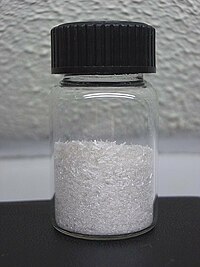
White or colorless prismatic crystals, sweetish in taste [7] [8] . It has modifications that differ in physical properties: a stable α-modification has a melting point of 173.8–174.8 ° C and a density of 1.36 g / cm 2 , an unstable γ-modification has a melting point of 169 ° C and a density of 1.325 g / cm 2 . Has a molar mass of 110.11 g / mol, boiling point 286.5 ° C, flash point 165 ° C. It sublimates at 163.5 ° C (10 mmHg) [8] .
Soluble in water (5.26 g / 100 ml at 5 ° C, 21.21 g / 100 ml at 50 ° C, 56.25 g / 100 ml at 70 ° C), alcohol (127.27 g / 100 g ), acetone (77.94 g / 100 g). Forms clathrates . In particular, the clathrate with methanol has the formula 3C 6 H 6 O 2 · CH 3 OH [8] .
The reagent may contain impurities that look like insoluble black powder. The amount of impurities increases with prolonged or improper storage and with a large number of impurities, the reagent becomes unusable [9] .
Chemical Properties
It is a strong reducing agent. The process of interaction with oxidizing agents takes place in two stages: in the first, hydroquinone is converted into a quinhydron, in the second, into 4-benzoquinone [8] .
When interacting with an aqueous solution of potassium carbonate at 130 ° C, it turns into 2,5-dihydroxybenzoic acid, forms 4-methylaminophenol with methylamine under pressure at 200 ° C, naphthazarin with maleic anhydride , and gives quinizarin with phthalic anhydride . It forms simple mono- and diesters when treated with alkylating reagents [8] .
Analytical Definition
Hydroquinone can be determined using color reactions [8] :
- the appearance of a color from yellow-green to golden when heating hydroquinone to 100 ° C with sodium nitrite and dilute sulfuric acid . When sodium hydroxide is added , the color changes to yellow-brown [8] ;
- the appearance of a dark red color with the addition of nitric acid , gradually turning into yellow color [2] .
Photographic manifestation
It has manifesting properties, restoring silver bromide in alkaline solutions with the formation of 4-benzoquinone and hydrogen bromide [10] with the general equation:
- + 2 AgBr + 2 Ag + 2 HBr
Manifestation begins at a pH above 9.5 [11] . The process consists of several stages [12] :
- in an alkaline environment, hydroquinone dissociates into the hydroquinone dianion [13] :
- + 2H +
- the hydroquinone dianion is oxidized at the center of manifestation with the formation of the semiquinone ion and 4-benzoquinone in the second [14] :
- silver ions are reduced to metallic silver [14] :
- 2Ag + + 2e - 2Ag
Getting
Hydroquinone was originally derived from quinone . Different versions of this method are still used for laboratory production of the reagent; for this, for example, the aqueous solution of 4-benzoquinone is reduced using sulfur dioxide [8] [15] .
In industry, synthesized in the following ways [8] :
- oxidation of 1,4-diisopropylbenzene with air, then acid hydrolysis of the obtained bis-hydroperoxide is carried out with the formation of hydroquinone and acetone;
- hydroxylation of phenol with 70% hydrogen peroxide at 90 ° C using 75% orthophosphoric acid or 65% perchloric acid as catalysts. As a result of the reaction, a mixture of hydroquinone and pyrocatechol is formed, which is further separated by distillation;
- the interaction of phenol and acetone with the formation of 4-isopropylphenol, which is oxidized with hydrogen peroxide in an acidic environment with the formation of hydroquinone and acetone;
- by oxidation of aniline sulfate with manganese dioxide or chromic acid to 4-benzoquinone, then 4-benzoquinone is reduced with powdered iron in water at 70–80 ° С in the presence of sodium hydrosulfite with a total reaction yield of 74–84%.
Technical conditions for the production of hydroquinone in the USSR and the Russian Federation are established by GOST 19627-74 [16] . In accordance with it, two grades of reagent are produced - the highest and the first. Top grade looks like a white or grayish-white powder and contains 99.5% of the main substance, the first - as white with a yellowish tint and contains 99% of the main substance [17] .
Although industrial production usually produces a sufficiently pure reagent, but if necessary, a greater degree of purification can be obtained by recrystallizing a commercial reagent from carefully deoxygenated water [18] .
Assessment of US production capacity for hydroquinone production amounted to about 11.3 thousand tons per year (as of 1965) [19] .
Application
Applicable:
- in analytical chemistry to determine the pH and some metal ions [8] ;
- in photography as a developing substance [8] ;
- in the production of organic dyes , medicines, photographic materials as raw materials [8] ;
- in the manufacture of food products and rubbers as an antioxidant [8] ;
- used in cosmetics for tanning and as a hair dye;
- in cosmetic medicine for skin whitening. Due to carcinogenicity, its use is limited. [20] ;
- as an inhibitor of the polymerization of vinyl monomers [8] , including for methyl methacrylate used in the composition of dental chemical curing composite materials.
Application in analytical chemistry
Used when [8] :
- photometric determination of niobium and tungsten;
- titrimetric determination of gold and cesium ions;
- when determining the pH using the method of the quinidron electrode , for which quinidron is prepared in the form of an equimolar mixture of quinone and hydroquinone.
Photo Application
As the only developing substance, it is usually used only in special developers intended for obtaining high optical density, for example, for reproduction or printing purposes, or for obtaining a brown color on silver-bromine photo paper [17] .
Compositions with hydroquinone are sensitive to temperature changes: the optimum is 18 ° C, at 19 ° C the speed is normal, but already at 20 ° C veiling begins; when the temperature drops to 10 ° C, the manifestation practically stops and when it reaches 5 ° C it stops completely [17] .
It is usually used in developers together with metol or phenidone, while the veiling ability inherent in hydroquinone disappears [17] .
Legal Status
As of 2006, it is known about the prohibition of drugs in Nigeria containing more than 5% hydroquinone due to their misuse, as well as the existence in Germany of restrictions on the use of drugs with hydroquinone, where they can only be used for cases of pathological pigmentation and not can be used for children and adolescents under 12 years of age [20] .
Biological role
It has a weak disinfecting effect similar to that of phenol [8] .
Security
Toxic LD50 is 302 mg / kg (rat, oral). When ingested, up to 4-benzoquinone is oxidized, converting hemoglobin to methemoglobin . It can cause eye damage - conjunctivitis , and skin - dermatitis . MPC for aerosol is 2 mg / m 3 . NFPA rating 704 : health hazard: 2, flammability: 1, instability: 1. Carcinogenicity in animals with unknown relevance to humans has been confirmed [21] [8] [2] .
Notes
- ↑ 1 2 http://www.cdc.gov/niosh/npg/npgd0338.html
- ↑ 1 2 3 Gurlev, 1988 , p. 278.
- ↑ 1 2 Still, 1976 , p. 485.
- ↑ Suzuki, 2006 , p. 385.
- ↑ Allen, 2011 , p. 257.
- ↑ Suzuki, 2006 , p. 385-386.
- ↑ Medvedev, 1929 .
- ↑ 1 2 3 4 5 6 7 8 9 10 11 12 13 14 15 16 17 Karpova, 1988 .
- ↑ Gurlev, 1988 , p. 279.
- ↑ Redko, 2006 , p. 855.
- ↑ Redko, 2006 , p. 856.
- ↑ Redko, 2006 , p. 863-864.
- ↑ Redko, 2006 , p. 863.
- ↑ 1 2 Redko, 2006 , p. 864.
- ↑ Pryanishnikov, 1956 , p. 112.
- ↑ GOST .
- ↑ 1 2 3 4 Gurlev, 1988 , p. 278-279.
- ↑ Still, 1976 , p. 488.
- ↑ Still, 1976 , p. 487.
- ↑ 1 2 UN, 2006 , p. 116.
- ↑ Fisher Scientific .
Literature
- Gurlev D.S. Reference book on photography (processing of photographic materials). - K .: Tekhnika, 1988 .-- 335 s. - ISBN 5-335-00125-4 .
- Karpova N. B. Hydroquinone: article // Chemical Encyclopedia / Editorial: Knunyants I. L. et al. - M .: Soviet Encyclopedia , 1988. - T. 1: A — Darzan. - S. 570. - 623 p.
- Medvedev S. Hydroquinone: article // Technical Encyclopedia / Ch. ed. Martens L.K. - M .: Joint Stock Company "Soviet Encyclopedia", 1929. - V. 5. - P. 569.
- Monomers for polycondensation / ed. J. Still , T.W. Campbell ; per. from English Vygodsky, Y. S., ed. Korshak V.V. - World, 1976.
- Pryanishnikov N.D. Workshop on Organic Chemistry. - M .: State Scientific and Technical Publishing House of Chemical Literature, 1956. - 244 p.
- Redko A.V. Chemistry of Photographic Processes. - SPb. : NPO Professional, 2006. - S. 837-954. - 1464 s. - (New reference book of a chemist and technologist / ed. A. Moskvin; issue. General information. The structure of the substance. Physical properties of the most important substances. Aromatic compounds. Chemistry of photographic processes. Nomenclature of organic compounds. Laboratory work technique. Fundamentals of technology.). - ISBN 978-5-91259-013-9 .
- ST / ESA / 282: Consolidated list of goods for which consumption and / or sale is prohibited, which are seized, severely restricted or not approved by governments. Medicines - eighth edition. - New York: United Nations , 2006.
- Allen E., Triantaphillidou S. The Manual of Photograpy . - 10th edition. - 2011.
- Suzuki R. Developing processes: article // Encyclopedia of twentieth-century photography / Warren L., editor. - New York: Routledge: Tailor & Francis Group LLC, 2006. - T. Volume 1: A — F Index. - S. 382-389.
Links
- GOST 19627-74 Hydroquinone (paradoxibenzene). Specifications (with Changes N 1, 2, 3). . USSR State Committee for Standards . Date of treatment November 19, 2017.
- Tishchenko V.E. , Mendeleev D.I. , Lipsky A.A. Hydroquinone // Brockhaus and Efron Encyclopedic Dictionary : 86 volumes (82 volumes and 4 additional). - SPb. , 1890-1907.
- Hydroquinone, Lab Grade. Safety Data Sheet . Fisher Scientific. Date of treatment November 19, 2017.