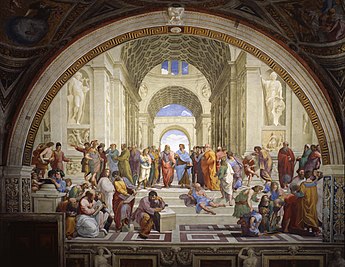
“Athenian School” ( Italian: Scuola di Atene ) - a fresco by Raphael in the stella della Senyatura of the Vatican Palace .
| ||
| Raphael Santi | ||
| Athenian school . 1511 | ||
| Scuola di atene | ||
| 500 × 770 cm | ||
| Apostolic Palace , Vatican | ||
History
In 1508, on behalf of Pope Julius II, Raphael paints the stanzas (ceremonial halls) of the Vatican Palace. Stanza della Senyatura was the first of the stations painted by Raphael (1508-1511). His frescoes are allegorical representations of human activity: “Athenian school” - philosophy , “ Dispute ” - theology , “Wisdom, moderation and strength” - justice , “ Parnassus ” - poetry . In his four great compositions, Rafael showed four foundations on which, in his conviction, human society should rest: reason (philosophy, science), kindness and love (religion), beauty (art), justice (justice). The mural "School of Athens" is rightfully recognized as one of the best works not only of Raphael, but also of the Renaissance art as a whole.
Character List [1]
- Zeno of China or Zeno of Elea
- Epicurus
- Frederico II, Duke of Mantua
- Anicius Manlius Torquat Severin Boethius or Anaximander or Empedocles of Acragantes
- Averroes (also known as Ibn Rushd)
- Pythagoras
- Alcibiades or Alexander the Great
- Antisphen or Xenophon
- Hypatia ( facial features of beloved Raphael, Margherita )
- Aeschineus or Xenophon
- Parmenides
- Socrates
- Heraclitus of Ephesus ( portrait resemblance to Michelangelo )
- Plato ( portrait of Leonardo da Vinci [2] ) with the treatise " Timaeus " in his left hand.
- Aristotle holding Nikomakhov's ethics
- Diogenes
- Dam
- Euclid (or Archimedes ) with students ( portrait resemblance to the architect Bramante )
- Most likely, Hipparchus [3] , according to other versions of Strabo or Zarathustra
- Claudius Ptolemy
- Protogen
- R - Apelles ( facial features of Raphael himself )
Fragments
Zeno of China or Zeno of Elea
Epicurus
Averroes and Pythagoras
Pythagoras
Alcibiades or Alexander the Great and Antisthenes or Xenophon
Beloved Raphael in the image of Hypatia and Parmenides
Parmenides
Aeschinus and Socrates
Michelangelo in the image of Heraclitus of Ephesus
Leonardo da Vinci in the image of Plato
Aristotle
Diogenes
Donato Bramante in the image of Euclid or Archimedes
Strabo or Zarathustra , Claudius Ptolemy , Raphael in the image of Apelles and Pietro Perugino or Timoteo Viti in the image of Protogen
See also
- Raphael's stanzas
Notes
- ↑ The School of Athens, “Who is Who?” , Michael Lahanas, hellenicaworld.com (Retrieved October 14, 2010)
- ↑ unanimous opinion of most art critics
- ↑ Phil Norfleet (c) [1] Archived on May 18, 2012.
Links
- Wikimedia Commons has media related to Athens School
- Athens School at Web Gallery of Art
- http://www.rafaelsanti.ru/txt/6afschk.shtml