Joseph (Joseph Kazimir) Hoffmann ( Polish: Józef Kazimierz Hofmann , known in the USA as Joseph Joseph Hofmann ; January 20, 1876 , Poguže near Krakow - February 16, 1957 , Los Angeles ) - American pianist and composer of Polish descent.
| Joseph Hoffmann Josef Hofmann, Józef Hofmann | |
|---|---|
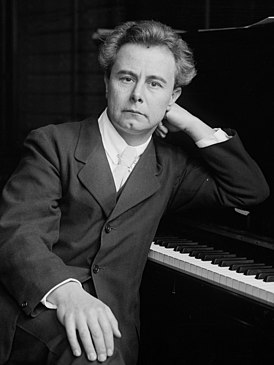 | |
| basic information | |
| Birth name | |
| Full name | Josef Casimir Hoffmann |
| Date of Birth | January 20, 1876 |
| Place of Birth | Podguže, near Krakow , Galicia , Austria-Hungary |
| Date of death | February 16, 1957 (81 years old) |
| Place of death | Los Angeles , USA |
| Buried | |
| A country |  Poland Poland  USA USA |
| Professions | pianist , composer |
| Instruments | The piano |
| Genres | |
| Aliases | Michelle Dvorsky |
Biography
Born in a family of musicians: his father, Casimir Hoffmann was a pianist, his mother sang in an Krakow operetta. At the age of three, Joseph received his first music lessons from his father, and having shown great talent, he soon began to act as a pianist and even a composer (he also had good abilities in mathematics, mechanics, and other exact sciences).
After touring Europe, Hoffmann made his debut in the United States on November 29, 1887 , with a concert at the Metropolitan Opera , where he brilliantly performed Beethoven's first concert , and also improvised on topics proposed by the audience, causing a real sensation in the audience.
Delighted with the art of the young musician, the American glass magnate Alfred Clark allocated him fifty thousand dollars, which allowed the family to return to Europe, where Hoffmann was able to continue his studies calmly. For some time, his teacher was Moritz Moszkowski , but then Hoffmann became the only private student of Anton Rubinstein (who lived in Dresden at that time), who greatly influenced his creative views.
Since 1894, Hoffmann again began to perform in public, no longer as a child prodigy, but as a mature mature artist. After he performed the Fourth Concert of Rubinstein in Hamburg under the direction of the author, he said that there was nothing more to teach him, and stopped studying with him.
At the turn of the century, Hoffmann was one of the most famous and sought-after pianists in the world: his concerts were held with great success in the UK, Russia, USA, South America, everywhere with full houses. At a series of concerts in St. Petersburg, he hit the public, having played over ten hundred and fifty different plays in ten performances. In 1903 and 1904, Hoffmann performed in St. Petersburg together with Kubelik , so, according to the memoirs of O. Mandelstam ,
| in the minds of the then Petersburger they merged into one image. As twins, they were of the same height and the same suit. Shorter than average, almost undead, hair blacker than the raven's wing. Both had a very low forehead and very small arms. Both now seem to me to be something like the premieres of a troupe of midgets. |
In 1914, Hoffman emigrated to the United States, where he soon accepted citizenship and continued his performances. In 1924, he accepted the proposal to lead the newly founded Curtis Institute of Music in Philadelphia , and led it until 1938 . During his leadership, the institute reached the world level, becoming an excellent school for many future musicians.
Hoffmann's active performances continued until the early 1940s; his last concert was held in New York in 1946 . In the last years of his life, Hoffmann was enthusiastically engaged in developments in the field of sound recording and mechanics: he owns several dozen patents for various improvements in the piano mechanism [1] [2] , as well as various improvements for the car, including a shock absorber designed by analogy with the piano pedal, and "wipers" , which are based on the principle of the metronome [3] .
Creativity
Hoffmann is rightfully considered one of the greatest pianists of the 20th century. The brilliant technique, coupled with an unusual rhythmic imagination, allowed him to play with elemental power and strength, and thanks to his excellent memory, he might not have to worry about “restoring” the piece he had once played before the next concert.
The pianist’s repertoire was huge, but not universal: it was essentially limited to the heritage of the first half of the 19th century - from Beethoven to Liszt . Most often, Hoffmann included Chopin’s compositions in his programs and played them - especially waltzes, mazurkas - with such perfection, “before which all criticism was silent” [4] . However, he almost never performed the music of contemporary composers. The Third Piano Concerto by Sergei Rachmaninoff , dedicated to Hoffmann, whose work Rachmaninov himself greatly appreciated, was no exception. Hoffmann was one of the first musicians in history to record his performance in 1887 on a phonograph , but later on he rarely recorded in the studio. A large number of Hoffmann's records, preserved to this day, were made at concerts.
Hoffmann is the author of about a hundred works (published under the pseudonym Michelle Dvorsky ), two books on the art of playing the piano: “Tips for Young Pianists” and “Piano Game”.
Bibliography
- Barinova M. N. Memoirs of Hoffmann and Busoni . - M.: Music, 1964.
- Rabinovich D. Playing Joseph Hoffmann. - “Soviet music”, No. 7 for 1961.
Notes
- ↑ HOFMANN - Google Patent Search
- ↑ PIANO ACTION - Google Patent Search
- ↑ Marek Kępa. Twice The Genius: The Music & Inventions of Józef Hofmann // Culture.pl , September 19, 2017.
- ↑ Introduction by G. M. Kogan to the book : Hoffman I. Piano Game. Answers to questions about the piano game // M .: Muzgiz, 1961-224 p. (see pages 12, 17-18)
Links
- Joseph Hoffmann: Sheet music on IMSLP
- Joseph Hoffmann (English) on the Allmusic website
- Biography of Hoffmann and other pianists
- Interview with Hoffmann