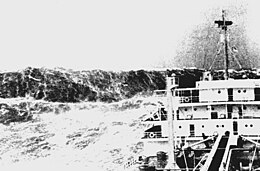
Killer waves ( wandering waves , monster waves , white wave , English rogue wave - robber wave , freak wave - crazy wave; French onde scélérate - villainous wave, galéjade - bad joke, practical joke) - giant single waves, arising in the ocean , with a height of 20-30 meters (and sometimes more), with behavior uncharacteristic of sea waves. “Killer waves” pose the most immediate danger to ships and offshore structures: the hull of a vessel that has encountered such a wave may not withstand the enormous pressure of the water falling on it (up to 1000 kPa or 10 atm), and the ship will sink in a matter of minutes.
An important circumstance that makes it possible to distinguish the phenomenon of killer waves as a separate scientific and practical topic and to separate it from other phenomena associated with waves of anomalously large amplitudes (for example, tsunamis ) is the suddenness of their appearance. Although there is apparently no single reason for killer waves, the nonlinear dynamics of surface waves on water is one of the characteristic reasons for the formation of killer waves in the ocean [1] .
For a long time, wandering waves were considered fiction, since they did not fit into any mathematical model of the appearance and behavior of sea waves that existed at that time, and there was also not enough reliable evidence. However, on January 1, 1995, a wave at a height of 25.6 meters, called the Dropner wave , was first recorded on the Dropner oil platform in the North Sea off the Norwegian coast for the first time. Further studies under the MaxWave project (“Maximum Wave”), which included monitoring the surface of the oceans using the ERS-1 and ERS-2 radar satellites of the European Space Agency (ESA) , recorded more than 10 single giant waves over the entire globe over three weeks whose height exceeded 25 meters. These studies compel a fresh look at the causes of the deaths of ships of the same size as container ships and supertankers over the past two decades, including killer waves among the possible causes.
The new project is called Wave Atlas (Atlas of waves) and provides for the compilation of a global atlas of observed killer waves and its statistical processing.
Reasons
There are several hypotheses about the causes of extreme waves. Many of them lack common sense. The simplest explanations are based on the analysis of a simple superposition of waves of different lengths. Estimates, however, show that the probability of the occurrence of extreme waves in such a scheme is too small. Another noteworthy hypothesis suggests the possibility of focusing wave energy in some structures of surface flows. These structures, however, are too specific for the energy focusing mechanism to explain the systematic occurrence of extreme waves.
It is interesting that such waves can be either crests or troughs, which is confirmed by eyewitnesses. Further research draws on the effects of nonlinearity in wind waves, which can lead to the formation of small groups of waves ( packets ) or individual waves ( solitons ) that can travel large distances without significant changes in their structure. Similar packages have also been repeatedly observed in practice. The characteristic features of such groups of waves, confirming this theory, is that they move independently of other waves and have a small width (less than 1 km), and the heights drop sharply at the edges [2] .
Numerical simulation of killer waves
Direct modeling of killer waves was undertaken in the works of V. E. Zakharov, A. I. Dyachenko [3] , R. V. Shamina [4] . The equations describing the unsteady flow of an ideal fluid with a free surface were numerically solved. Using a special type of equations made it possible to carry out calculations with great accuracy and at large time intervals. In the course of numerical experiments, characteristic profiles for killer waves were obtained that are in good agreement with experimental data.
During a large series of computational experiments on modeling the dynamics of surface waves of an ideal fluid with physical parameters characteristic of the ocean, empirical functions were constructed for the frequencies of occurrence of killer waves depending on the steepness (~ energy) and variance of the initial data [5] .
Experimental observation
One of the problems in studying killer waves is the difficulty of obtaining them in the laboratory. Basically, researchers are forced to work with data obtained from observations in vivo, and such data is very limited due to the unpredictable nature of the occurrence of a killer wave.
In 2010, for the first time, Peregrin solitons-breathers were experimentally obtained, which, according to many scientists, are a possible prototype of killer waves. These solitons, which are a particular solution of the nonlinear Schrödinger equation , were obtained for the optical system [7] , but already in 2011 the same solitons were also obtained for water waves [8] . In 2012, in another experiment, scientists were able to demonstrate the generation of a higher-order soliton-breather, for which the amplitude is five times the amplitude of the background wave [6] .
Observation Cases
- On the morning of February 7, 1933, a wave 34 meters high crashed on a Ramapo ship, which was traveling from Manila to San Diego , [9] .
- On April 12, 1966, in the middle Atlantic, the Italian transatlantic liner Michelangelo was hit by a giant “white” wave 20 meters high. Two passengers were washed away at sea, 50 were injured. The ship received serious damage to the bow and one of the sides [10] .
- On September 11, 1995, the British transatlantic liner Queen Elizabeth 2 in the North Atlantic recorded a 27-meter wave during Hurricane Louis [11] .
Ship
- The Soviet trawler "Kartli" in December 1991 was the victim of a killer wave off the coast of the Scottish island of Gia. The vessel first ran aground, then sank. Killed 4 crew members. The rest was saved by coastal rescue services [12] .
See also
- Ninth shaft
- Perfect storm
- Caproller
- Big Wave Surfing
Notes
- ↑ R.V. Shamin. Math questions of killer waves. M.: Lenand / URSS, 2016
- ↑ Frederic-Moreau. The Glorious Three , translated by M. Olagnon and GA Chase / Rogue Waves. 2004, Brest, France.
- ↑ AI Dyachenko, VE Zakharov. On the Formation of Freak Waves on the Surface of Deep Water. // Pis'ma v ZhETF. - 2008. - T. 88 , No. 5 . - S. 356-359 .
- ↑ R.V. Shamin. On the existence of smooth solutions of the Dyachenko equations describing unsteady flows of an ideal fluid with a free surface. // Reports of the Russian Academy of Sciences. - 2006. - T. 406 , No. 5 . - S. 112-113 .
- ↑ V.E. Zakharov, R.V. Shamin. On the likelihood of killer waves. // Pis'ma v ZhETF. - 2010. - T. 91 , No. 2 . - S. 68-71 .
- ↑ 1 2 A. Chabchoub, N. Hoffmann, M. Onorato, and N. Akhmediev. Super Rogue Waves: Observation of a Higher-Order Breather in Water Waves // Phys. Rev. X - 2012. - Vol. 2. - P. 011015. - DOI : 10.1103 / PhysRevX . 2.011015 .
- ↑ B. Kibler, J. Fatome, C. Finot, G. Millot, F. Dias, G. Genty, N. Akhmediev & JM Dudley. The Peregrine soliton in nonlinear fiber optics (Eng.) // Nature Physics . - 2010 .-- Vol. 6. - P. 790-795. - DOI : 10.1038 / nphys1740 .
- ↑ A. Chabchoub, N. Hoffmann, and N. Akhmediev. Rogue Wave Observation in a Water Wave Tank (Eng.) // Phys. Rev. Lett. . - 2011. - Vol. 106. - P. 204502. - DOI : 10.1103 / PhysRevLett.106.204502 .
- ↑ Where do killer waves come from? (Russian) , Komsomolskaya Pravda (September 23, 2004). Date of treatment September 6, 2017.
- ↑ Michelangelo accident . www.michelangelo-raffaello.com. Date of treatment September 6, 2017.
- ↑ QE2 - History - Hurricane Luis . www.qe2.org.uk. Date of treatment September 6, 2017.
- ↑ Elizabeth Gerson. The last catastrophe of the USSR navy: 25 years ago, the Kartli trawler crashed . NTV. Date of treatment September 6, 2017.
Links
- Pelinovsky E.N., Slyunyaev A.V. “Freaks” - sea waves-killers // Nature. - No. 3. - 2007.
- Badulin S., Ivanov A., Ostrovsky A. The influence of giant waves on the safety of offshore production and transportation of hydrocarbons.
- Kurkin A.A., Pelinovsky E.N. Killer waves: facts, theory and modeling. N. Novgorod. - Nizhny Novgorod. state those. un-t - 2004.
- Shamin R.V. Mathematical problems of killer waves. M.: Lenand / URSS, 2016
- Space exploration of the ocean
- Lectures by R.V.Shamin on the course "Mathematical problems of killer waves" at Steklov Mathematical Institute , 2018
- Scientists recreated the "killer wave" in the laboratory // RIA , Jan 2019