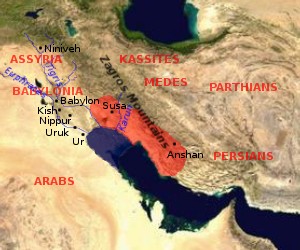
Elam (also Elam [1] ; noise, Nimes , Akkad. Elamtu , self-name - Haltamti ) is a historical region and an ancient state ( 3 thousand years - middle of the 6th century BC ) in the south-west of modern Iran ( Khuzestan province and Lurestan ).
The center ( capital ) is the city of Susa .
By the beginning of our era, the Elamites still retained their ethnic identity and were present in Jerusalem at the celebration of the day of Pentecost ( Acts 2: 9 ).
Content
Elam language
Genetically, the Elama language was an isolate , although there are hypotheses about its relationship to the Dravidian or Afrasian languages. From the point of view of grammar , it is an agglutinative , ergative language. The usual word order is SOV (subject - addition - predicate). Proto-Elama pictographic writing was originally used as writing , from the XXIII century. BC er - linear Elama letter, then - cuneiform .
Description
Elam in ancient times was called lowland, and in the middle and upper part - the mountain valley of the Karuna and Kerha rivers, flowing into the now-dried lagoon of the Persian Gulf east of r. The tiger , as well as the surrounding mountainous areas, at least the current Iranian regions of Khuzistan and Fars, and perhaps more distant (to the east). In the Elama texts themselves, the country is called Hatamti ; Hal-tamti is also found - a form that is probably more archaic (cf. Elam. hal "country").
In the III millennium BC. er A number of Elamic city-states are known from the Sumerian-Akkadian sources: Shushen (Susi), Anshan (Anchan), Simashki , B / Parakhse (later Markashi) , Adamdun (apparently, the Sumerian term Hatamti ) and many others.
In the II millennium BC. er the most important parts of Elam were Shushen (Shushun) and Anchan; Elam kings invariably indicate these two cities in their titles. Sushen is the Susa of the Greek authors, a well-studied fortified settlement between Karun and Kerkhe, a settlement dating back to the 4th millennium BC. er Anchan is a site Tepe-Malian not far from the present day. Shiraz in Fars [2] .
History and Kings of Elam
The history of Elam can be divided into three periods, covering more than two millennia. The period before the first is known as Proto-Elam.
- Proto-Elama period: 3200 BC er - 2700 BC. e., proceeding locally in Susa.
- Old Elama period: 2700 BC er - 1600 BC. e., the early period, which took place before coming to power in Susa dynasty Eparty .
- Middle Elama period: 1500 BC. er - 1100 BC. e., the period before the Babylonian invasion of Susa.
- Neo-Elamian period: 1100 BC er - 539 BC e., the period of the characteristic Iranian and Syrian influence. In 549 BC. er Elam was conquered by the Persians , and at the same time they adapted the culture of the enslaved country so much that Josephus (c. 37 AD - c. 100 AD) even called the Elamites the ancestors of the Persians ( ID book 1, ch. 6: 4).
Avan Dynasty
The first information about the state of Elam dates back to about the end of the XXVII - the first half of the XXVI century BC. Oe. when the kings of Awan ruled the Northern Mesopotamia. About 2500 BC. er The rulers of the Sumerian city of Kish were able to get rid of Elama domination. At this time, a new dynasty, the founder of which was probably Sang, was established in Avan. However, the history of this time is very poorly known. Around 2300 BC. er Elam was conquered by the Akkadian state , but the Akkadians failed to keep the country in their power and were forced to leave it for several years. The new Akkadian king Rimush was able to retake Elam and completely devastate the country. Nevertheless, the kings of Akkad, despite a series of campaigns, probably failed to truly conquer Elam, and the heir to Manistushu , king Naram-Swan , ultimately concluded a written agreement with the Elamites under which Elam committed himself to coordinate his foreign policy with Akkadian kingdom, but retained internal independence. This is the first international treaty known to us in world history. It is written in Elama, but the Akkadian cuneiform, which from that time began to spread in Elam. Under the last representative of the Avan dynasty , Kutik-Inshushinaka , when Akkad himself fell under the onslaught of the Guti tribes, Elam regained his independence. But the Gutians attacked Elam, as a result of which the state disintegrated into several separate areas. Only a hundred years later, the country managed to reunite, and a new elevation of Elam began under the rule of the kings of the Simashki dynasty [3] .
Simashki Dynasty
Soon after the complete disintegration of the kingdom of Avan, Elam was conquered by the king of Ur Shulgi . For several decades, the country was ruled by Sumerian officials. Only when the King of Shu-Suen was an Urk, information appeared that in the Elamean city of Simashka a certain king Girnamme ruled. Girnamme's successor, Enpilukhan, was able to separate from Ura and captured the cities of Awan and Susa. Although Enpilukhan himself was soon captured by the Sumerian army, by then Elam had completely thrown off the power of the Sumerians. The Ursky garrisons were expelled everywhere, and the Sumerians themselves soon had to flee the country. Under the rule of the king Khutrantempti, the Elamites began to raid the territory between Entre Rios and were soon able to avenge Uru for their dominion in Elam. The last king of the 3rd dynasty of Ur, Ibbi Swan, was deposed with the help of the Elamite troops, after which the Elamite garrisons were deployed in Ur and other major cities of Sumer. However, they had to leave after a few years. During the reign of King Idattu I, the rulers of Simashki subordinated the whole of Elam to their power. However, the prosperity of the Elam state lasted less than half a century. Soon the kings of Simashka began to lose their power, and approximately in the first half of the XIX century BC. er power over Elam passed to the new dynasty of Sukkal-Machs .
Sukkal-Machs (Epartids) dynasty
The founder of the dynasty - a certain Eparty - was a native of the lower classes, who gained power over the country not by inheritance, but as a result of the struggle. The descendants of Eparty, especially Queen Shilhah, were able to significantly strengthen the royal power and strengthen the Elamic state. The structure of power in Elam was then a kind of triumvirate . Three rulers existed simultaneously in the country: 1) Sukkal Suz, 2) Sukkal Elama and Simashka, 3) Sukkal-max. Sukkal-max was actually considered the king of the country, his residence was in Susa. After his death, the Elamian throne was usually taken by Sukkal Elam and Simashka. Usually it was the brother of the deceased. And Sukkal Suz (ruler of the capital) sukkal-max put his eldest son. Thus, the power in Elam did not pass from father to son, as was the case then in other states, but from elder brother to younger. On the political history of the Sukkal-Machs dynasty, only fragmentary information reached us. Elam then led the war with Babylon and other cities of Mesopotamia with varying success. At the beginning of the XV century BC. er Sukkal-makhiv dynasty suddenly stopped. It is not known why, but it can be assumed that Elam was conquered by the Kassites . Only a century later, Elam was able to regain his independence under the rule of the kings Anshan and Suz .
Dynasty of the kings of Anshan and Souz (Igehalkida and Shutrukids)
This is undoubtedly the most glorious period of Elam history, which also left the largest number of archaeological monuments - in particular, the famous ziggurat Dur-Untash (now Choga-Zambil), built during the reign of Untash-Napirish .
A new Elama dynasty, apparently, managed at this time to break the separatism of the local nobility and strengthen the central power. Since the beginning of the XIII century. BC er begins a new series of Elam conquests. The Elamites managed to capture a vast area on the River Diyala, including the city of Eshnunnu (under King Untash Napirish , who entered the kingdom in 1275 BC). Caravan routes from Dvorichya to the highlands of Iran passed through this area. These victories of the Elamites contributed to the crisis of the Kassite dynasty in Babylonia and the complete liberation of Elam from the Babylonian power.
During the reign of Kiten-Khutran (he began to reign in 1235 BC), two conquest marches to Babylonia were carried out, Nippur was taken, and then Isin . But all the attempts of the Elama ruler to establish themselves in Babylonia were thwarted by the Assyrian king Tukulti-Ninurta I , who himself was interested in the hegemony over Babylon, in which much more of the Elam king succeeded. Shortly after the death of Kiten-Hutran in Elam, a new dynasty came to power - the Shutrukids , named after the king Shutruk-Nahkhunta . This king in 1160 made a victorious march on Babylon , completely ravaged the city, taking a huge tribute from Babylonia. Among the spoils of war, a famous stele with the laws of Hamurappi was taken, later found in Susa by archaeologists. In 1157 BC. er The Kassite dynasty in Babylon ended its existence, but Elam did not manage to completely conquer Babylonia.
The highest development of the Elam power reached under the king Shilhak-Inshushinaka , which greatly expanded the Elama possessions, especially in the mountains of Zagra and east of them. He managed to invade Assyria , where he occupied the southern Assyrian city of Ekallate.
After the defeat of Elam, inflicted upon him by Nebuchadnezzar I , reigned in Babylon in 1130 BC. er (Battle of the River Ulay), and then after the defeat of Babylonia, inflicted on it by the Assyrian king Tiglatpalasar I at the end of the XII century BC. e., both countries, Elam and Babylonia, are experiencing a period of decline. However, Babylon does not lose its value as an object of conquest, but Elam ceases to be mentioned in texts for three centuries. In Elam, the domination of the local nobility is restored or maintained; the absence of a strong centralized state and the utter fragility of the royal power, which turned into a toy of struggling cliques of the nobility, we find in the 1st millennium BC. er as characteristic features of the story of Elam.
New Elam dynasty
The Roman numerals below are marked by the generations of the Elam kings:
I. Humban-tah-rah (760-742 BC), the founder of the dynasty, little information remained about him.
Ii. Khumban Nikash (742-717 BC), the son of the previous one. Rules during the creation of the great Assyrian state Tiglatpalasar III , broke in 721 BC. er under Dere his son Sargon II .
Iii. Shutruk-Nahhunte II (717-699 BC), “sister's son” Khumban-Nikasha . Supported Sargon II of the Babylonian king of Chaldean origin Marduk-apla-iddin II , expanded the boundaries of Elam. In 709 BC. er Sargon II conquered Babylonia, and his son Sinahérib in 702 BC. er under Kish, Chaldean and Elama armies were routed. Shutruk-Nakhunt II was overthrown by his brother Hallutush-Inshushinak II and imprisoned in a dungeon.
Khalutush-Inshushinak II (699-693 BC) in 694 BC er He defeated at Sippar and captured the son of Sinahribib, the Babylonian king, Ashur-nadin-shumi , who soon died (or killed) in Elam. He planted on the Babylonian throne his protege Nergal-usyziba . In 693 BC. er was beaten by Sinaherib under Nippur. Nergal-usezib was captured and was placed in a cage near the city gates in Nineveh. Hallutush-Inshushinak II himself fled to his homeland, but residents of the capital Elama Souz closed the city gate in front of him and killed him.
Iv. Kutir-Nahhunte (693-692 BC), the eldest son of Hallutush-Inshushinaka II . During his reign, Elam underwent the invasion of Sinahriba, Kutir-Nahhunte himself was soon killed during the uprising.
Khumban- Niemena (692-688 BC), the youngest son of Hallutush-Inshushinaka II . In alliance with the Babylonians continued the struggle with Assyria. In 689 BC. er was broken by paralysis, which prompted Sinaheriba to march on Babylon, which ended with the destruction of the city in the same year.
Khumban-Khaltash I (688-681 BC), a cousin of the 2 previous kings, ruled peacefully, died suddenly (which does not preclude poisoning).
Shilhak-Inshushinak II (681–668 BC), a cousin of the three previous kings, reigned at Susa, had a co-ruler of his cousin Humban-Khaltash II (681–675 BC). Both kings tried to live in peace with the Assyrian king Assarhaddon , the son of Sinahkherib , for which they even went to kill the Nabu-zer-kishi-lashir , the son of Marduk II, who fled to Elam.
However, in 675 BC. er Khumban-Khaltash II made a raid on Sippar, after which he "died without showing signs of illness" - believed to have been killed by Assyrian agents.
He was inherited by his brother Urtaki (675-663 BC), who also made a raid on Babylonia at the end of his life, where he was supported by local princes. Upon their return to Elam, all of them "suddenly died" - apparently, they were killed by supporters of Assyria.
V. Tempti-Humpan-Inshushinak (Assyrian Te-Umman , 668-653 BC), son of Shilhak-Inshushinka II , originally ruled only in Susa. After the death of Urtaki captured his possession. 60 members of the reigning home of Elam, including the 3 sons of Urtaka and 2 sons of Humban-Khaltash II , took refuge in Assyria. He made successful campaigns on the tribes living on the outskirts of Elam (including the "country of villains" - perhaps the Persians). With him, Elam prospered, recovering from continuous wars.
Speech against Assyria proclaimed in 654 BC. er its independence of Egypt, supported by Lydia, prompted Te-Umman to also start a war with Assyria, demanding the extradition of escaped relatives. However, Assyrian king Ashshurbanapalu managed to make peace with Lydia and Egypt, after which Assyrian troops attacked Elam. Near Susa, the Elamites suffered a complete defeat. Te-Umman was captured and executed in front of the surrendered Elam army. Elam was divided between the relatives of Te-Ummann who found refuge in Assyria.
Attakhamitti-Inshushinak (653-648 BC), Te-Ummann’s cousin , died of his death in Susa.
Khumban-Nikash II (653-651 BC), the son of Urtaki, supported the uprising of Shamash- shum -Ukin in Babylon (in 652-648 BC). However, the army sent to Babylon was defeated, and Humban-Nikash II himself was overthrown and executed with his whole family by his brother Tammarita .
Tammarita (653-649, and in 646 BCE), the son of Urtaki . Resumed in 649 BC. er war with Assyria, but was overthrown by the nobleman Indabigash , fled, but was captured by the Assyrians. In 646 BC. er Assyrians planted on the throne of Elam, soon raised a rebellion against them, defeated and captured.
Indabigash * (649-648 BC), did not help the already doomed Shamash-shum-ukinu , but after the fall of Babylon he refused to give out Nabu-bel-shume , the grandson of Marduk-apla-iddin II , and other Babylonian fugitives. Soon, Khumban-Haltash III was killed.
| * Apparently he, like the later Umbahabua and Pa’e who ruled later, did not belong to the New Elam dynasty |
Vi. Khumban-Khaltash III (Assyrian Ummanaldash) (648–644 BC), the son of Attakhamitti-Inshushinaka , also refused to extradite the fugitives from Babylonia. In 646 BC. er during the invasion of the Assyrians took refuge in the mountains. The king was proclaimed Umbahabua , when approaching the Assyrians fled "to the depths of the waters of the distant." The Assyrians put Tammarita on the throne, who soon revolted and was captured by the Assyrians.
With the departure of the Assyrian troops, Humban-Haltash III returned and again took the throne. In 645 BC. er followed by a new invasion of the Assyrians, headed by Ashshurbanapal himself. Khumban-Khaltash III was defeated and again took refuge in the mountains. Pa'e was proclaimed king of Elam, but he soon surrendered to the Assyrians. Ashurbanafal developed Susa and brutally devastated the whole country.
After the Assyrians left, Humban-Haltash III returned to the destroyed Madakta and made peace, agreeing to give out Nabu-Bel-Shumeate *. In 640 BC. er Assyrians invaded again and the following year the resistance of the Elamites was finally broken. Humban-Khaltash III, who had taken refuge in the mountains, was extradited to the Assyrians by local tribes.
| * Killed himself, the Assyrians were given his salted corpse |
Three Elama kings - Humban-Khaltash III , Pa'e , Tammarita, and the Arab prisoner Sheikh Wyate were harnessed to the chariot of Ashurbanapal during the celebration of the conquest of Elam. Elam became a province of Assyria, ceasing independent existence.
Elam (Elam) in the Bible
According to the Bible , Elam (the ancestor of Elam) was a Semite ( Gen. 10:22 ). Even before its fall, Sodom was attacked by the troops of the king of Elam, Chedorlaomer, who acted in alliance with the king of Sennaar ( Gen. 14: 1-11 ). The Elamites were famous for their archers ( Jer. 49 :: 35 ), however, they were conquered by Assyrians and partially settled in Samaria ( Ez. 4: 9-10 ).
The city of Susa was located in the Elam land ( Dan. 8: 2 ).
Religion of the Elamites
The religion of the Elamites - polytheism - had many features that brought it closer to the religions of neighboring Mesopotamia . The main deity in the III millennium BC. er was the goddess Pynenkir (there were 2 more mother-goddesses - Party and Kirirish), after a thousand years “on the throne” she was replaced by the male god Humpan . The cult of the god Susa Inshushinaka also played a great role. Other famous gods are Hutran (son of Humpan), Manzat , Nahhunta , Narundi .
According to the beliefs of the Elamites, each deity possessed a supernatural aura of Kiten , which could turn into a metal or stone sign - a taboo.
Sacrifices were made to the gods and worshiped in temples built like Mesopotamian on the tops of step pyramids - ziggurats . Such a ziggurat has been preserved in the current Choga-Zanbil , it was built during the time of King Untash-Napirish. In addition, the rites of worship to gods in sacred groves that grew near temples are known.
Notes
- ↑ Elam // Encyclopedic Dictionary of Brockhaus and Efron : in 86 tons (82 tons and 4 additional). - SPb. , 1890-1907.
- ↑ Dyakonov I.M. Elam language. // Languages of Asia and Africa. T. III. - M., 1979. - pp. 37-49.
- ↑ Akkad. Formation of the state and the rule of the Sargonids // World History
Literature
- Dandamaev MA , Lukonin VG Culture and Economy of Ancient Iran. - M .: Science, Main edition of Oriental literature, 1980. - 416 p.
- Dyakonov I.M. The Elama kingdom in the Old Testament period // History of the Ancient East. The origin of the oldest class societies and the first centers of civilization. Part I .: Mesopotamia. - M., 1983. - P. 391-414.
- Dyakonov I. M. Elama language // Languages of Asia and Africa. T. III. - M., 1979. - p. 37-49.
- Turaev B.A. Elam // Encyclopedic Dictionary of Brockhaus and Efron : 86 t. (82 t. And 4 extra.). - SPb. , 1890-1907.
- Elamityans // Encyclopedic Dictionary of Brockhaus and Efron : 86 t. (82 t. And 4 extra.). - SPb. , 1890-1907.
- Khachikyan M. L. Elama language // Languages of the world: Ancient relict languages of Asia Minor. / Ed. N. N. Kazan, and others - M., 2010. - S. 95-117.
- Hints V. . State Elam = Das Reich Elam / Trans. with him. L. L. Shokhina; rep. ed. and auth. afterglow Yu. B. Yusifov . - M .: Science . The main editors of Eastern literature, 1977. - 208 p. - 5500 copies
- Yusifov Yu. B. Elam: Socio-Economic History / Academy of Sciences of the Soviet Socialist Republic of Azerbaijan. Institute of history. Institute of the peoples of the Middle and Mid. East. - M .: Science , 1968. - 408 p.
- Potts DT The Iranian State. 2nd edition. - Cambridge , 2015.