Surimi ( Jap. 擂 り 身 Surimi , beaten and finely chopped meat) is a Japanese dish, usually prepared from white fish ( pollock , hake , sea bass , Far Eastern sardine , mackerel ...) or shrimp by freezing and grinding into a homogeneous mass.
| Surimi | |
|---|---|
| Included in the national cuisine | |
| Place of origin | |
| Components | |
| Main | |
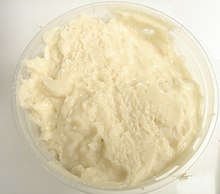

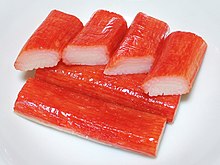
Since surimi does not have a strong smell and taste, it is often used to imitate various seafood, adding dyes and spices. The most common product of surimi is crab sticks .
Content
History
Even in ancient times (the first mention of surimi found in 1100), the Japanese noticed that from ground and pressed oceanic fish with white meat you can get a similar mass, which will have an almost imperceptible but pleasant taste and smell, from which you can sculpt various figures . The most popular were fish balls or surimi sausages, which became known as “ Kamaboko ”. As culinary art developed, Japanese chefs invented new dishes from surimi.
Surimi production process
- Fish for the production of surimi is caught on the high seas in the fishing zones. The catch is either processed onboard a specialized ship-factory, or supplied for processing to a coastal factory.
- Freshly caught fish is filleted . The skin, heads, bones and entrails are sent to the production of fish meal . Only fillets are sent for surimi production.
- Fish fillet is crushed and repeatedly washed with clean cold water. At this stage only insoluble proteins remain, which in essence are surimi themselves.
- The resulting washed mass is fed to the centrifuge to remove excess moisture.
- Blocks of 10 kg are molded from the finished mass and frozen by shock freezing (freezing in a very short period) to t −20 ºС. Since surimi consumer plants are located far from fishing zones (often on other continents), surimi are transported to processing sites in refrigerated containers , in which a constant temperature of –20 ° C is created and maintained.
Surimi Production in Russia
The Karelian plant in Sortavala produces surimi on an industrial scale in the European part of the country [1] .
Surimi production facilities are also concentrated in the Russian Far East [2] .
See also
- Fish balls
Notes
Literature
- 7.3.2 Technology of production of surimi // Technology of fish and fish products / ed. A.M. Ershov . - SPb. : GIORD, 2006. - p. 603-606. - 941 s. - 1000 copies - ISBN 5-901065-78-6 .