The incident with the Boeing 747 over Java (also known as the Jakarta incident ) is an accident that occurred on June 24, 1982 . British Airways' Boeing 747-236B made a scheduled BA9 flight (callsign Speedbird 9 ) on the route London - Bombay - Madras - Kuala Lumpur - Perth - Melbourne - Auckland , but fell into a volcanic cloud a few minutes after departure from Kuala Lumpur ash from the suddenly erupted Galunggung volcano , as a result of which all 4 engines stalled one after another. The crew was able to safely land a plane at Halim Perdanakusuma airport in Jakarta . None of the 263 people on board (248 passengers and 15 crew members) were injured [1] .
| Flight 009 British Airways Jakarta incident | |
|---|---|
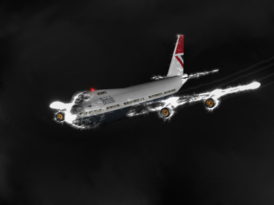 Computer reconstruction of an incident | |
| General information | |
| date | June 24, 1982 |
| Time | 20: 40-21: 30 WIT (13: 40-14: 30 UTC ) |
| Character | Emergency landing |
| Cause | All engine shutdown due to volcanic ash |
| A place |  Galunggung volcano ( West Java , Indonesia ) - the place of falling into the ash cloud , Halim Perdanakusuma Airport , Jakarta ( Indonesia ) - emergency landing Galunggung volcano ( West Java , Indonesia ) - the place of falling into the ash cloud , Halim Perdanakusuma Airport , Jakarta ( Indonesia ) - emergency landing |
| Coordinates | - the place of falling into the ash cloud |
| Dead | 0 |
| The wounded | 0 |
| Aircraft | |
 Affected aircraft 2 years before the accident | |
| Model | Boeing 747-236B |
| Aircraft name | City of edinburgh |
| Airline |  British airways British airways |
| Departure point | Heathrow , London ( UK ) |
| Stopover |  Sugar , Bombay ( India ) Chennai , Madras ( India ) Sugar , Bombay ( India ) Chennai , Madras ( India )  Kuala Lumpur ( Malaysia ) Kuala Lumpur ( Malaysia )  Perth ( Australia ) Melbourne ( Australia ) Perth ( Australia ) Melbourne ( Australia ) |
| Destination |  Auckland ( New Zealand ) Auckland ( New Zealand ) |
| Flight | BA9 |
| Board number | G-bdxh |
| Date of issue | March 19, 1979 (first flight) |
| Passengers | 248 |
| Crew | 15 |
| Survivors | 263 (all) |
Content
Aircraft
Boeing 747-236B (registration number G-BDXH, serial 21635, serial 365) was released in 1979 (the first flight was made on March 19). March 27 of the same year was transferred to British Airways , in which it received the name City of Edinburgh . It is equipped with four twin - circuit turbofan engines Rolls-Royce RB211-524D4 [2] [3] .
Crew
The crew of flight BA9 was as follows:
- The aircraft commander (FAC) is 41-year-old Eric Moody.
- The co - pilot is the 32-year-old Roger Greaves.
- Flight Engineer - 40-year-old Barry Townley-Freeman ( born Barry Townley-Freeman ).
In the cabin, 12 flight attendants worked under the direction of senior flight attendant Graham Skinner.
Timeline
Engine Failure
On the night of June 24, 1982, flight BA9 flying at FL370 ( 11,300 meters ) flew into a volcanic ash column ejected by the Galunggung volcano on Java . Neither the crew nor the passengers knew about this, which influenced further events.
The first oddities arose after 20:40 WIT (13:40 UTC) over the Indian Ocean , south of Java, when the co-pilot and flight engineer noticed the lights of St. Elm on the windshield, as if he had been fired by tracer bullets [1] . Returning to the cockpit, the FAC could also observe this phenomenon. Usually the lights of St. Elmo can be seen on the toes of the wings during a thunderstorm, but the weather radar did not show the presence of a thunderstorm. Despite this, the crew turned on the de-icers and the “FASTEN SEATBELT” signal (“SEAT BELTS”).
Smoke began to enter the passenger compartment. At first, it was attributed to cigarette smoke, since smoking on board the aircraft at that time was still allowed. However, the smoke became denser, the smell of sulfur appeared, and the passengers became worried. Flight attendants began to look for a source of smoke, but, having searched the entire plane, they did not find it.
Through the windows, passengers could see an unusual strobe light emanating from the engines [4] . They also noticed long, bright tails of flame bursting from the engines.
At approximately 8:42 p.m. WIT (1:42 p.m. UTC), signs of surge appeared in engine No. 4 (rightmost), and then it stopped. The co-pilot and flight engineer immediately turned off the fuel supply and put the fire extinguishing system in a state of readiness.
Less than a minute later, engine No. 2 (the left closest to the fuselage) stopped. Even before the crew had time to stop supplying fuel to it, the remaining engines No. 1 and 3 stopped almost simultaneously.
Flying with idle engines
Deprived of engine thrust, the crew could only rely on the aerodynamic quality of the aircraft, which for the Boeing 747-200 is about 15 (for every 15 kilometers of flight, the plane loses 1 kilometer of altitude). The crew quickly estimated that from the FL370 echelon ( 11,300 meters ) the aircraft could plan about 23 minutes over a distance of about 167 kilometers [4] . At 20:44 WIT (13:44 UTC), the co-pilot sent the Mayday signal to the dispatcher, saying that all four engines had stopped on his plane. However, the dispatcher in Jakarta did not understand the message and decided that only the fourth engine had stopped. The pilot of the nearby Garuda Indonesia plane interfering in negotiations was able to convey the correct information to the dispatcher. Despite the inclusion of an emergency beacon, the dispatcher in Jakarta could not see the plane on his radar.
To safely cross the high mountain range on the southern coast of Java, the crew needed to do this at FL115 ( 3,500 meters ). The crew decided if it was not possible to deploy the aircraft and try to make an emergency landing on water in the Indian Ocean.
All this time, the co-pilot and flight engineer continued trying to start the engines, the plane was at an altitude that exceeded the maximum allowable for such an operation (FL280, 8550 meters ). It was not possible to start the engines.
Despite the lack of time, the PIC made an announcement for passengers, which they later described as “the greatest understatement” [4] :
| Ladies and gentlemen, says the commander of the ship. We have a little problem. All four engines stopped. We are doing our best to launch them again. Hope this doesn't bother you too much. Original text Ladies and gentlemen, this is your captain speaking. We have a small problem. All four engines have stopped. We are doing our damnedest to get them going again. I trust you are not in too much distress [4] . |
The engine shutdown led to the shutdown of the pressurization system, and the pressure began to drop. In the cabin, oxygen masks fell out of the ceiling panels, but in the cockpit the co-pilot's mask was broken (the oxygen supply hose was separated from it). PIC immediately decided to drop to a height where you could breathe without an oxygen mask.
At an altitude of 4100 meters, the crew had to decide on further actions - to try to fly over the mountains or turn around for an emergency landing in the ocean. Despite the availability of recommendations, no one ever made an attempt to put the Boeing 747 on water, either before or after the incident. It is also not possible to work out the maneuver on the simulator due to the lack of its mathematical model.
The ongoing attempts of the co-pilot and flight engineer to start the engines led to a positive result - engine No. 4 started. The FAC used its traction to reduce the rate of descent. After a while, engine No. 3 started, which allowed the commander to begin climbing. Soon, the other two engines started up. The crew requested and received permission to climb to overcome the mountain range.
At that moment, the lights of St. Elmo reappeared on the windshield. Despite a decrease in traction, engine # 2 stopped again. The crew returned to a height of 3700 meters .
Landing in Jakarta
Before landing, the crew found that the windshield had lost transparency. As it turned out later, flying at cruising speed through a cloud of volcanic ash not only damaged the glass, but also almost completely wiped the livery from the fuselage.
Instrument landing was not possible due to a malfunction of the automatic landing gear system at Halim Perdanakusuma Airport in Jakarta. The crew could look forward only through two very narrow sectors of the windshield. In this case, the second pilot monitored the distance from the strip, and the commander monitored the height. Landing lights of the aircraft did not work.
Taxiing was also impossible, because the runway lights created a flare that became an opaque windshield.
At approximately 9:30 p.m. WIT (2:30 p.m. UTC), BA9 made a safe landing at Jakarta Airport. None of the 247 passengers and 15 crew members were injured.
Engine Research
After landing, the engines were dismantled and shipped to the UK. The examination revealed that all of them were damaged by abrasive materials, which were particles of volcanic ash from the eruption of the Galunggung volcano. Because the ash was dry, it did not appear on a weather radar designed to detect moisture in the clouds. This led to the fact that the windshield of the cockpit became opaque and clogged engines.
As the ash flew into the engines, it melted in the combustion chambers and stuck to the inside of the power plant. The engine turned off was cooled, the molten ash solidified and partially blocked the air duct, which prevented the engine from restarting successfully. The engines had enough power to restart, because one generator and the batteries on board were still operational and produced the necessary electrical power.
Consequences of the incident.
- The incident with flight 009 led to the fact that information about the eruption of volcanoes began to be quickly transferred to all aviation services.
- British Airways did not change BA9 flight number, but its route changed (London- Bangkok , without intermediate landings) and a Boeing 777 flies through it.
- Pilots of Flight 009 were presented for the award.
- The airspace near Galunggung was closed after the incident, but was opened several days later. But 19 days later (July 13), after the Boeing 747 of Singapore Airlines during the flight over the Galunggung three engines stalled, the airspace in this area was finally closed.
- The incident with the Boeing 747 of British Airways was not the only one - before that, on April 5, 1982, the McDonnell Douglas DC-9 of Garuda Indonesia also fell into the ash cloud from Galunggung and its engines stopped. The crew was able to emergency land the plane, no one on board was injured.
The fate of the aircraft
After repair, replacement of all four engines and painting (in some places, especially on the vertical tail stabilizer, he had a livery erased), the Boeing 747-236B board G-BDXH continued flights in the British Airways fleet, changing its name to City of Elgin .
On January 20, 2002 he transferred to the airline European Aviation Air Charter , but on March 17, 2004 it was deposited in it in connection with the revocation of the certificate of activity from the airline, and in 2008 the airline went bankrupt. In July 2009, the liner was cut into scrap metal.
Cultural Aspects
The incident with flight 009 British Airways shown in season 4 of the Canadian documentary television series Air crash investigations in the series All engines failed! .
See also
- Incident with Boeing 747 over Redout
- Gimli glider
- The effect of the eruption of Eyjafjädlajökull volcano on international air traffic
Notes
- ↑ 1 2 Faith, Nicholas. Black box. - Boxtree, 1996, 1998 .-- P. p. 156. - ISBN ISBN 0-7522-2118-3 .
- ↑ European Aircharter G-BDXH (Boeing 747 - MSN 21635) | Airfleets aviation . www.airfleets.net. Date of treatment November 26, 2017.
- ↑ G-BDXH European Aircharter Boeing 747-200 (English) . www.planespotters.net. Date of treatment November 26, 2017.
- ↑ 1 2 3 4 Job , Macarthur. Air Disaster Volume 2. - Aerospace Publications, 1994 .-- P. 96-107. - ISBN ISBN 1-875671-19-6 .
Links
- The story of BA flight 009 and the words every passenger dreads ...
- Air crash investigations - All engines failed!
- Description of the incident on the Aviation Safety Network . Date of treatment January 31, 2007. Archived March 15, 2012.
Literature
- Betty Tootell. All Four Engines Have Failed (British edition). - Andre Deutsch, 1985. - ISBN ISBN 0-233-97758-9 .