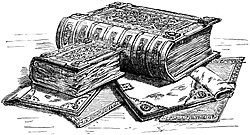
The Book of the Last Judgment , or the Book of Judgment Day ( cf. Domesday Book ) is a compilation of the materials of the first universal land census in medieval Europe , conducted in England in 1085-1086 by order of William the Conqueror . Census materials are an unprecedented source of information on the social , economic and demographic development of England in the eleventh century . In particular, the census data allow us to draw a conclusion about the population of England in this period. But due to incomplete data and the use of various calculation methods by different authors, it is determined very differently, in the range from about 1.3 to 2.5 million people [1] . The title of the book refers to the biblical Doomsday , when a full list of their actions should be presented to all people.
| Doomsday Book | |
|---|---|
| Domesday book | |
 | |
| Other names | Winchester Book, Liber Wintonia |
| Original language | Medieval latin |
| Release | 1086 |
Content
Population Census
Census Goal and Tasks
The purpose of the general census, apparently, was to determine the available economic resources of the king of England after the Norman conquest of 1066 . The fragility of the dynastic claims of William I to the English throne, the continued threat of foreign invasion, and the king’s desire to maximize the financial and military support of his power formed the basis for the decision to conduct the census. During the census, it was supposed to assess the economic resources of each estate, firstly, to bring the traditional tax distribution norms ( Danish money ) in line with the real level of profitability of land holdings, and secondly, to resolve judicial disputes over land rights, the number of which is sharp increased as a result of redistribution of the Anglo-Saxon manor after the Norman conquest, and, finally, to determine the economic potential of the fiefs of the barons of the king in order to determine what the maximum Included Quantity TVO knights of each county can give to the king. The purpose of the census was succinctly defined by the author of the Anglo-Saxon Chronicle , according to which the king wanted to know more about his new country: “how it is populated and what kind of people” ( English how it was peopled and with what sort of men ).
Procedure
The decision to conduct the census was made at a meeting of the Grand Royal Council at Christmas 1085 . Immediately, representatives of the king responsible for the census were sent to all English counties. In each county, special assemblies were convened, representing an expanded version of the judicial boards of counties. They included: the sheriff , barons and their knights, who have land in this county, members of the judicial boards of each hundred , as well as a priest, headman and six villans from each village. These meetings were called upon to confirm with oath the information that was part of the census, and also, possibly, to resolve land disputes that arose. In addition, data on land holdings in each hundred were recorded by commissions formed from the landowners of this hundred. So, in Cambridgeshire , the Commission included hundreds of Anglo-Saxons and Normans in equal shares, holding land in the hundreds.
There are two versions of how the census went. According to one of them, the royal representatives visited every hundred, where they listened to the commission of the corresponding hundred. According to another version, the census of county estates took place within the framework of one session of the county meeting, in which hundreds of commissions took part. The second assumption, expressed back in 1897 by F.V. Maitland [2] , seems to most modern scholars more likely.
The census was completed by the end of 1086 , and its results in the form of a huge array of lists and reports were provided to the king. They were further stored in the Treasury of the Kingdom of England in Winchester . In addition, by 1088, on the basis of this documentation, two volumes of the Doomsday Book had been compiled, which in a compact form included the most important information obtained from the census, sorted by counties.
Census
The census object was the economic status of land holdings ( manors ). In this regard, the questions clarified by the royal census takers concentrated around various aspects of the economic potential of the estate. For each land ownership the following data were recorded:
- the names of the owners of the estate on the date of the census and for 1066;
- names of other holders of the estate, if the owner transferred it to conditional holding ;
- the area of arable land in guides [3] ;
- the number of arable teams (measured by teams of eight bulls) on the owner's domain lands and on the lands of peasants;
- the number of peasants of various categories ( villans , cottarii , servos , free and succeses ) living on the estate [4] ;
- sizes of pastures, meadows and forests related to the estate;
- number of mills and places for fishing;
- monetary valuation [5] of the estate economy on the census date and for 1066;
- the size of allotments of free peasants and commanders within the boundaries of the estate as of the date of the census and for 1066;
- the potential for increasing estate productivity.
Obviously, the number of livestock heads in the estate and the value of agricultural stocks could also be recorded, however, these data were mainly not included in the Doomsday Book. All information subject to census should have been indicated as of: a) the year of the death of Edward the Confessor ( 1066 ); b) the year the estate was transferred to the new owner; c) the year of the census ( 1086 ). In fact, however, this principle was not fully implemented, and information on the economic situation of the estates as of the date of their transfer to the new owners appears in the Doomsday Book only occasionally.
The list of questions put forward for the census demonstrates the king’s desire to record and evaluate possible sources of income to the treasury. In particular, castles and other buildings not directly related to economic activity were not included in the census. Also, “The Last Judgment Book” does not contain data on the size of feudal obligations of landowners to the king.
Record Structure
Based on the collected records, the Doomsday Book was compiled, which consists of two parts: the so-called Small Book, which describes the counties of Norfolk , Suffolk and Essex , and the Big Book, which describes the rest of England, with the exception of the northern regions [6 ] , as well as London , Winchester and some other cities (it is assumed that the census task in them was too complicated). In fact, the Small Book is larger because it contains more detailed information about each estate. It is assumed that its creation was the first attempt to systematize the census results, which had to be abandoned due to the impossibility or inconvenience of using such a detailed amount of information.
The material of the Doomsday Book is grouped by counties, and in them by feudal possessions (rather than hundreds ). For each county, the king’s land holdings are first described, then the church and religious orders , then the largest landowners holding their lands directly from the king (barons), and close the list of holding women, royal servers , surviving Anglo-Saxon tenes and other small landowners. In some counties, urban settlements are separately allocated.
Additional Information
The book was kept in Winchester, the capital of the Anglo-Norman monarchy until the reign of Henry II , who transferred the royal treasury to Westminster . Under Queen Victoria, the book was transferred to the British National Archives . It was first reprinted in printing form in 1773 , and in 1986 , to mark the 900th anniversary of the book, the BBC, together with several companies, created the “new Doomsday Book” ( BBC Domesday Project ) - a multimedia project designed to capture the memory of Britain this time. In addition, in August 2006, an electronic version of the “Book” was published with a translation into English (the original “The Last Judgment Book” was written in Latin ).
Census materials are used by historians to obtain new information based on methods of statistical data processing.
Notes
- ↑ Urlanis B. Ts. Population growth in Europe . - M. , 1941.
- ↑ Maitland, FW Domesday Book and Beyond. - Cambridge, 1897.
- ↑ The actual size of arable land was not recorded, but the rate established for land taxation.
- ↑ If servos were counted individually, then for villans, free and co-mothers, only the number of family households of the corresponding social status on the estate was taken into account. The census of 1086 was not a census in the strict sense of the word.
- ↑ Apparently, the amount of rent paid by the holder of the estate to its owner was recorded.
- ↑ Northumberland north of Tees , Cumberland , Westmoreland and northern Lancashire
Literature
- The Last Judgment Book // Great Soviet Encyclopedia : [in 30 vol.] / Ch. ed. A.M. Prokhorov . - 3rd ed. - M .: Soviet Encyclopedia, 1969-1978. (Retrieved February 26, 2013)
- Schepkin E.N. Doomsday-book // Brockhaus and Efron Encyclopedic Dictionary : in 86 volumes (82 volumes and 4 additional). - SPb. , 1890-1907.
- Anglo-Saxon Chronicle
- Monuments of the History of England / Transl. D.M. Petrushevsky. - M. , 1936.
- Savelo N.F. Early feudal England. - L. , 1977.
- Shtokmar V.V. History of England in the Middle Ages. - SPb. , 2001.
- Maitland, FW Domesday Book and Beyond .
- Stenton, F. Anglo-Saxon England. - Oxford, 1973.
Links
- The Last Judgment Book: Full Text
- Electronic Edition of Domesday Book , complete text available at the UK Data Archive. (eng.)
- Searchable index of landholders in 1066 and 1087 , Prosopography of Anglo-Saxon England (PASE) project. (eng.)
- Focus on Domesday , from Learning Curve . Annotated sample page. (eng.)
- Secrets of the Norman Invasion Domesday analysis of wasted manors. (eng.)
- Domesday Book place-name forms All the original spellings of English place-names in Domesday Book (link to pdf file). (eng.)
- Domesday Book Online Simple to use directory with interactive map of England in Norman times
- Commercial site with extracts from Domesday Book Domesday Book entries including translations for each settlement. (eng.)
- Open Domesday Interactive map, listing details of each manor or holdings of each tenant, plus high-resolution images of the original manuscript. Site by Anna Powell-Smith, Domesday data created by Professor JJN Palmer, University of Hull. (eng.)
- In Our Time - the Domesday Book. BBC Radio 4 program available on iPlayer
- Domesday Book and Cambridgeshire