Flying dragons [1] [2] ( lat. Draco ) - a genus of lizards from the agam family, living in Southeast Asia . Other Russian names of this kind are also found in the literature - dragons , flying dragons . They differ from other lizards with wide skin folds on the sides, thanks to which they can plan for a distance of more than 20 m
| Flying dragons |
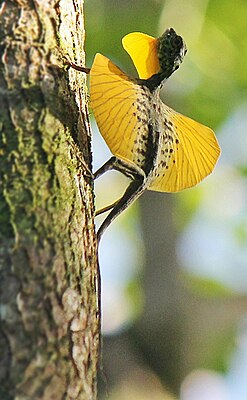
Draco spilonotus |
| Scientific classification |
|---|
| No rank : | Bilateral symmetrical |
| Infraclass : | Lepidosauromorphs |
| Subfamily : | Afro-Arabian Agamas |
|
| International scientific name |
|---|
Draco Linnaeus , 1758 |
|
Content
Skeleton of a flying dragon
Adult specimens reach a length of 21 cm. The body is narrow and flattened, in some species - brightly colored. The tail is thin and long; it can account for up to half the length of the body. The head is brown or green with a metallic sheen.
A characteristic feature of representatives of this genus is wide skin folds (membranes) located on the sides of the body, supported by false ribs and capable of spreading in the form of wings. Thanks to them, flying dragons can plan a distance of over twenty meters, while being able to change direction during the flight. The males have a bag-shaped skin fold on their throats, which advances forward - when planning a flight, it serves as a stabilizer.
The back of the flying membrane is painted with a mixture of dark brown and dark red colors and also with a metallic sheen. The color of the front of the membrane in different lizards can be yellow, orange, pink or red. Against this background, there are many dark lines, dots and spots, and the edge of the membrane is decorated with a silver border. Paws, belly and tail are also colorful decorated. The male is very easy to distinguish from the female, he has a bright orange throat sac, in females he is usually blue or blue.
They live in tropical forests in the crowns of trees, and where the forests are kept down - on the Hevea plantations, they do not descend to the ground. They also do not go down to the lower tier of the forest and, as a rule, keep closer to the crowns of trees. They feed on adult insects and their larvae. They sit mostly motionless, being invisible due to their colorful coloring.
Flying dragon females lay their eggs in cracks in the bark. The young hatch in a few weeks.
Distributed mainly on the islands of the Malay archipelago , in Southeast Asia ( Indonesia , Malaysia , Philippines ).
As of July 2018, 42 species are included in the genus [3] [2] :
- Draco abbreviatus Hardwicke & Gray, 1827
- Draco affinis Bartlett, 1895
- Draco beccarii W. Peters & Doria, 1878
- Draco biaro Lazell, 1987
- Draco bimaculatus Günther, 1864
- Draco blanfordii Boulenger, 1885 - Blanford's Flying Dragon
- Draco boschmai Hennig, 1936
- Draco caerulhians Lazell, 1992
- Draco cornutus Günther, 1864
- Draco cristatellus Günther, 1872
- Draco cyanopterus W. Peters, 1867
- Draco dussumieri AMC Duméril & Bibron, 1837 - Indian Flying Dragon
- Draco fimbriatus Kuhl, 1820 - Fringed Flying Dragon
- Draco formosus Boulenger, 1900
- Draco guentheri boulenger, 1885
- Draco haematopogon Gray, 1831 - Redbeard Flying Dragon
- Draco indochinensis MA Smith, 1928
- Draco iskandari McGuire et al. , 2007
- Draco jareckii Lazell, 1992
- Draco lineatus Daudin, 1802 - Linear Flying Dragon
- Draco maculatus (Gray, 1845) - Spotted Flying Dragon
- Draco maximus Boulenger, 1893 - Big Flying Dragon
- Draco melanopogon Boulenger, 1887 - Flying Blackbeard
- Draco mindanensis Stejneger, 1908
- Draco modiglianii Vinciguerra, 1892
- Draco norvillii Alcock, 1895
- Draco obscurus Boulenger, 1887
- Draco ornatus (Gray, 1845)
- Draco palawanensis McGuire & Alcala, 2000
- Draco quadrasi Boettger, 1893
- Draco quinquefasciatus Hardwicke & Gray, 1827 - Five - Striped Flying Dragon
- Draco reticulatus Günther, 1864
- Draco rhytisma Musters, 1983
- Draco spilonotus Günther, 1872
- Draco spilopterus wiegmann , 1834
- Draco sumatranus Schlegel, 1844
- Draco supriatnai McGuire et al. , 2007
- Draco taeniopterus Günther, 1861
- Draco timoriensis Kuhl, 1820
- Draco volans Linnaeus, 1758 - Ordinary Flying Dragon
- Draco walkeri Boulenger, 1891
Draco taeniopterus in flight
Disguise the Indian Flying Dragon
- Icarosaurus
- Cuneosaurus
- Coelurosaurus
- ↑ Bobrov V.V., Semenov D.V. Lizards of Vietnam (Series: Vietnam Biodiversity). - M .: Partnership of scientific publications of KMK, 2008. - P. 44. - 226 p. - ISBN 978-87317-498-0
- ↑ 1 2 Ananyeva N. B. , Borkin L. Ya. , Darevsky I.S. , Orlov N.L. The Pyatiling Dictionary of Animal Names. Amphibians and reptiles. Latin, Russian, English, German, French. / edited by Acad. V. E. Sokolova . - M .: Rus. Yaz., 1988 .-- S. 161. - 10,500 copies. - ISBN 5-200-00232-X .
- ↑ The Reptile Database: Draco
- Knipovich N.M. Dragon, lizards // Brockhaus and Efron Encyclopedic Dictionary : in 86 volumes (82 volumes and 4 additional). - SPb. , 1890-1907.
- Great Encyclopedic Dictionary. Biology. - M .: Scientific Publishing House "BDT", 1999.
- Flying Dragon // Animals and Plants. Illustrated Encyclopedic Dictionary / Scientific. ed. Editions T. M. Chukhno. - M .: Eksmo, 2007 .-- S. 736-737. - 1248 s. - 5,000 (additional, circulation) copies. - ISBN 5-699-17445-1 .
- Goin CJ, Goin OB, Zug GR (1978). Introduction to Herpetology, Third Edition . San Francisco: WH Freeman & Company. xi + 378 pp. ISBN 0-7167-0020-4 . (Genus Draco , pp. 41, 86, 112, 279, 288).
- Inger RF. Morphological and ecological variation in the flying lizards (Genus Draco ) . - Chicago: Field Museum of Natural History. ( Fieldiana Zoology , New Series, No. 18)., 1983. 33 pp.
- Linnaeus C (1758). Systema naturæ per regna tria naturæ, secundum classes, ordines, genera, species, cum characteribus, diferentiis, synonymis, locis. Tomus I. Editio Decima, Reformata. Stockholm: L. Salvius. 824 pp. (Genus Draco , p. 199).
- McGuire JA, Dudley R. The Biology of Gliding in Flying Lizards (Genus Draco ) and their Fossil and Extant Analogs (Eng.) // Integrative and Comparative Biology: journal. - 2011. - Vol. 51 , no. 6 . - P. 983–990 . - DOI : 10.1093 / icb / icr090 . - PMID 21798987 .
