Kayo Hiroyuki ( 魁 皇 博 之 Kayo: Hiroyuki , born July 24, 1972, Fukuoka Prefecture, Japan ) is a Japanese professional sumo wrestler in the rank of ozeki . The real name is Hiroyuki Koga . Retired, heads the Asakayama Sumo School .
| Kayo Hiroyuki 魁 皇 博 之 | |
|---|---|
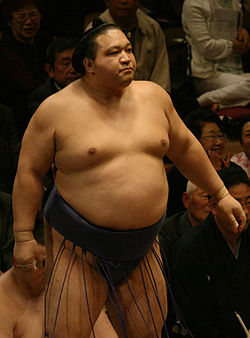 | |
| personal information | |
| Name | Hiroyuki Koga |
| Date of Birth | June 24, 1972 (aged 47) |
| Place of Birth | Nogata ( Japan ) |
| Height | 185 cm |
| Combat weight | 170 kg |
| Professional career [* 1] | |
| Hea | Tomozuna Bay |
| Rank | ozeki |
| Results [* 2] | 1047-700-158 |
| In makuuti [* 2] | 879-581-141 |
| Debut date | March 1988 |
| Top rank | Ozeki (September 2000) |
| Resignation date | July 2011 |
| Cups | 5 makuti , 1 makusita , 1 sandamme |
| Special prizes | 10 Shukun-sho , 5 Kanto-sho |
| Kimbosi | 6 ( Akebono (2), Takanohana (3), Wakanohana ) |
| |
Content
- 1 Career Summary
- 2 Wrestler Achievements
- 3 style of struggle
- 4 Results from Mukuti Debut
- 5 notes
- 6 References
Career Summary
He made his debut in 1988 under the name Koga along with the future Yokozunas Takanohana , Wakanohana and Akebono . He progressed more slowly than they did and did not reach such heights, however, as a wrestler, he was noticeably more durable. By the end of 2003, all three of these wrestlers resigned, but Cayo remained active ozeki for more than 7 years. During his career, he won the Imperial Cup 5 times, but did not become Yokozuna, which is a unique case. Cayo is highly respected in the world of sumo, he was especially popular at the autumn tournament in his native Fukuoka.
His career as a fighter lasted more than 23 years. The wrestler continued it, despite the burden of old injuries. He repeatedly stated that he would resign with the loss of the Ozeki title, but he was quite successful in holding this title year after year. So, in July 2010, in a duel with Kotoosyu, he received a serious shoulder injury, which put his participation in the September Aki Basho, and with it the continuation of his career, in doubt. However, in September he defended the title, albeit with a minimum score of 8-7, and in November showed a brilliant result of 12-3.
Retired from July 2011, continued his career as a junior oyakata Asakayama in Tomozuna Bay. October 22, 2013 announced that in early 2014 he would open his own Asakayama Bay Sumo School. [1] . In January 2014, the board of directors of the Sumo Association officially issued Cayo a permit [2] . As of September 2016, the strongest fighter of the Kaisei Asaki school takes 18th position in the third division of makushita [3] .
At the end of 2014, a monument to Cayo was erected at the Nogata railway station, built with funds collected by fans of the wrestler [4] .
Wrestler Achievements
At the end of his career, the wrestler owned the following career achievements:
- 107 top division tournaments ( makuuchi )
- 65 tournaments in the rank of Ozeki (shares a record with Tietaykai )
- 879 wins in the top division (the record was broken by Hakuho in May 2016)
- 1047 career victories (the record was broken by Hakuho in July 2017; the previous record holder was Tiyonofuji - 1,045 victories; Kayo broke his record in July 2011, just a few days before retirement)
- 1444 fights in the top division
In addition, Cayo is in the top ten in a number of other career indicators.
Wrestling Style
Preferred power struggle with captures, stamping and throws. He was known for his throw with a grab on the opponent's hand (kotenage), who sometimes carried out a traumatic hazard.
Makuuti Debut Results
| Sumo Year | January Hatsu Basho, Tokyo | March Haru Basho, Osaka | May Natsu Basho, Tokyo | July Nagoya Basho, Nagoya | September Aki Basho, Tokyo | November Kyushu Basho, Fukuoka |
|---|---|---|---|---|---|---|
| 1993 | x | x | Maegashira # 15 West 4–11 | (Juru) | (Juru) | Maegashira # 15 West 10–5 |
| 1994 | Maegashira # 6 West 8–7 | Maegashira # 1 West 9–6 In ★ | Komusubi # 1 East 8–7 | Komusubi # 1 East 5-10 | Maegashira # 2 East 9–6 | Komusubi # 1 East 8–7 |
| 1995 | Sekivake # 1 East 8–7 AT | Sekivake # 1 East 8–7 | Sekivake # 1 West 9–6 | Sekivake # 1 East 9–6 | Sekivake # 1 West 11–4 AT | Sekivake # 1 East 9–6 D |
| 1996 | Sekivake # 1 East 10–5 AT | Sekivake # 1 East 9–6 | Sekivake # 1 West 11–4 AT | Sekivake # 1 East 10–5 AT | Sekivake # 1 East 9–6 | Sekivake # 1 West 11–4 – P D |
| 1997 | Sekivake # 1 East 6–9 | Maegashira # 1 East 12–3 – P In ★ ★ | Sekivake # 1 East 7–5–3 | Missed due to injury 0–0–15 | Komusubi # 1 West 3–8–4 | Maegashira # 3 West 8–7 |
| 1998 | Komusubi # 1 East 8–7 | Komusubi West 8–7 AT | Sekivake # 1 West 7-8 | Komusubi # 1 West 7-8 | Maegashira # 1 East 7-8 ★ | Maegashira # 1 West 8–7 ★ ★ |
| 1999 | Maegashira # 1 East 9–6 | Komusubi # 2 West 10–5 | Sekivake # 1 West 12–3 D | Sekivake # 1 East 8–7 | Sekivake # 1 East 9–6 | Sekivake # 1 East 11–4 D |
| 2000 | Sekivake # 1 East 7-8 | Komusubi West 8–7 | Komusubi # 1 West 14–1 In D | Sekivake # 1 East 11–4 AT | Ozeki # 2 East 11–4 | Ozeki # 1 East 11–4 |
| 2001 | Ozeki # 1 East 10–5 | Ozeki # 1 East 13–2 | Ozeki # 1 East 4–5–6 | Ozeki # 3 East 13–2 | Ozeki # 1 East 0–4–11 | Ozeki # 2 East 10–5 |
| 2002 | Ozeki # 1 East 9–6 | Ozeki # 2 West 12–3 | Ozeki # 1 East 11–4 | Ozeki # 1 East 0–4–11 | Ozeki # 2 East 12–3 | Ozeki # 1 East 2–2–11 |
| 2003 | Missed due to injury 0–0–15 | Ozeki # 2 West 10–5 | Ozeki # 1 West 11–4 | Ozeki # 1 East 12–3 | Ozeki # 1 East 7-8 | Ozeki # 2 East 10–5 |
| 2004 | Ozeki # 2 East 10–5 | Ozeki # 1 West 13–2 | Ozeki # 1 West 10–5 | Ozeki # 1 East 11–4 | Ozeki # 1 East 13–2 | Ozeki # 1 East 12–3 |
| 2005 | Ozeki # 1 East 4–6–5 | Ozeki # 1 West 10–5 | Ozeki # 1 East 5–1–9 | Ozeki # 2 West 10–5 | Ozeki # 1 East 0–4–11 | Ozeki # 2 West 10–5 |
| 2006 | Ozeki # 1 West 3–6–6 | Ozeki # 2 West 8–7 | Ozeki # 2 West 9–6 | Ozeki # 2 East 9–6 | Ozeki # 2 East 1–6–8 | Ozeki # 3 West 10–5 |
| 2007 | Ozeki # 2 East 8–7 | Ozeki # 2 West 8–7 | Ozeki # 2 East 10–5 | Ozeki # 1 East 8–5–2 | Ozeki # 2 East 1–5–9 | Ozeki # 2 West 9–6 |
| 2008 | Ozeki # 2 East 8–7 | Ozeki # 2 East 8–7 | Ozeki # 1 West 8–7 | Ozeki # 2 East 9–6 | Ozeki # 2 East 9–6 | Ozeki # 1 West 1-3–11 |
| 2009 | Ozeki # 2 West 8–7 | Ozeki # 2 East 8–7 | Ozeki # 2 East 8–7 | Ozeki # 2 East 8–7 | Ozeki # 2 West 8–7 | Ozeki # 2 West 8–7 |
| 2010 | Ozeki # 2 West 9–6 | Ozeki # 2 East 8–7 | Ozeki # 2 West 9–6 | Ozeki # 3 West 6–5–4 | Ozeki # 2 West 8–7 | Ozeki # 2 West 12–3 |
| 2011 | Ozeki # 1 East 9–6 | Cancel Basho | Ozeki # 1 West 9–6 | Ozeki # 2 East Resignation 3–8–0 | x | x |
| The result is shown as won-lost-starred Victory Small Cup Resignation Did not play in makuuti Special prizes : D = For morale (Kanto-sho); B = For an outstanding performance (Shukun-sho); T = For technical excellence (Gino-sho) | ||||||
Notes
- ↑ Kaio établi l'Asakayama beya | Dosukoi, le site du sumo Archived January 13, 2014 on Wayback Machine
- ↑ Cayo opens his own school | Sumo. Traditions and modernity of Japanese wrestling
- ↑ Aki 2016 Banzuke
- ↑ Ozeki Cayo - man and statue
- ↑ Rikishi in JURO and Makunouchi . szumo.hu. Date of treatment December 31, 2009. Archived March 15, 2012.