Tolkiens (from Tolkien ) - fandom fans of the books of J. R. R. Tolkien , who has a close relationship with the role-playing subculture.
| Tolkiens | |
|---|---|
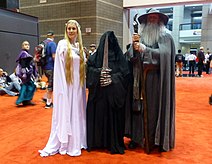 Cosplay characters "Lord of the Rings" | |
| Occurrence | 1960s |
| Heyday | 1960s, 2000s |
| Focus | fandom |
| Spread | Europe America Australia and New Zealand |
| Items | |
| fantasy , role-playing , fanfiction , filk , minstrel song | |
| Related | |
| Role , reenactors , geeks | |
Content
History
Fanaticism from Tolkien is mainly associated with the success of his epic The Lord of the Rings. The book was approvingly greeted with criticism, but at first did not cause much excitement. The real “boom” on Tolkien began after the publication in 1965 in the United States of a cheap edition of The Lord of the Rings in paperback, affordable for teenagers and young people. Interestingly, this edition was pirated, and John Tolkien himself tried to prevent him [1] . And within a few months, the official publication, also now in paperback, blocked the one hundred thousandth edition of the Ace Book with a million copies [2] .
"The Lord of the Rings" fell on fertile soil. The young people of the 1960s, fascinated by the hippie movement and the ideas of peace and freedom, saw a like-minded person in Tolkien. Many interpreted the book as an allegory of the struggle against an unjust social system, although Tolkien himself never claimed anything like this [3] . John himself was dissatisfied with his "cult", although he recognized that such success flattered him. He even had to change the number, because the fans bored him with calls.
Tolkienism in Russia can be counted from the first edition of The Hobbit in 1976 or The Lord of the Rings in 1982 [4] . However, only in the restructuring of the book Tolkien became truly accessible to the reader. Russia experienced a Tolkien boom in the 1990s. This can be attributed both to the fact that censorship has finally disappeared and western fashion for fantasy has reached Russia, and to the need of young people in escapism in a difficult historical period [5] .
Another wave of Tolkien’s popularity began in the early 2000s with the release of Peter Jackson ’s extremely popular film trilogy “ The Lord of the Rings ”. The screenshots attracted many people to the Tolkien fandom.
Some features
Tolkiens love to play role-playing events described by the Professor (as Tolkien is often called), call themselves the names of Tolkien's characters, or come up with names for themselves, guided by languages from the world of Tolkien ( Middle-earth ) [5] . They call themselves representatives of the magical peoples described in Tolkien: elves , gnomes , ents , orcs , goblins , hobbits , and others [6] . Tolkinists often appear at role-playing games or pose in clothes and make-up, depicting their alter ego [7] .
During the 2002 census, many Tolkien players expressed themselves, indicating elves, or hobbits, as their nationality. The largest percentage of "ethnic elves" was identified in Perm , where a local Tolkien club specifically organized a flash mob . [eight]
Some Tolkienians believe that the world described in the books of Tolkien really existed, and they are looking for confirmation or live according to this statement, and often “remember” that world and believe that they have incarnation there; or vice versa - their embodiment is only a shadow of those who lived there, and that they are not humans, but elves. Usually this does not prevent them from clearly realizing that in fact they are people - this is a manifestation of the so-called “mythological thinking”.
Tolkien Studies
Many Tolkiens are studying the creative heritage of J. R. R. Tolkien . For example, they study the languages of elves ( Sindarin or Quenya ), people ( Adunaik ), orcs ( Black dialect ), dwarves ( Khuzdul ), invented by Tolkien.
In addition, they translate Tolkien's articles and stories that were not published in their native language. There is, in particular, the literary society Tolkien Texts Translation, engaged in translation into Russian [9] .
Fan fiction / Apocrypha
Many Tolkinists, as well as fans of other writers, write fan fiction based on their favorite works. Some of these works became so popular that they were published by publishers, and their authors eventually became well-known writers [10] .
Among fan fiction there are both continuations, and polemical "views from the other side", and humorous parodies. The degree of compliance with the canon of different authors is different, so all of them belong to the apocrypha . Sometimes these apocrypha contradict the basic ideas of Tolkien , enter into polemics with them, defending another point of view - “The professor was wrong!”
Discussion of these apocrypha - the subject of fierce online disputes on sites and forums, where often appear Tolkinista. All works have both their ardent supporters and fierce opponents, and a neutral majority. So, at Lythforum, Olmer Citadel organized special “duels” to discuss Perumov’s “ Ring of Darkness ” and “ On the Other Side of Dawn ” by Brileva-Chigirinskaya.
Role-playing games
Role-playing games are especially closely associated with Tolkinists. They carry out "voles", conventions, role-playing games dedicated to the universe of Tolkien [11] . In the 1990s, the annual Hobbit Games (HIshki) were very popular. For some time the words “roleviki” and “tolkinists” were synonymous for the uninitiated, but the concept of “role-playing” is much broader.
Zilantkon (from Tatar Zilant - the mythical dragon depicted on the emblem of the city of Kazan ), which has been held since 1991 annually in November in Kazan , Sibcon , held since 1993 in Tomsk or Novosibirsk annually in February, KomCon, held in March near Moscow, and BlinKom - in December in St. Petersburg.
Folklore
Russian Tolkiens have a rich variety of folklore , which is regularly updated with the efforts of members of the subculture. This includes thematic songs , and anecdotes , and fan fiction , which have become popular enough to retell verbally. In addition to inventing jokes and writing songs and fan fiction, many Tolkinists devote attention and time to drawing fanart or creating objects of the “everyday culture of Middle-earth”. In some groups, over time, the canons of the "culture of Middle-earth" are established, complementing those described by Tolkien.
Interesting Facts
- In Omsk, on the territory of the natural recreational complex “Coastal” there is a memorial stone in honor of the Tolkiens, established in 1993 [12] ; there began the development of the Omsk role-playing movement.
See also
- Role players
- Mushroom Elves
- Historical reenactors
Notes
- ↑ The Letters of JRR Tolkien. Boston: Houghton Mifflin. ISBN 0-395-31555-7
- ↑ Carpenter, Humphrey. “D. R. R. Tolkien. Biography, ch. 3
- ↑ Mike Foster, America in the 1960s: Reception of Tolkien, in Drout (ed.) JRR Tolkien Encyclopedia (2006).
- ↑ Fiction Lab . J. R. R. Tolkien. Keepers. Translated by V. Muravyev, A. Kistyakovsky. Children's literature, 1982.
- ↑ 1 2 Subculture of Tolkiens (essay on sociology)
- ↑ * Tolkienist subculture through the eyes of a mythologist
- ↑ IS THAT WHO - IN CALCHUG AND JEANS? Arguments and Facts , Moscow, № 32.
- ↑ The census revealed in Russia hobbits, elves and Scythians
- ↑ Informal creative association Tolkien Texts Translation
- ↑ "Followers of the Professor - Another Look at Middle-earth" - the magazine " World of Science Fiction "
- ↑ With a wooden sword against reality
- ↑ Monument to the Tolkiens in Omsk . The appeal date is September 9, 2018.