Physalis Peruvian , or Cape gooseberry , or Peruvian cherry ( lat. Physalis peruviana ) is a fruit bush of the Solanaceae family .
| Physalis Peruvian | ||||||||||||||
|---|---|---|---|---|---|---|---|---|---|---|---|---|---|---|
 Flowers of Physalis Peruvian | ||||||||||||||
| Scientific classification | ||||||||||||||
| ||||||||||||||
| Latin name | ||||||||||||||
| Physalis peruviana L. |

Description
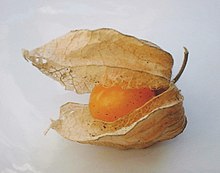
Physalis Peruvian is a herbaceous shrub 0.9-1.6 m high with heart-shaped velvety dentate leaves up to 6-15 cm long and up to 4-10 cm wide. The flowers are bell-shaped yellow with five dark violet-brown spots and a purplish-green hairy cup. The fruit is a spherical berry 1.25-2 cm in diameter, with smooth glossy orange-yellow skin and juicy pulp containing numerous small yellowish seeds. Ripe fruits have a sweet taste with a pleasant grape flavor. As with other types of physalis, the fruits of the physalis of Peruvian are enclosed in a hard, husky, inedible shell-cover formed from fused sepals .
Distribution
The birthplace of the physalis of Peruvian is the mountainous regions of Colombia , Peru and Chile . Currently introduced and cultivated in South Africa, parts of Central Africa, Central Asia, Australia , India , China , Malaysia , Belarus , Crimea and the Philippines . Grown in the steppe regions of Altai in the form of a bush with a height of about 40 cm and a diameter of fruits up to 1.5 cm (the local name is "berry").
Usage
The ripened fruits of the physalis of Peruvian are edible fresh. They are used to make jams , puddings , fruit salads and cocktails . In Colombia, a decoction of leaves is used as a diuretic and anti-asthma. Unripe fruits are poisonous.