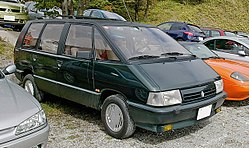


A minivan [1] ( eng. Minivan - “small van”) is a passenger car with a one - volume body and a bonnet-less (less often a wagon) or one-and-a-half (semi-flush) layout, usually with three rows of seats.
In domestic sources, this type of body previously could be designated as "UPV" - wagon with increased capacity.
The body of a minivan is always higher than that of conventional passenger-and-freight bodies of passenger cars such as station wagons and hatchbacks, since the main consumer property of a minivan consists precisely in maximizing the internal volume of the passenger compartment , as well as in the possibility of transforming it by folding easily removable (sometimes turning) passenger seats .
Early minivan models were often limited to a single rear passenger door.
The class of minivans includes cars with the number of passengers not exceeding 8 (with driver 9) seats. Cars with a large number of passenger seats are minibuses.
Over the past 20 years, the minivan has firmly occupied a consumer niche between conventional cars with cargo-and-passenger bodies belonging to category B and minibuses (class M1).
Content
The history of minivans
First Monocabs
The first attempts to create more rational in terms of layout and streamlined drop-shaped car bodies were undertaken before the First World War, for example, the Alfa 40-60 HP Aerodinamica 1914 protodovobodobenamika, preserved to this day, reappeared in the West mid-1930s due to the success of aerodynamics in aviation. The first domestic running models of “monospaces” went from the end of the 1940s, for example, NAMI-013 , created under the direction of designer Yu. A. Dolmatovsky or the revolutionary Belka microcar created jointly by NAMI and the Irbit motorcycle factory . Such prototypes were usually rear-engine (engine behind the rear axle) and with the driver's landing over the front axle, that is, related to the carriage layout. The passenger compartment was located exactly in the center of mass, which, in the opinion of the then designers, should have improved the weight distribution and, accordingly, handling at high speeds, although the driver’s workplace was located in front of or above the front wheel arches, in a zone of rigid vertical oscillations that did not contribute to comfort. and contributed to a strong galloping (longitudinal buildup of the car) when driving over the surface irregularities. The issue of expanding functionality was not yet on the agenda - a single-passenger car was considered from the point of view of creating a more rational replacement of the traditionally assembled one, with a reduction in its overall length while maintaining capacity, rather than a specialized passenger-and-freight version with a more spacious cabin.
Minivan ahead of time
The most famous production model of this type is the Fiat 600 Multipla created in 1956 on the platform of the mass Fiat 600 minicar. Thanks to the wagon layout, it was possible to place three double rows of seats in the cabin , ie, while maintaining the length of the base car, increase the capacity by 50%, plus the unfolded middle seat turned into a bed, actually allowing to operate the car as a tourist. However, the tightening of safety standards did not allow further development of the minivan on the basis of the wagon layout, and besides, consumers were not yet ready to accept such an original car, therefore already in 1960, the Multipla release was curtailed. Thus, the idea of a minivan ahead of its time by two decades. In the 1960-1970s, only a few attempts were made to develop this area, in fact, limited to concept cars at international car dealerships. At the same time, German and Japanese manufacturers made small-sized versions of wagon-type minibuses popular, for example, Volkswagen Transporter Typ 2 and Toyota Liteace .
The birth of a modern minivan
The next decisive step in the direction of the minivan was made by the French aerospace company Matra , which also had an automobile division (which was part of the PSA group), which in 1980 created a prototype of a one-volume automobile with a plastic body. However, he was not interested in the management of Peugeot-Citroën and, after appropriate refinement, the Renault concern became interested in the project, presenting the front-drive 7-seater minivan Renault Espace , which became the ancestor of all modern European minivans, at the 1984 Paris Motor Show. The success of the minivan was so great that it was even going to be released under license at the factories of American Motors Corp. ( AMC ), and in the first ten years after the debut Espace remained virtually a monopolist in this segment of the European market. On the other side of the ocean, the idea of a minivan received even more serious development. In connection with the sharp increase in the cost of oil, the Big Three concerns faced the issue of producing a more economical alternative to the popular family “Station Wagon”, that is, a full-sized station wagon with a three-row cabin layout. And, as a rule, the entrance and exit from the back row of seats facing against the course was through the rear pivot door, which was not very convenient, especially when transporting children and the elderly. In addition, the fuel consumption of such rear-wheel drive cars equipped with voracious multi-liter engines was very large (25-30 l / 100 km). The first problem was solved by Chrysler , which launched the family of original family minivans based on the T115 front-wheel-drive platform in 1983 and included three models: Dodge Caravan , Plymouth Voyager and Chrysler Town & Country . A year later, Chrysler's example was followed by competitors from GM , who offered the Chevrolet Astro and GMC Safari twin minivans to the market, which were made with a more conservative rear wheel drive layout, and another six months later Ford Aerospace was presented. At the same time, German and Japanese manufacturers tried to solve the problem with "little blood", throwing on the market improved equipment and faster versions of the same 7-9-seat "carriages", respectively, Volkswagen Caravelle (T3), Toyota Model F / Toyo Ace etc. The experts noted that although the weight of the “carriages” was better due to the appearance of lighter engines, as well as options with all-wheel drive transmission, semi-fleet and bonnetless minivans are still safer and more convenient, so that later such a scheme won, but carriage model Applicants were only able to stay in the segment vans .
Van or Minivan
The existing view that minivans are based on commercial delivery vans is fundamentally wrong, since they were originally developed on separate platforms and only later were commercial versions created on the basis of passenger models, for example, the family of commercial vans on the enhanced U64 Citroën Jumpy / Fiat Scudo platform / Peugeot Expert was created in 1995 on the basis of passenger minivans of the U60 family of the 1994 sample ( Citroën Evasion / Fiat Ulysse / Peugeot 806 ), and vans (Delivery Van) based on, for example, Chevrolet Astro / GMC Safari are released only after two or three years after assazhirskih versions.
Four Wheel Drive
Gradually, minivans became widespread and all-wheel drive (integrated) circuit, for example, Renault Espace received four-wheel drive in 1988. However, later all-wheel drive minivans actually merged with 7-seater full-size crossovers (with the exception of the Japanese market). It is characteristic that in Russia the first full-fledged minivan of the VAZ-2120 “Nadezhda” was created precisely on the all-wheel-drive platform of the VAZ-2131 “Niva”.
The rise and fall of American minivans
The sensational success of minivans in North America led the previously popular Station Wagons to a complete collapse - this class of cars actually left the market in the early 1990s. But the minivans themselves, having experienced the peak of success in the 80-90s (annual sales reached 2.5 million) in the 2000s, began to give way to the popularity of SUVs and, especially, to crossovers that took minivans practicality, a spacious three-row salon with a transformable layout and differing in a favorable direction with a more dynamic design and the possibility of going beyond asphalt roads. By 2008, sales of minivans in North America were reduced to the level of the early 1980s (less than 600 thousand), when this class of cars was just entering the market. In fact, in the 2009 model year of American brands, the production of “classic” minivans was kept only by Chrysler (Dodge Grand Caravan / Chrysler Town & Country ).
CompactWave
In Europe, the class of full-size minivans in the late 1990s was complemented by more economical and cheaper models, the so-called. compact cars on the platforms of passenger models of class C +, the firstborn among which were Renault Megane Scenic and Fiat Multipla (despite the fact that Multiple was several times named “the ugliest car of the year” by several authoritative publications, it deserved recognition and love among many Italian families). Such models can be attributed rather to the universal high-capacity ( UPV ).
Classification minivans
On the market there is a wide variety of body types such as a minivan, and there is no generally accepted classification of minivans. The following classification methods can be given:
1 way
- compact van ;
- mikroven , or monobody ;
- Multivan - minivan, designed to carry not only passengers, but also a variety of goods. Examples: Citroën Jumpy / Peugeot Expert Tepee , Hyundai H-1 , Toyota Hiace EU
2 way to
- large - cars longer than 4600 mm. They are characteristic of the North American market, where they are supplanted by the hood and semi-coiled (one and a half) crossovers of the MPV subclass. Examples of American full-size "clean" minivans: Chrysler Grand Voyager / Dodge Grand Caravan , Honda Odyssey , Toyota Sienna . European models in this segment include Citroën C8 / Fiat Ulysse / Peugeot 807 , Ford Galaxy / Volkswagen Sharan , Renault Espace / Renault Grand Espace ;
- Compact, or Compact MPV - cars with a body length of 4200-4600 mm. Popular both in Europe and in Japan. In North America, the class is practically not represented. Examples: Renault Scénic / Renault Grand Scénic , Volkswagen Touran , Mazda 5 ;
- mini - cars up to 4100 mm. Characterized by European and Japanese markets. Examples: Opel Meriva , Renault Modus , Nissan Cube ;
- micro - subcompact (length up to 3.4 m, width up to 1.475 m, height up to 2 m) city cars. They are characteristic of the Japanese (so-called key class microvenes), Chinese and Indian (as a rule, licensed copies of outdated Japanese models) markets. Examples: Daihatsu Atrai , Honda Acty , Suzuki Wagon R , Chery Riich II , Maruti Versa
Examples of modern minivans
"American"
- Ford Grand C-Max II
- Honda Odyssey IV
- Nissan quest
- Toyota Sienna II
"European"
- Citroën C4 Picasso / Grand C4 Picasso
- Opel zafira
- Peugeot partner
- Renault Espace IV
- Volkswagen Touran
Korean
- Hyundai ix20
- Kia venga
- Ssangyong rodius
- Hyundai matrix
- Kia karnival
"Russian"
- UAZ-220695
- Lada largus
- GAZ-2217 "Barguzin"
"Japanese"
- Daihatsu Atrai / Extol
- Honda Freed / Freed Spike
- Mazda MPV
- Mitsubishi Delica D: 5
- Nissan Note
- Nissan serena
- Subaru dex
- Toyota Estima