Galapagos penguin [1] [2] ( lat. Spheniscus mendiculus ) is a type of spectacled penguin .
| Galapagos penguin |
 |
| Scientific classification |
|---|
| No rank : | Bilateral symmetric |
|
| International Scientific Name |
|---|
Spheniscus mendiculus Sundevall , 1871 |
| Area |
|---|

|
| Security status |
|---|
Endangered speciesIUCN 3.1 Endangered : 22697825 |
|
The Galapagos penguin is unique among the other penguins in that the range is not Antarctic and sub-Antarctic areas , not even moderate, but Galapagos Islands just a few dozen kilometers from the equator . The air temperature in the habitat varies between + 18–28 ° C , water - + 22–24 ° C. [3] About 90 % of penguins live on the islands of Fernandina and Isabela [4] .
Adults reach a height of about 50 cm and weigh about 2.5 kg . The main diet - small fish , crustaceans .
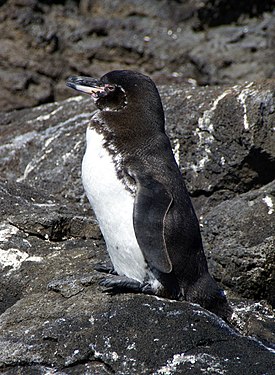
In the Galapagos penguins, the head and back are black , there is a white stripe going from the throat up to the head and reaching the eyes , in front of the penguins are white. The mandibles and the tips of the mandibles are black, the mandibles and the skin around the eyes are pinkish - yellow .
Birds usually hatch eggs for 38–40 days , alternately male with female. At the age of 60-65 days, the chicks go to sea with adults. Galapagos penguins nest near the water .
The number of individuals is estimated at 1500-2000 adult birds .