The Arab Caliphate ( Arabic: خلافة إسلامية - Islamic Caliphate) is a theocratic Islamic state that arose as a result of Muslim conquests in the 7th-9th centuries and was led by caliphs . Old Russian sources also know under the names the kingdom of Hagar and the kingdom of Izmailty , which thus included it in the general list of kingdoms (empires) of the world known to book people in Russia at that time.
| Historical state | |
| Arab caliphate | |
|---|---|
 Arab Caliphate on a world map. | |
632 - 1517 Righteous Caliphate (632–661) Umayyad Caliphate (661-750) Abbasid Caliphate (750–945, 1124–1258) | |
| Capital | 630–656 Medina 656–661 Mecca 661-750 Damascus 754-762 Al-Kufa 762-836 Baghdad 836–892 Samarra 892-1258 Baghdad 1259-1517 Cairo |
| Languages) | Arab |
| Population | Arabs , Persians , Iraqi Ajemis, Syrians |
| Official language | |
| Continuity | |
← Sassanid state ← Byzantine Empire ← Hassanids ← Kingdom of the Visigoths ← Caucasian Albania ← Khorezm ← Sogdiana | |
Medina community
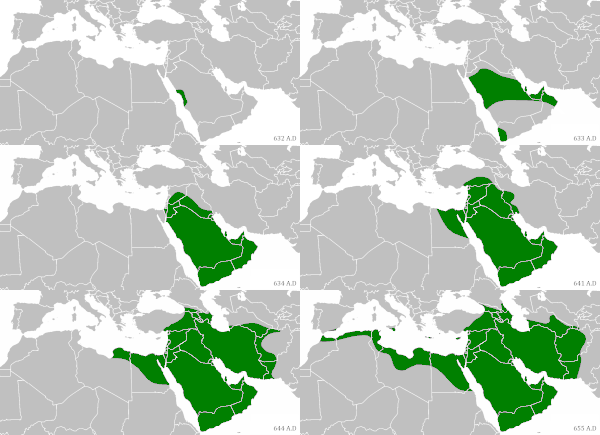
The initial core of the caliphate was the Muslim community, the Ummah, created by the Prophet Muhammad at the beginning of the 7th century in Hijaz (Western Arabia). Initially, this community was small and was a proto-state entity of a super-religious nature, by analogy with the Moses State or the First Christ Communities. As a result of the Muslim conquests , a huge state was created, including the Arabian Peninsula , Iraq , Iran , most of Transcaucasia (in particular, the Armenian Highlands , the Caspian territories, the Colchis Lowland , as well as the areas of Tbilisi ), Central Asia , Syria , Palestine , Egypt , North Africa , most of the Iberian Peninsula , Sind .
The word caliphate ( Arabic. خليفة - Khalīfah - “heir”, “representative”) means both the title of the caliph and the vast state created after Muhammad by the Arabs-conquerors under the leadership of his “caliphs” (governors).
The era of the existence of the Arab caliphate, along with several subsequent centuries of prosperity of the common Islamic science and culture, is referred to in Western historiography as the Golden Age of Islam .
Righteous Caliphate (632–661)
After the death of the Prophet Muhammad in 632, the Righteous Caliphate was created. He was led by four Righteous Caliphs : Abu Bakr al-Siddiq , Umar ibn al-Khattab , Usman ibn Affan and Ali ibn Abu Talib . During their reign, the Arabian Peninsula, the Levant (Sham), the Caucasus , part of North Africa from Egypt to Tunisia and the Iranian Highlands were included in the Caliphate.
In 632, the prophet Muhammad died without leaving an heir, and a dispute began between the Muhajirs (Meccans) and Ansars (Medins) over his successor, ending with the election of Caliph Abu Bakr al-Siddik, a close friend of the Prophet Muhammad. Meanwhile, with the news of the death of Muhammad, almost all of Arabia , except Mecca, Medina and at-Taif, immediately departed from Islam ( riddah ). The war against apostates allowed Abu Bakr to bring the tribes of Arabia back to Islam. Most of all, he was helped by the experienced commander Khalid ibn al-Walid , who defeated the 40,000th army of followers of the false prophet Musailima in the so-called "death fence" under Akrab (633). Immediately, to pacify the rebellion of the Arabs, Abu Bakr, continuing the policy of the Prophet Muhammad, led them to war against the Byzantines and the Persians.
The righteous caliph Umar ibn al-Khattab successfully continued his conquests, and thus, at the end of his life, he, in addition to Arabia himself, ruled in Asia Syria , Mesopotamia , Babylonia and the western part of modern Iran, and in Africa - Egypt , Barca and Tripoli .
Under caliph Usman , eastern Iran was conquered to Amu Darya (Oxus), the island of Cyprus , the region of Carthage . Civil strife among the Arabs caused by the assassination of Usman caused a break in the conquests, and some border areas fell away.
The last of the four Righteous Caliphs, Ali ibn Abu Talib , was killed by the Kharijites , after which Muawiya ibn Abu Sufyan of the Umayyad clan became the sole ruler in the Caliphate. Mu'awiy I proclaimed the heir of his eldest son, Yazid . Thus, a hereditary monarchy was formed from a state with elective rule, and Muaviya I himself became the ancestor of the Umayyad dynasty.
Umayyad Caliphate (661-750)
During the first Umayyad of Mu'awiyah I (661-680), the Arabs crossed the Amu Darya (Oxus) to Maverannahr , to Paikend , Bukhara and Samarkand , and in India they reached the Punjab ; they captured Asia Minor , they even approached Constantinople , and in Africa reached Algeria .
The second series of civil wars broke out under the son of Muaviya Yazid (680–683) and the Umayyad’s struggle with Hassan ibn Ali , Abdullah ibn az-Zubayr , Kharijits and others allowed some border areas to fall back, but after pacifying civil strife (since 693) Abd al-Malik (685–705) and his son Valide I (705–715) Arabs gain almost incredible success in Afghanistan, sowing. India and Maverannahr (751) - in the east, the Caucasus and Asia Minor - in the center, app. Africa (to the ocean), Spain and southern France - in the west. Only the energy of the emperor Leo Isaur and the Bulgarian khan Tervel , who bravely repelled the Arabs from Constantinople and Asia Minor (717–718), and Karl Martell (who lived in 717–741; from the Pipinid family, which went down in history as the savior of Europe), which put a limit to success Arabs in France (732), saved Europe from Muslim conquest.
In Iran since the end of the 6th century, troubles were going on. The country was exhausted by the wastefulness and extortion of Khosrov II Parviz (590-628), exhausting wars with Byzantium ( Irakli ) and anarchy . The vassals became independent and did not obey the shah; nobles elevated their henchmen to the throne, and the Zoroastrian clergy managed to weaken the country's internal fortress with their centuries-old, merciless persecutions of numerous heretics (Manichaeans, Mazdakites, etc.), sometimes even the culturally important element of the Christian state. Even before Muhammad, when Khosrov II abolished the vassal kingdom of Hira on the Euphrates , the border Bedouins- backrites defeated the Iranian army at Zu-Qar (near the lower Euphrates) and began to boldly carry out a series of robber raids on the Iranian outskirts. And under Abu Bakr, the Bekrit leader Mosann, who converted to Islam , tried to convince Abu Bakr that, with the rule of rule in Iran, a campaign against him could be quite successful.
In Byzantium, no matter how exhausted it was by the wars with Iran, there was more order, but in its eastern provinces with a foreign population (Semitic, on the outskirts even directly Arabic and Coptic ), Syria , Mesopotamia and Egypt - the inhabitants suffered from excessive taxes, from the Greek national arrogance and from Greek religious intolerance: the local religion was heretical ( Monophysite , etc.). Therefore, in those countries no one made an effort to oppose the Arabs; Moreover: out of hatred of the Greeks, in many cases the population itself called Arabs and helped them. On the contrary, Asia Minor, populated by real Greeks and fighting against the Arabs themselves, was never conquered by them for long, and under the walls of Constantinople the Arabs failed several times.
Caliphate government system
The following distinguishing features of the Arab Caliphate can be noted. The source of power is mainly based on religion. Religious, political and administrative authorities are inseparable. Ownership of land may be state, public and private. However, land is not a commodity. Taxes were imposed on the entire population. To maintain their combat readiness, the soldiers received a salary, and also had the right to collect some taxes from the population in the amount that was necessary so that the combat readiness was at the proper level.
Central government authorities
The caliph in the Arab caliphate had supreme power. He was the religious leader of the Arabs and all who believed in Allah. In addition, he held all the leading positions: he was the head of the church, the supreme head of state, the supreme owner of the land, the supreme commander, the supreme judge. And all the top officials were appointed only by the caliph.
The highest official under the caliph was the vizier as the chief adviser to the caliph. The vizier was endowed with great secular and military power. The vizier had the right to rule on behalf of the caliph, as well as control his court. It is worth noting that in the early stages of the development of the Arab Caliphate, the vizier’s competence was not at all like that, and he could only follow the orders of the caliph.
Over time, the competence of the viziers expanded, and they were able to manage on behalf of the caliph, but on their own. There were other important officials in the caliphate and at the court: the head of the caliph's bodyguards, the head of the police, and a special official to oversee other officials.
In the caliphate, the supreme central governing bodies were sofas (according to the Persian model) [1] :
Divan al-Jund is a military department that exercises control over all the armed forces, deals with equipment and weapons of the army, taking into account the number of armed forces, especially the standing army, and also takes into account salaries and awards for military service.
Divan al-Haraj is a financial and tax agency that oversees all internal affairs, takes into account taxes and other revenues to the state treasury, and also collects various statistical data for the country.
Divan al-Barid is the main postal agency, which oversees mail, communications, is engaged in the delivery of public goods, carries out road repairs, construction of caravanserais, and wells. In addition to its basic duties, the post office also served as the secret police. This was possible due to the fact that under the control of this department were all roads, the main points on the roads, transportation of goods, correspondence.
When the territory of the country began to expand, and its economy became much more complicated, the complexity of the country's governance structure became inevitable.
Local government
Initially, the territory of the Caliphate included Hijaz - the sacred land, Arabia - Arab lands and non-Arab lands. At first, in the conquered countries, the local apparatus of officials was preserved as it was in them before the conquest. The same was true for forms and methods of management. For the first hundred years, local state and administrative bodies in the territories that were conquered remained untouched. But gradually (towards the end of the first hundred years), pre-Islamic rule in the conquered countries was over.
Local government began to be built on the Persian model. Countries began to divide into provinces into which military governors were appointed - emirs, sultans, sometimes from the local nobility. The appointment of the emirs was the caliph himself. The main duties of the emirs were collecting taxes, commanding the troops and leading the local administration and police [2] . The emirs had assistants, who were called naibs .
It is worth noting that Muslim religious communities often led by sheikhs (foremen) often became the administrative unit. They often engaged in the implementation of local administrative functions. In addition, there were also officials and officials of various ranks who were appointed in cities and villages.
Judicial system
For the most part, in the Arab state, the court was directly connected with the clergy and separated from the administration. As mentioned earlier, the caliph was the supreme judge. He was subordinate to the college of the most respected legal scholars, scholars of Sharia, which belonged to the highest judicial power. On behalf of the ruler, they appointed lower-ranking judges (kadi) from the local clergy, as well as special commissioners who were supposed to monitor the activities of local judges.
Kadi were engaged in the consideration of court cases in places of all categories, monitored the execution of court decisions, supervised places of detention, certified wills, distributed inheritances, verified the law of land use, and managed vacuous property transferred by the owners to religious organizations [3] . Thus, it is obvious that the Cadi were endowed with very extensive powers. When the Cadi made a decision (whether judicial or otherwise), they were guided by the Qur'an and the Sunnah and decided cases based on their independent interpretation.
The sentence imposed by the cadi was final and it was impossible to appeal it. Only the caliph or his representatives could change this sentence or decision of the qadi. As for the non-Muslim population, as a rule, it was subject to the jurisdiction of the courts from representatives of its clergy.
Armed Forces
According to Islamic military doctrine, all believers are warriors of Allah. The original Muslim teaching says that the whole world is divided into two parts: the faithful and the infidels. The main task of the caliph is to conquer the infidels and their territories through the "holy war". All free Muslims who have come of age are required to take part in this "holy war."
It is worth noting that initially the main armed force was the Arab militia. If you look at the Caliphate of the Abbasids of the 7th-8th centuries, then there the army included not only a standing army, but also volunteers, commanded by their commanders. In the service in the standing army there were privileged Muslim soldiers, and the light cavalry was the basis of the Arab army [4] . In addition, the Arab army was often replenished with militias. At first, the army was subordinate to the caliph, and then the vizier became the commander in chief. The professional army appeared later. Mercenaryism also began to appear, but not on a large scale. Later, governors, emirs and sultans began to create their own armed forces.
The position of the Arabs in the Caliphate
The position occupied by the Arabs in the lands they conquered resembled a military camp very much; imbued with religious zeal for Islam, Umar I consciously sought to strengthen the character of the militant church behind the Caliphate and, bearing in mind the religious indifference of the total mass of Arabs-conquerors, forbade them to own land in conquered countries; Usman canceled this prohibition, many Arabs became landowners in the conquered countries, and it is clear that the interests of the landowner are more attracted to peaceful activities than to war; but in general, even under the Umayyads, Arab villages among foreigners did not manage to lose the character of a military garrison (v. Vloten, Recherches sur la domination arabe, Amsterd., 1894).
Тем не менее, религиозный характер арабского государства быстро изменялся: мы видим, как одновременно с распространением пределов X. и утверждением Омейядов совершается его быстрый переход из религиозной общины, руководимой духовным главой правоверных, наместником пророка Мухаммеда, в светско-политическую державу, управляемую государем единоплеменных ему арабов и покорённых инородцев. У пророка Мухаммеда и первых двух Праведных халифов политическая власть была лишь дополнением к его религиозному главенству; однако, уже со времён халифа Усмана начинается поворот, как вследствие вышеуказанного разрешения арабам иметь недвижимую собственность в завоёванных областях, так и вследствие отдачи Усманом правительственных должностей своим родственникам- Омейядам .
Положение неарабских народов
Уплачивая поземельный налог ( харадж ) в обмен на предоставление им защиты и неприкосновенности со стороны мусульманского государства, а также поголовный налог ( джизья ), иноверцы имели право исповедовать свою религию. Даже вышеупомянутым постановлениям ' Умара , принципиально признавалось, что закон Мухаммада вооружается только против язычников-многобожников; « люди Писания » — христиане , иудеи — могут, взнося плату, оставаться в своей религии; по сравнению с соседней Византией, где всякая христианская ересь преследовалась, закон ислама даже при ' Умаре был относительно либерален.
Так как завоеватели были совсем не подготовлены к сложным формам государственной администрации, то даже ' Умар принуждён был сохранить для новообразованного огромного государства старый, хорошо заведённый византийский и иранский государственный механизм (до Абдуль-Малика даже канцелярия велась не по-арабски), — а потому иноверцам не был отрезан доступ ко многим должностям по управлению. Из политических соображений Абд аль-Малик счёл нужным удалить не мусульман с государственной службы, но с полной последовательностью это распоряжение не могло быть проведено ни при нём, ни после него; да и у самого Абд аль-Малика близкие его придворные бывали христианами (известнейший пример — отец Иоанн Дамаскин ). Тем не менее среди покорённых народов заметна была большая наклонность отрекаться от своей прежней веры — христианской и парсийской — и добровольно принимать ислам. Новообратившийся, пока Омейяды не спохватились и не издали закон 700 г., не платил податей; наоборот, по закону Омара, он пользовался от правительства годовым окладом и полностью уравнивался с победителями; ему делались доступны более высокие государственные должности.
С другой стороны, обращаться в ислам покорённые должны были и по внутреннему убеждению; — как же иначе объяснить массовое принятие ислама, например, теми христианами-еретиками, которые перед тем в царстве Хосровом и в империи византийской никакими преследованиями не могли быть отклонены от веры своих отцов? Очевидно, ислам с его простыми догматами вполне говорил их сердцу. К тому же, ислам не представлялся ни для христиан, ни даже для парсов каким-нибудь резким новшеством: во многих пунктах он был близок к обеим религиям. Известно, что Европа долгое время видела в мусульманстве, высоко почитающем Иисуса Христа и Пресвятую Деву , не более, как одну из христианских ересей (например, православный архимандрит-араб Христофор Жара доказывал, что религия Мухаммада есть то же арианство )
Принятие ислама христианами и — затем — иранцами имело чрезвычайно важные последствия как религиозные, так и государственные. Ислам вместо индифферентных арабов приобретал в новых своих последователях такой элемент, для которого веровать было существенной потребностью души, и так как это были люди образованные, то они ( персы гораздо больше, чем христиане) занялись к концу этого периода научной обработкой мусульманского богословия и соединённой с ним юриспруденции, — предметов, скромно разрабатывавшихся до тех пор лишь немногочисленным кружком тех мусульман-арабов, которые, без всякой симпатии со стороны омейядского правительства, пребывали верны учению пророка.
Выше было сказано, что общий дух, которым проникнут Халифат в первом веке своего существования был староарабским (этот факт, гораздо яснее даже, чем в правительственной омейядской реакции против ислама, выразился в тогдашней поэзии , продолжавшей блистательным образом разрабатывать те же языческо-племенные, жизнерадостные темы, какие были намечены и в староарабских стихотворениях). В виде протеста против возвращения к доисламским традициям была образована небольшая группа сподвижников (« сахабов ») пророка и их наследников (« табиинов »), которая продолжала блюсти заветы Мухаммада, вела в тиши покинутой ею столицы — Медины и кое-где в других местах Халифата теоретическую работу над правоверным истолкованием Корана и над созданием правоверной сунны , то есть над определением истинно мусульманских традиций, согласно которым должна была бы перестроиться нечестивая жизнь современного им омейядского X. Эти традиции, которые, в числе прочего, проповедовали уничтожение племенного принципа и уравнительное объединение всех мусульман в лоне Мухаммадовой религии, пришлись новообращённым инородцам, очевидно, по сердцу более, чем высокомерное неисламское отношение правящих арабских сфер, и потому мединская богословская школа, забитая, игнорируемая чистыми арабами и правительством, нашла себе в новых мусульманах-неарабах деятельную поддержку.
Perhaps there were known disadvantages for the purity of Islam from these new, believing followers of it: partly unconsciously, partly even consciously, ideas or tendencies began to creep into it, Muhammad was alien or unknown. Probably, the influence of Christians (A. Müller, “Ist. Isl.”, II, 81) explains the appearance (at the end of the 7th century) of the Murghiite sect, with its teaching on the Lord's immense mercy forbearance, and the Kadarita sect, which is a teaching on free will man prepared the triumph of mutazilites ; probably, mystical monasticism (under the name of Sufism ) was borrowed by Muslims at first from Syrian Christians (A. f. Kremer “Gesch. d. herrsch. Ideen”, 57); in lower Mesopotamia Muslim converts from the Muslims joined the ranks of the republican democratic sect of the Kharijites , equally disgusting to both the unbelieving Umayyad government and the Medina rightists.
The participation of the Persians, which later came, but was more active, turned out to be even more double-edged. A significant part of them, not being able to get rid of the centuries-old ancient Persian view that “royal grace” (farrakh kayanik) is transmitted only through heredity , joined the Shiite sect (see), which stood behind the dynasty of Ali (husband of Fatima, daughter of the prophet) ; moreover, to stand behind the direct heirs of the prophet meant for foreigners to constitute a purely legitimate opposition against the Umayyad government, with its unpleasant Arab nationalism. This theoretical opposition acquired a very real meaning when Umar II (717–720), the only Umayyad devotee to Islam, decided to implement the principles of the Qur'an that are favorable for non-Muslim Muslims and, thus, introduced disorganization into the Umayyad system of government.
30 years after it, the Khorasan Shiite Persians overthrew the Umayyad dynasty (the remains of which fled to Spain; see the corresponding article). True, due to the tricks of the Abbasids, the throne of X. was won (750) not by the Alids, but by the Abbasids, also relatives of the prophet (Abbas is his uncle; see the corresponding article), but, in any case, the Persians' expectations were justified: under the Abbasids they gained an edge in the state and breathed new life into it. Even the capital X. was transferred to the borders of Iran: first - to Anbar , and since Al-Mansur - even closer to Baghdad , almost to the same places where the capital of the Sassanids was ; and for half a century, the members of the Barmakid visor family, descended from Persian priests, became hereditary advisers of the caliphs.
Abbasid Caliphate (750–945, 1124–1258)
First Abbasids
The founder of the dynasty Abu-l'Abbas al-Saffah , that is, "Bloodshed" ( 750 - 754 ); compared in the way of action with Louis XI , the brilliant organizer of the state and finances Al-Mansur (754-775); to the extravagance, the generous and therefore popular in literature father of Harun ar-Rashid - Al-Mahdi (775–785); the fierce Al-Hadi (785-786); the famous patron of poets and writers Harun ar-Rashid (786–809), who witnessed the highest splendor of the caliphate; Al Amin (809-813); friend of scientists and freedom-loving philosophers, Persian by mother - Al-Mamun (813-833); the successors of his liberal views are Al-Mutasim (833–842) and Al-Wasik (842–847).
The caliphate has narrowed somewhat: the surviving Umayyad Abd al-Rahman I laid the first foundation in Spain ( 755 ) for the independent Cordobian emirate , which has officially been called the "caliphate" (929-1031) since 929 . 30 years later, Idris , great-grandson of Caliph Ali and therefore equally hostile to both the Abbasids and the Umayyads, founded the Alid Idrisid dynasty ( 785 - 985 ) in Morocco , the capital of which was the city of Tudga; the rest of the northern coast of Africa ( Tunisia , etc.) was actually lost to the Abbasid caliphate when the governor Aglab appointed by Harun al-Rashid was the founder of the Aglabid dynasty in Kairouan ( 800 - 909 ). The Abbasids did not consider it necessary to resume the foreign aggressive policy against Christian or other countries, and although at times there were military clashes both on the eastern and northern borders (like two unsuccessful campaigns of Mamun against Constantinople ), however, in general, the caliphate lived peacefully.
Such a feature of the first Abbasids as their despotic, heartless and, moreover, often insidious cruelty is noted. Sometimes, as with the founder of the dynasty, it was an open subject of Caliph pride (the nickname "Bloodshed" was chosen by Abul Abbas himself). Some of the caliphs, at least the cunning al-Mansur, who loved to put on the hypocritical clothes of piety and justice in front of the people, preferred, where possible, to act cunningly and execute dangerous people stealthily, at first lulling their caution with oaths and promises. Al-Mahdi and Harun al-Rashid brutality was obscured by their generosity, however, the treacherous and ferocious overthrow of the Barmakid Vizier family, which is extremely useful for the state, but imposed a certain reins on the lord, is one of the most disgusting acts of oriental despotism in Harun. It must be added that under the Abbasids, a system of torture was introduced into legal proceedings. Even the tolerant philosopher Mamun and his two successors are not too free from the reproach of tyranny and hard-heartedness towards people unpleasant for them. Kremer finds (“Culturgesch. D. Or.”, II, 61; compare Müller : “Isst. Isl.”, II, 170) that the very first Abbasids notice signs of hereditary Caesar madness, which is further intensified among posterity.
In justification, one could only say that to suppress the chaotic anarchy that the Islamic countries were in during the reign of the Abbasid dynasty, excited by the adherents of the ousted Umayyads, bypassed Alids, predatory Kharijits and not ceasing to rise in the northern outskirts of the state by various Persian radical sects, cool , terrorist measures were, perhaps, a simple necessity. Apparently, Abul Abbas understood the meaning of his nickname "Bloodshed". Thanks to the formidable centralization that the heartless man managed to introduce, but the brilliant policy of al-Mansur, the subjects were able to enjoy inner peace, and public finances were delivered brilliantly.
Even the scientific and philosophical movement in the caliphate dates from the same cruel and treacherous Mansur ( Masudi : “Golden Meadows”), who, despite his notorious stinginess, was encouraged by science (having in mind, first of all, practical, medical goals) . But, on the other hand, it remains certain that the caliphate could hardly have flourished if Saffah, Mansur and their successors ruled the state directly, and not through the talented Vizirian Persian-Barmakid family. Until this family was overthrown ( 803 ) by the reckless Harun ar-Rashid, weighed down by her guardianship, some of its members were the first ministers or close advisers to the caliph in Baghdad ( Khalid , Yahya , Jafar ), others were in important government posts in the provinces (like Fadl ), and all together managed, on the one hand, to maintain the necessary balance between the Persians and Arabs for 50 years, which gave the caliphate its political strength, and on the other hand, to restore the old Sassanian life, with its social structure, from its cultures oh, with her mental movement.
The Golden Age of Arab Culture
This culture is usually called Arabic, because the Arabic language has become the organ of mental life for all peoples of the caliphate, - they say therefore: “Arabic art”, “Arab science”, etc. but in essence it was most of all the remnants of the Sassanian culture and the Old Persian culture in general (which, as you know, also absorbed much from India , Assyria , Babylon and, indirectly, from Greece ). In the West Asian and Egyptian parts of the caliphate, we observe the development of remnants of the Byzantine culture, just as in North Africa, Sicily and Spain - the culture of the Roman and Roman-Spanish - and the uniformity in them is imperceptible, if we exclude their link - the Arabic language. It cannot be said that the alien culture inherited by the caliphate rose under the Arabs qualitatively: the Iranian-Muslim architectural structures are lower than the old Parsi, Muslim products from silk and wool are equally, household utensils and jewelry, despite their charm, are inferior to the old ones.
But on the other hand, in the Muslim, Abbasid period in a vast united and orderly state, with carefully arranged communication lines, demand for Iranian-made items increased, and the number of consumers increased. Peaceful relations with neighbors allowed the development of a wonderful foreign exchange trade: with China through Turkestan and - by sea - through the Indian archipelago , with the Volga Bulgars and Russia through the Khazar kingdom , with the Spanish emirate , with all of Southern Europe (with the possible exception of Byzantium ), with eastern shores of Africa (from where, in turn, ivory and slaves were exported), etc. Basra was the main port of the caliphate.
The merchant and industrialist are the main characters of Arabian tales; various dignitaries, military leaders, scholars, etc. were not ashamed to add the nickname Attar (“ Muscovite ”), Hayyat (“tailor”), Javkhariy (“jeweler”), etc. to their titles. However, the nature of the Muslim-Iranian industry is not so much a satisfaction of practical needs as luxury. The main production items are silk fabrics ( muslin-muslin , satin, moire , brocade ), weapons ( sabers , daggers, chain mail ), embroidery on canvas and leather, gimmicks, carpets, shawls, embossed, engraved, carved ivory and metals , mosaic works, earthenware and glass products; less often, products that are purely practical - paper, cloth, and camel wool.
The well-being of the agricultural class (from considerations, however, taxable, and not democratic) was raised by the restoration of irrigation canals and dams, which were launched during the last Sassanids . But even according to the consciousness of the Arab writers themselves, the caliphs were not able to bring the people's ability to such a height as was achieved by the tax system of Khosrov I Anushirvan , although the caliphs ordered that the Sassanid cadastral books be translated into Arabic deliberately for this purpose.
The Persian spirit also masters Arab poetry, which now instead of Bedouin songs gives sophisticated works by the Basriian Abu Nuwas (“Arab Heine ”) and other court poets Harun al-Rashid. Apparently, not without Persian influence (Brokkelman: “Gesch. D. Arab. Litt.”, I, 134) a correct historiography arises, and after the “Life of the Apostle” compiled by Ibn Ishaq for Mansur, a number of secular historians also appear. From the Persian language, Ibn al-Mukaffa (circa 750) translates the Sassanian Book of Kings , the Pahlavi version of Indian parables about Kalila and Dimna, and various Greek-Syro-Persian philosophical works, which Basra, Kufa and later became familiar with. and Baghdad . The same task is performed by people of a language closer to the Arabs, former Persian subjects, Aramaic Christians Jondishapur, Harran , etc.
Moreover, Mansur also takes care of translating Greek Greek medical, and also mathematical and philosophical works into Arabic (Masudi: “Golden Meadows”). Harun gives the manuscripts brought from Asia Minor trips for transfer to the Jondishapur doctor John Ibn Masaveykh (who was even involved in vivisection and was then a medical doctor at Mamun and his two successors), and Mamun arranged, especially for abstract philosophical purposes, a special translation college to Baghdad and attracted philosophers ( Kindi ). Under the influence of Greek-Syro-Persian philosophy, the commentary on the interpretation of the Qur'an turns to scientific Arabic philology (Basrik Khalil, Basrik Persian Sibavehihi ; teacher Mamuna, Kufi Kisviy) and the creation of Arabic grammar, philological collection of works of pre-Islamic and Umayyad folk literature, ( Hoseilite poems , etc.).
The century of the first Abbasids is also known as the period of the highest tension of Islamic religious thought, as the period of a strong sectarian movement: the Persians, who now converted to Islam by the masses, took Muslim theology into their hands and aroused a lively dogmatic struggle, among which heretical sects, which were outlined even during Umayyads, got their development, and Orthodox theology and jurisprudence was defined in the form of 4 schools, or explanations: under Mansur - the more progressive Abu Hanifa in Baghdad and the conservative Malik in Medina e , under Harun - relatively progressive al-Shafi'ah , under Mamun - ibn Hanbal . The attitude of the government towards these orthodoxes was not always the same. Under Mansur, a supporter of mutazilites , Malik was carved to mutilation.
Then, during the next 4 reigns, faith prevailed, but when Mamun and his two successors elevated (from 827 ) mutazilism to the level of state religion, followers of the Orthodox faiths were officially persecuted for “ anthropomorphism ”, “ polytheism, ” etc., and al-Mutasime was carved and tortured by the holy imam ibn Hanbal ( 834 ). Of course, the caliph sect of mutazilites could patronize fearlessly, because its rationalist doctrine of the free will of man and the creation of the Qur'an and its penchant for philosophy could not seem politically dangerous. To sects of a political nature, such as Kharijits , Mazdakites , and Shiites , who sometimes raised very dangerous uprisings (the false prophet Persian Mokanna in Khorasan under al-Mahdi, 779 , the brave Babek in Azerbaijan under Mamun and al-Mutasim, etc. ), the attitude of the caliphs was repressive and merciless even at the time of the supreme power of the caliphate.
Caliphs political power
Caliphs witnessed the gradual collapse of X.: the already mentioned Mutawakkil (847-861), the Arabian Nero , very much praised by the right-wingers; his son Muntasir (861–862), who ascended the throne, killing his father with the help of the Turkic Guard, Mustain (862–866), Al-Mutazz (866–869), Mukhtadi I (869–870), Mutamid (870–892 ), Mutadid (892–902), Muktafi I (902–908), Muktadir (908–932), Al-Kahir (932–934), Al-Radi (934–940), Muttaki (940–944), Mustakfi (944–946). In their face, the caliph from the lord of a vast empire turned into the prince of a small Baghdad region, at war and at peace with its sometimes stronger, sometimes weaker neighbors. Inside the state, in their capital Baghdad , the caliphs became dependent on the high-handed Praetorian Turkic guard, which Mutashim considered it necessary to form (833). Under the Abbasids, the national identity of the Persians came to life (Goldzier: "Muh. Stud.", I, 101-208). The reckless extermination by Harun of the Barmakids, who knew how to unite the Persian element with the Arab, led to disagreement between the two nationalities.
Under Al-Mamun, the strong political separatism of Persia was expressed in the founding of the Tahirid dynasty in Khorasan (821–873), which turned out to be the first symptom of the impending retreat of Iran. After the Tahirids (821–873), independent dynasties formed: Saffarids (867–903; see), Samanids (875–999; see), Ghaznavids (962–1186; see), and Persia slipped out of the hands of the caliphs. In the West, Egypt, along with Syria, separated under the rule of the Tulunids (868–905); however, after the fall of the Tulunids, Syria and Egypt were again under the control of the Abbasid governors for 30 years; but in 935, Ihshid founded his dynasty (935–969), and since then not a single region west of the Euphrates ( Mecca and Medina also belonged to the Ihshids ) was subordinate to the secular authority of the Baghdad caliphs, although their rights of spiritual masters were recognized everywhere (except , of course, Spain and Morocco ); a coin was minted with their name and a public prayer ( hutba ) was read .
Гонения на свободомыслие
Почувствовав своё ослабление, халифы (первый — Аль-Мутаваккиль , 847) решили, что им следует снискать себе новую поддержку — в правоверном духовенстве, а для этого — отречься от мутазилитского вольнодумства. Таким образом со времён Мутаваккиля наряду с прогрессирующим ослаблением власти халифов идёт усиление правоверия, преследование ересей, свободомыслия и иноверства (христиан, иудеев и пр.), религиозное гонение на философию, на естественные и даже на точные науки. Новая могущественная школа богословов, основанная Абуль-Хасаном аль-Ашари (874—936), покинувшим мутазилитство, ведёт научную полемику с философией и светской наукой и одерживает победу в общественном мнении.
Однако, фактически убить умственное движение халифы, с их всё более и более падающей политически властью, не были в силах, и наиболее славные арабские философы (басрийские энциклопедисты, Фараби , Ибн Сина ) и др. учёные жили под покровительством вассальных государей как раз в ту эпоху ( IX — XI в.), когда официально в Багдаде, в исламской догматике и в мнении народной массы философия и несхоластические науки были признаваемы за нечестие; а литература к концу названной эпохи дала величайшего вольнодумного арабского поэта Маарри (973—1057); в то же время и суфизм , очень хорошо привившийся к исламу, переходил у многих своих персидских представителей в полнейшее вольномыслие.
Каирский халифат
Шииты (ок. 864) также сделалась могущественной политической силой, особенно их ветвь Карматы (см.); когда в 890 г. карматами была построена в Ираке сильная крепость Дар аль-хиджра, ставшая оплотом для новообразованного грабительского государства, с тех пор «все боялись исмаилитов, а они никого», по выражению арабского историка Новейрия, и карматы распоряжались, как хотели, в Ираке, Аравии и пограничной Сирии. В 909 г. карматам удалось основать в северной Африке династию Фатимидов (909—1169), которая в 969 г. отняла у Ихшидов Египет и южную Сирию и провозгласила Фатимидский халифат ; власть фатимидского X. признала и северная Сирия с её талантливой династией Хамданидов (929—1003), у которой нашла покровительство свободомыслящая арабская философия, наука и поэзия. Так как в Испании Омейяд Абд ар-Рахман III тоже успел принять титул халифа (929), то теперь сразу оказалось три X.: Фатимидский (Египетский), Кордовский и Багдадский .
Последние халифы из династии Аббасидов
Халиф аббасидский, то есть в сущности мелкий багдадский князь с титулом, был игрушкой в руках своих тюркских военачальников и месопотамских эмиров: при Ал-Ради (934—941) учреждена была особая должность майордома («эмир-аль-умарâ»). Между тем по соседству, в западной Персии, выдвинулась шиитская династия Буидов , отложившаяся от Саманидов в 930 г. (см.). В 945 г. Буиды захватили Багдад и владели им более ста лет, с титулом султанов, а в это время там номинальными халифами были: Мустакфи (944—946), Ал-Мути (946—974), Ал-Таи (974—991), Ал-Кадир (991—1031) и Аль-Каим (1031—1075). Хотя из политических расчётов, для противовеса Фатимидам, шиитские султаны-Буиды называли себя вассалами, «эмирами аль-умарâ» суннитского Багдадского халифата, но, в сущности, они обращались с халифами как с пленниками, с совершенным неуважением и презрением, покровительствовали философам и вольномыслящим сектантам, и в самом Багдаде делал успехи шиизм .
Вторжение сельджуков
Луч надежды на избавление от притеснителей мелькнул халифам в лице нового завоевателя, тюркского султана Махмуда Газневи (997—1030), который, создав вместо низринутого им саманидского государства свой собственный огромный султанат, показал себя ярым суннитом и всюду вводил правоверие; однако, только у мелких Буидов он отнял Мидию и ещё кое-какие владения, а столкновений с главными Буидами избегал. В культурном отношении походы Махмуда оказались для завоёванных им стран очень губительными. В 1036 г. страшное несчастье поразило всю мусульманскую Азию: турки - сельджуки приступили к своим опустошительным завоеваниям и нанесли первый смертельный удар азиатско-мусульманской цивилизации, потрясённой уже тюрками-Газневидами. Но халифам стало лучше: в 1055 г. вождь сельджуков Тогрул-бек въехал в Багдад, освободил халифа от власти еретиков-Буидов и вместо них сам сделался султаном; в 1058 г. он торжественно принял от аль-Каима инвеституру и окружил его внешними знаками почтения.
Аль-Каим (ум. 1075), Мухтади II (1075—1094) и Аль-Мустазхир (1094—1118) жили в материальном довольстве и уважении, как представители мусульманской церкви, а аль-Мустаршиду (1118—1135) сельджукид Мас'уд даровал для самостоятельного светского управления Багдад и большую часть Ирака, которые остались и за его преемниками: ар-Рашидом (1135—1136), аль-Муктафи (1136—1160), аль-Мустанджидом (1160—1170) и аль-Мустади (1170—1180).
Кордовский халифат прекратил своё существование в 1031 году: оставшиеся удельные князья и главные из них, Аббасиды Севильские, ввиду трудной борьбы с христианским полководцем Сидом , пригласили к себе в 1086 г. марокканскую династию Альморавидов , которую сменили крайне фанатичные Альмохады (1130—1269).
Конец X. Фатимидскому, столь ненавистному для Аббасидов, положил верный суннит Саладин (1138—1193). Основанная им египетско-сирийская династия Айюбидов (1169—1250) почитала имя багдадского халифа.
Вторжение монголов
Пользуясь слабостью распавшейся сельджукской династии, энергичный халиф Ан-Насир (1180—1225) задумал расширить пределы своего маленького багдадского X. и отважился вступить в борьбу с могущественным хорезмшахом Мухаммедом ибн Текешем , который выдвинулся вместо сельджуков. Ибн Текеш велел собранию богословов перенести X. с рода Аббаса на род Али и направил войска на Багдад (1217—1219), а Ан-Насир послал посольство к монголам Чингисхана , приглашая их вторгнуться в Хорезм . Ни Ан-Насир (ум. 1225), ни халиф Аз-Захир Биамриллах (1220—1226) не видели конца навлечённой ими катастрофы, которая погубила исламские страны Азии. Последними багдадскими халифами были Аль-Мустансир (1226—1242) и Аль-Мустасим (1242—1258), который в 1258 году сдал Багдад монголам и был казнён последними с большей частью членов своей династии [прим. 1] .
Один из них бежал в Египет, и там мамлюкский султан Бейбарс I ( 1260 — 1277 ) с целью иметь для своего султаната духовную поддержку, возвёл его в ранг «халифа» под именем Мустансира ( 1261 ). Потомки этого Аббасида оставались номинальными халифами при султанах каирских до тех пор, пока власть мамлюков не была свергнута османским завоевателем Селимом I (1517). Чтобы иметь все официальные данные духовного главенства над целым исламским миром Селим I заставил последнего из этих халифов и последнего в роду Аббасидов, Мотаваккиля III, торжественно отречься от своих халифских прав и титула в пользу османских султанов .
Notes
- Comments
- ↑ По монгольской традиции не проливать кровь правоверных Халифа, завёрнутого в ковёр, растоптали лошадьми. .
- Sources
- ↑ Пашков Р. В. Исламское государственное право в двух томах. Том 1. — Москва: Издательство "Русайнс", 2017. — С. 30—32. — 210 с. — ISBN 978-5-4365-1572-4 .
- ↑ Пашков Р. В. Исламское государственное право в двух томах. Том 1. — Москва: Издательство "Русайнс", 2017. — С. 30—32. — 210 с. — ISBN 978-5-4365-1572-4 .
- ↑ Пашков Р. В. Исламское государственное право в двух томах. Том 1. — Москва: Издательство "Русайнс", 2017. — С. 30—32. — 210 с. — ISBN 978-5-4365-1572-4 .
- ↑ Пашков Р. В. Исламское государственное право в двух томах. Том 1. — Москва: Издательство "Русайнс", 2017. — С. 30—32. — 210 с. — ISBN 978-5-4365-1572-4 .
Literature
- Гевонд (VIII век), Товма Арцруни (IX век), Ованес Драсханакертци (X век), и др.
- Стенли Лэн-Пуль . Мусульманские династии. M., 2004.
Links
- Наумкин В. В. Халифат. Как это начиналось // Военное обозрение. — 23.01.2015.