The brilliant Order of St. Patrick ( Eng. The Most Illustrious Order of Saint Patrick ) - British Order of Knight , associated with Ireland . Equivalent to the English Order of the Garter and the Scottish Order of Thistle . It was founded in 1783 by King George III . Regular awards continued until most of Ireland became independent in 1921. The last award took place in 1936. The last knight of the order, Prince Henry, Duke of Gloucester , died in 1974. However, officially the order still exists, being a “sleeper”. Its head is Queen Elizabeth II . Order motto - “ Quis separabit? ”(“ Who will separate us? ”), An abbreviated Gospel phrase“ Who will separate us from the love of Christ? ”( Romans 8:35).
| Brilliant Order of St. Patrick | |||
|---|---|---|---|
| The Most Illustrious Order of Saint Patrick | |||
| |||
| Motto | Quis separabit? | ||
| A country |  Great Britain Great Britain | ||
| Type of | knightly order | ||
| Who is awarded by | |||
| Status | "Sleeping" (not given, but not abolished) | ||
| Statistics | |||
| Establishment Date | 1783 | ||
| Last award | 1936 | ||
| Sequence | |||
| Senior award | |||
| Junior reward | |||
| Complies | Order of the Garter Order of the Thistle | ||


History
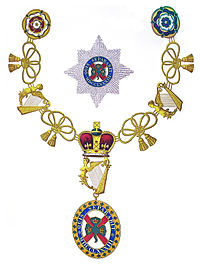

Of the three highest British orders, the Order of St. Patrick is the youngest. Its English equivalent, the Order of the Garter , was founded in 1348 and is the most ancient order of Great Britain. The Scottish Order of Thistle was founded in 1687 .
The Order was founded in 1783, one year after Ireland gained substantial autonomy. Bylaws of the order, membership was limited to men, noblemen of the third generation, both from the father and the mother, in fact, only Irish princes and peers of the Irish Parliament were dedicated to the knights of the order. The cross of St. Patrick (red St. Andrew’s cross on a white background) was chosen as one of the symbols of the order. The flag with the cross of St. Patrick was later used as a semi-official flag of Ireland up to the Union Act of 1800 , when this cross was included in the flag of Great Britain .
In 1907, the main insignia of the Order ( Royal Regalia of Ireland , Eng. Irish Crown Jewels ) shortly before the visit of King Edward VII were stolen from Dublin Castle . The royal regalia of Ireland were worn by the monarch at the ceremony of consecration of new knights. The whereabouts of the abducted is still unknown.
After 1922, only three people were awarded, all three of whom were the sons of George V : in 1927, Prince of Wales , future King Edward VIII , in 1934, Prince Henry, Duke of Gloucester , in 1936, Prince Albert, Duke of York and King George VI .
In 1943, Winston Churchill proposed to revive the order in honor of Harold Alexander’s merits during the hostilities in Tunisia , but the government and parliament did not support this idea, believing that the revival of such an order would upset the balance of power between London and Dublin .
In the 1960s, Irish Prime Minister Sean Lemass also attempted to revive the order, but the decision was never made.
Literature
- Galloway, Peter. Order of St Patrick and its knights. - London: Unicorn, 1999. - ISBN 0-906290-23-6 .
- Nicolas, Nicholas H. History of the Orders of the British Empire, Vol iv. - London, 1842.
- Woodcock, T. The Oxford Guide to Heraldry. - Oxford: Oxford University Press, 1988. - ISBN 0-19-211658-4 .
- Statutes of the Most Illustrious Order of St. Patrick. This is the first installation in 1783 . - Dublin: G. Grierson, 1800.
- Statutes and Ordinances of the Most Illustrious Order of Saint Patrick . - Dublin: GA and JF Grierson, 1831.
- Order of Saint Patrick. Report . - HMSO, 1908. - Vol. Cd.3906.
- Order of Saint Patrick. Appendix . - HMSO, 1908. - Vol. Cd.3936.
Links
- Monarchy Today: Queen and Prayer: Honor: Order of St Patrick . Official website of the British Monarchy . The date of circulation is December 3, 2006. Archived August 18, 2011.
- The National Cathedral and Collegiate Church of Saint Patrick. (2004). "Knights of St Patrick"