 Play media file
A film ( English film - film), as well as cinema, motion picture, television movie, motion picture is a separate work of cinema art . Technologically, a film is a collection of moving images ( editing frames) connected by a single plot [1] . Each editing frame consists of a sequence of photographic or digital still images ( frames ), on which individual phases of movement are fixed. The film, as a rule, has a soundtrack .
At the beginning of the 20th century, it was customary in Russia to say “film” (in the feminine gender [2] ), and, in addition to the usual meaning, this word referred to film [3] .
The area of human activity associated with the creation and reproduction of films is called cinema . Cinema includes the scope of the film as one of the areas of art ( film art ), ( film technology ), as well as the film industry . Films are created by recording moving images of the surrounding world using movie cameras or digital movie cameras , and are also made from individual images using animation or special effects .
Watching movies is part of modern culture. Heroes of popular films and actors who play them often become famous, and their images are recognizable. Especially for mass viewing of movies, cinemas are being built. Typically, a film is 90-120 minutes (1.5-2 hours). At home, to watch movies, a TV with a video player connected to it is traditionally used; in recent years, a personal computer, a smartphone and other electronic video playback devices have been increasingly used for these purposes.
History
The birth of cinema in a form close to what we can observe now took place on December 28, 1895 , when the first cinema was held on Kapucinok Boulevard in one of the halls of the Grand Cafe .
The first step towards cinema was taken in 1685 , when the “magic lantern” was invented - the camera obscura .
The second step to cinema was made in 1832 by Michael Faraday and his friend Max Roger . All of Europe tried to invent an apparatus to revive the drawing. The Faraday device was called a phenacystiscope . A number of consecutive pictures were attached to the apparatus. The scientist Joseph Plateau was involved in the decomposition of motion into phases (for example, the movement of man). When Faraday received these works in his hands, until the completion of the phenacystiscope, he had very little left.
The third step took place in 1877. It became possible thanks to the work of Louis Daguerre and Jose Niepce . California Governor Leland Stanford and photographer Edward Maybridge conducted one interesting experiment. Leland loved horses, and argued with Maybridge on the subject of "tearing off a horse's legs during a gallop or not." They purchased 60 cameras and placed them on both sides of the treadmill (30 cameras each). Opposite them, booths were installed in which people controlling cameras were located. A lace was pulled between the camera and the booth. When the horse moved to a gallop and found itself on the segment where the cameras were installed, she touched the thread with her foot, after which the camera was triggered and an image of one of the phases of the horse’s movement was obtained. This was the first attempt to decompose the movement into phases [4] .
Movie Classification
Classification of films by the degree of documentary (reliability) of the video material:
- Fiction , pseudo-documentary
- Documentary (or non-fiction), documentary-fiction
- Popular science films (or educational films)
Fiction movies are usually classified according to the following criteria:
- by screen time
- by the number of episodes
- in relation to the source (the source of the script or idea of the film)
- by audiovisual series, art form
- on an innovative approach, degree of innovation
- by consumer (target audience of the film, audience segment of the market), including classification by volume (mass) and age of the audience
- by manufacturer
- in the main genres of drama
- according to the goals of the authors
Classification of films by screen time:
- Short film
- Feature film
Classification of films by the number of episodes:
- One-part film
- Small-scale film - 2-3 episodes
- A serial film (mini-movie series) - 4–9 episodes
- Movie series - 10-15 episodes
- TV series - more than 15 episodes
- Newsreel - more than 15 issues
Classification of films in relation to the source (the source of the script or idea of the film):
- Screen adaptation of works of art of other genres - literature, computer games, comics
- Various types of continuation of the original film: sequel , prequel , spin-off and more
- Remake (re-release of the film) and reboot (film that ignores the plots of previous films of this series)
Classification of films by audiovisual series, art form:
- Sound:
- Silent movie , including stylized
- Talkies
- Picture:
- Black and white cinema , including stylized
- Color cinema
- Animation:
- Animated (animated) films
- Animated films
- Musical films , including those with choreography elements
- Films in verse
- Other
Classification of films by innovative approach, degree of innovation:
- Experimental cinema , including avant-garde cinema
- Traditional movie
Classification of films by consumer (target audience of the film, audience segment of the market):
- Classification by audience mass:
- mass cinema ( blockbusters )
- arthouse ( elite films)
- Classification by audience age:
- age-specific cinema with restrictions on the age of the viewer (usually erotica, horror, thrillers, crime films), which is aimed at an adult audience
- family movies designed for a wide audience
- child- oriented cinema
Classification of films by manufacturer:
- Professional movie
- Amateur movie .
Classification of films by major genres of drama:
- Tragedy
- Comedy
- Tragicomedy
The classification of feature films by genre and subgenre is given in the article “ Feature film genres ”.
Classification of films by the author’s goals (for what purpose?):
- Artistic interests - independent or auteur cinema ( underground in cinema)
- Commercial interests - commercial cinema ( mainstream cinema), including cinema commissioned by commercial companies that are not part of the film business ( advertising cinema )
- Social and political interests (commissioned by the ruling elite, political parties, public and religious associations) - propaganda cinema , ideological cinema :
- patriotic cinema - a sense of patriotism, a sense of civic identity
- social cinema - humanistic feelings, compassion, the formation of attitudes towards problems of society
- religious cinema - religious feelings
- Mixed interests
Movie
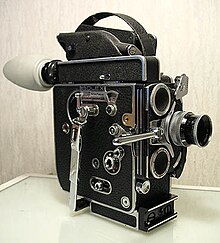
Cinema film is a sequence of photographic images taken at a certain frequency on a film using a special device (movie camera) and designed for projection (with the same frequency) onto the screen. There are narrow-film (amateur) films shot on films of 8 or 19 mm wide, and professional films shot on 16 or 35 mm film with a regular lens or using a special wide-format nozzle that allows you to change the aspect ratio without changing the size of the camera’s frame and film projector . Initially, the movie was “dumb” , that is, it represented a sequence of frames shot on a black and white film. "Great Mute" was shown in cinemas to the accompaniment of a taper . Improving technology has allowed recording sound on film (optical recording) or magnetic tape deposited on a positive film - in the late 1930s the era of sound cinema began. In addition, a color photo and film film appeared.
Film production - the vast majority of films are created by teams of creative workers and technical specialists at specialized film studios using a variety of film technology in the process of staging, shooting in film studios , on-site platforms and so on. In addition, films for scientific, technical and educational purposes are often produced in film laboratories of research institutes and educational institutions. Amateur - films that are shot by individual film enthusiasts, as well as at amateur film studios created at clubs, educational institutions and enterprises [1] .
Panoramic movie
Further development of the quality of the cinema image is associated with the appearance in the early 1950s of panoramic cinema systems , which received great popularity among viewers, but expensive and unsuitable for wide distribution. Panoramic cinema - cinematic systems with a very large aspect ratio of a strongly curved screen. A characteristic feature of panoramic cinema was a very large horizontal viewing angle that exceeded the human field of view and made it possible to make the borders of the screen inconspicuous [5] . Such systems for shooting films use the separation of the image into several parts and, as a rule, several films . In the USSR and the rest of the world, such formats were not widely used due to their high cost and incompatibility with the mass cinema network. A small number of films shot by panoramic technologies, both here and abroad, were most often reprinted onto wide film formats for demonstration in traditional movie theaters .
Cinema Panorama (USSR, 1957)
The Soviet “Cinema Panorama” was developed at the Moscow Scientific and Research Film and Photo Institute (NIKFI) on the basis of the “Cinerama” system under the leadership of E. M. Goldovsky and was presented in 1957 [5] . In some countries where Soviet films filmed under this system were shown, it was called Soviet Cinerama . The first cinema to use this technology was the Mir cinema in Moscow on Tsvetnoy Boulevard , building 11, next to the famous circus, opened in February 1958 . At the time of the opening, it was the largest in Europe, and by the size of the screen (200 m 2 ) - the largest in the world. It accommodated 1220 spectators, and its screen, with seats in the front rows, had visible angular dimensions of 146 ° horizontally and 78 ° vertically [6] .
Subsequently, the cinema was converted to show widescreen cinema [7] .
Widescreen Movie
Widescreen cinema is a kind of cinematic systems based on the use of film with a width exceeding the standard 35 mm [8] (most often from 50 to 70 mm [9] ). Large-format movie systems are distinguished by a large frame area that does not require strong magnification and allows you to get high-quality images on large screens [10] . Wide formats were developed as a replacement for expensive panoramic cinema, and with a comparable frame area give a seamless image without joints. Wide-format systems that use 70-mm-wide film with a frame occupying a height of 5 perforations and wide-screen [11] aspect ratio of 2.2: 1 (5/70 format) are most widely used. The modern look of large-format cinema is regulated by the ISO 2467: 2004 standard [12] in accordance with the recommendations and standards of SMPTE . Currently, wide-format cinema uses 65-mm-wide film and spherical ( axially symmetric ) optics for shooting, and 70-mm-wide film is used for printing films [13] .
Contrary to a widespread misconception, the appearance of a wide film film on the market was initially not associated with attempts to increase the resolution , but mainly as a way of placing an optical phonogram on a single image carrier [14] . Widescreen movie systems began to evolve with the advent of sound cinema. The sound quality then depended on the width of the track, and on a standard 35 mm film, the frame, if the width of the phonogram was too large, became square. The problem was solved by a wide film on which phonograms of any width could be printed, as well as a wide-screen image of a large area. Attempts to create widescreen cinema have been made since the first days of the cinema, but widescreen cinema was only put into practical use since the mid 50s of the 20th century, after the experience of shooting and showing 35mm widescreen films using anamorphic optics showed that the gain in image size achieved at the cost of some deterioration in its quality. The creation of large-format cinema marked a new stage in the development of cinema, characterized by a significant increase in the size of the screen image without deteriorating its quality, achieved through the use of film doubled (compared to normal) width and a system of 6-channel stereo recording and sound reproduction. In some systems of large-format cinema, along with a wide film strip, image anamorphy is simultaneously used [9] .
Amateur movie
Amateur cinema ( cinematography ) is a hobby or one of the types of amateur art using the methods and means of cinema . In the era of the first experiments in the field of cinema, there was no strict division into amateur and professional. Thus, the naming (including self-name) of one or another collective (group) of film enthusiasts, as well as the assignment of one or another equipment to film amateur until about the 1920s, was arbitrary. Gradually, by the 1970s , there was a classification that categorized films of a width of 35 mm and more as professional, for showing a large number of viewers in cinemas , and a narrower one (except for television production) as amateur. This need was dictated, in particular, by the indicator of the permissible luminous flux (respectively, and the maximum screen size), depending on the size of the frame on the film. Such a division also determined significantly smaller overall dimensions of amateur equipment and its optics. That is how the films produced in the world, film cameras , projectors and editing tables were positioned (in particular, in terms of mass production and price scale ). Amateur cinema exists in many countries and appeared almost simultaneously with professional cinema , attracting the attention of creative people with new, previously non-existent visual opportunities. As for amateur photography, as a result, an entire industry emerged and developed, focused on narrow-film, small-format, low-budget cinema.
A significant part of the film enthusiast’s costs (both material and temporary) for the film is film and its chemical-photographic processing. The desire to reduce these costs determines the main features of amateur cinema.
- In contrast to the film rental industry, which initially implies the production of several copies of the film and therefore uses negative film, the vast majority of amateur films were shot on black and white and color reversed film , with the receipt of a single copy of the film directly in a positive form. In the USSR, narrow negative and positive film was on sale a rarity. Photocopiers for film enthusiasts were produced in small batches (for example, KAU-16 [15] ) and were available only to amateur associations. In addition, “Ekran” movie cameras suitable for contact printing of 8-mm films were produced, however, the complexity of the technology and the inevitable loss of image quality in a small format made amateur printing exotic.
- In the USSR, home amateur cinema was shot, as a rule, on a film of the format “ 8 mm ” or “ Super-8 ” (“ 8 mm type C ”). To increase the length of the film, a 16 mm film was produced with double perforation (on both edges), which was designated “2 × 8 mm”. after exposure, the film in the movie camera was recharged (turned over). To protect against erroneous re-exposure, the inscription “1/2 ex” was perforated on the inner end of the 10-meter film roll. After exposure of both sides of the double film, it was developed, and then cut along with a special cutter and wound onto 8 mm reels (which were also produced for winding magnetic tape with a width of 6.25 mm, and then 6.3 mm for household reel tape recorders) . The 16 mm film was used mainly in mugs and clubs. Домашнее применение сдерживалось высокой стоимостью аппаратуры, её большими размерами и весом, а также большей стоимостью киноплёнки.
Для домашнего кинолюбительства необходимо было приобрести:
- кинокамеру с запасом киноплёнки или кассетами ,
- наборы химикатов для лабораторной обработки обращаемой чёрно-белой или цветной киноплёнки, а также лабораторную посуду и термометр ,
- бачок для проявки киноплёнки,
- сушилку для киноплёнки,
- в крупных городах СССР была доступна централизованная обработка фотокиноплёнки.
- резак для плёнки (если применялась двойная 8-мм плёнка),
- монтажный стол для просмотра отснятого фильма, монтажа и склейки его (иногда для этой цели использовали кинопроектор либо специальные увеличительные стёкла с фильмовым каналом),
- специальные бобины для намотки смонтированного фильма,
- синхронизатор к бытовому бобинному магнитофону для озвучивания 8-мм фильмов,
- кинопроектор и переносной сворачиваемый экран (чаще белая простыня) для демонстрации отснятых шедевров,
- станок для перемотки фильмов (чаще изготавливался из подручных материалов),
- пресс для склейки киноплёнки и специальный киноклей (позже стали выпускать скотч в кассетах ).
С массовым распространением бытовых видеокамер и видеомагнитофонов , любительские фильмы начали сниматься на видеокассеты. В настоящее время видеолюбительство полностью вытеснило кинолюбительство, а съёмочное оборудование и узкая киноплёнка не выпускаются.
Видеофильм
Видеофи́льм — кинокартина, снятая не на киноплёнке, а на магнитной ленте с помощью видеокамеры. В настоящее время вместо магнитной ленты используются твёрдотельные накопители или жёсткие диски. Понятие «видеофильм» относится в большей мере к любительскому кинематографу или к промышленным и учебным фильмам. Телефильмы, снимаемые по такой же технологии, не считаются видеофильмом. От цифрового кино видеофильм отличается использованием телевизионных стандартов изображения , в том числе высокой чёткости . Однако, в некоторых случаях разница между видеофильмом и цифровым кинофильмом может быть условна, а в полнометражных фильмах используются кадры, снятые видеокамерами. Совершенствование цифровой видеотехники и доступность нелинейного видеомонтажа с помощью компьютера позволяют достигать результатов, сопоставимых по техническому качеству с профессиональными. Многие независимые кинематографисты создают документальные и игровые фильмы любительским и полупрофессиональным видеооборудованием.
Телефильм
Телефи́льм (или телевизио́нный фи́льм ) — игровой фильм , снятый специально для показа по телевидению . При создании телефильмов учитываются технические возможности телевидения и особенности восприятия телезрителями изображения на экране телевизора [16] . Изначально по телевидению демонстрировались обычные кинофильмы. Вскоре начали создаваться фильмы по заказу телеканалов . В процессе производства таких фильмов была выработана определённая телевизионная специфика, что, собственно, и привело к появлению понятия «телефильм». Важнейшим фактором в производстве телефильмов является размер телевизионного экрана. В то время как на телевидении наиболее распространённым соотношением сторон экрана всё ещё остаётся традиционное полноэкранное 4:3 (1,33:1), а развитие телевидения высокого разрешения только набирает популярность широкоэкранное 16:9 (1,78:1), в киноиндустрии самым популярным на данный момент является суперширокоэкранное соотношение 2,39:1. Поскольку телеэкран значительно меньше киноэкрана, телефильмы отличаются от кинофильмов меньшим числом общих планов и отсутствием высокодетализированных изображений. Таким образом, телефильм, (как жанр) возник в начале 1960-х годов из слияния телевидения и классического кинематографа . Наиболее часто телефильм состоит из двух и более последовательных, но демонстрируемых в разное время частей — серий. Телефильмы с бо́льшим количеством серий принято называть телесериалами . Телефильмам и телесериалам в частности свойственно специфичное «растянутое» повествование. При монтаже современных телефильмов учитываются рекламные блоки в эфирной сетке телеканалов — на интригующем моменте делается пауза, и после предполагаемой рекламы следует продолжение с небольшим «откатом» сюжета.
Мультипликационный фильм
Мультипликацио́нный фи́льм (или мультфи́льм ) — это ряд рисунков, выполненных с помощью средств рисования, графики или фильм, снятый методом покадровой съёмки объектов из пластилина и других подручных материалов, а также кукол или компьютерных моделей на какой-либо из существующих носителей (кино-, видео-, цифра) и предназначенный для показа в кинотеатре, по телевизору или на экране компьютера. Как и обычные кинофильмы, мультфильмы бывают короткометражными и полнометражными (обычно более часа).
Диафильм
Диафи́льм (от греч. δια — приставка, здесь означающая «переход от начала до конца» , и англ. film — фото- или киноплёнка ) — последовательность изображений, отпечатанных на стандартной позитивной 35-мм перфорированной плёнке , кадры которой тематически связаны друг с другом и, как правило, снабжены текстом (имеются титры ), превращающим кадры в иллюстрированный рассказ. Фактически диафильм — это неразрезанный диапозитив без рамок. Кадры диафильма неразрывно связаны между собой, что не позволяет менять порядок их демонстрации — каждый кадр диафильма является продолжением предыдущего. Стандартный размер кадра диафильма — 18×24 мм. Длина диафильма, как правило, была около 1 м. Возможность коллективного просмотра диафильмов на большом экране позволяла заменить дорогостоящую кинопроекцию более доступным шоу, особенно популярным у детей, предпочитавших его чтению иллюстрированных книг вслух. За пределами советского блока диафильмы были, например, в США. Небольшое количество диафильмов выпускалось со звуковым сопровождением на магнитной ленте (катушках) или гораздо чаще на виниловых пластинках — показ озвученных диафильмов мог проводиться одновременно с воспроизведением грампластинки с дикторским текстом или музыкальным сопровождением. В настоящий момент выпускаются диафильмы в России и в Венгрии, в том числе на русском языке. Звуковые диафильмы в виде картриджей для диапроектора «Светлячок» — в Китае. Диафильмы, выпущенные в последнее время в России, являются перепечаткой старых плёнок и отличаются низким качеством (очень высоким контрастом). С распространением бытовой видеозаписи диафильмы практически вышли из употребления. Однако в последнее время интерес к диафильмам снова вырос и сейчас в Китае выпускают диапроекторы «Светлячок» и «Реджио», а в Белоруссии продолжается выпуск «Пеленг-500».
Разновидностью диафильма является микрофильм .
Микрофильм
Микрофи́льм — документ в виде микроформы на рулонной светочувствительной фотоплёнке с последовательным расположением кадров в один или два ряда или фотокопия документов, рукописей, книг и так далее, выполненная со значительным уменьшением на фотоплёнке или киноплёнке. В свою очередь, процесс получения ( копирования ) фотографическим способом уменьшенного в десятки и сотни раз изображения с бумажных носителей информации ( чертежи , рукописи , рисунки , архивные документы ) получил название Микрофильми́рование .
Первые работы по микрофильмированию отмечены к началу XIX века и связаны с именами изготовителя оптических приборов англичанина Д. Дансера и французского фотографа Луи Дагера . В России большая заслуга в развитии микрофильмирования принадлежит Е. Ф. Буринскому — одному из основоположников судебной и научной фотографии. Научно-технический прогресс вызвал резкое увеличение объёма научно - технической информации на бумажных носителях, обусловил широкое использование микрофильмирования на производстве, в науке, библиотечном и архивном делопроизводстве . Микрофильмирование сокращает размер хранилищ, исключает возможность поврежнения редких книг, обеспечивает бо́льшую доступность раритетных изданий. Благодаря копированию появляется возможность передачи копии в другие библиотеки и архивы, уменьшаются транспортные расходы. Для фотографирования документов чаще всего применяются специализированные фотоаппараты , имеющие оптику с высокой разрешающей способностью . В СССР для съёмки микрофильмов применялась чёрно-белая негативная фотоплёнка «МЗ-3Л», «Микрат-200» и «Микрат-300» с разрешением 150, 200 и 300 лин/мм соответственно [17] . Для просмотра и получения увеличенных копий на бумажном носителе используются читально-копировальные аппараты, при создании копий применяется электрографический метод . Для хранения носителей, их быстрого поиска применялись информационно-поисковые системы («Иверия» — для микрофильмов в отрезках и «Поиск» — для рольных микрофильмов) [18] .
See also
- Телефильм
- Документальное кино
- Научно-популярное кино
- Игровое кино
- Жанры игрового кино
- Аудиовизуальное произведение
- Cinema
- Video
Notes
- ↑ 1 2 Фильм — статья из Большой советской энциклопедии . Е. А. Иофис.
- ↑ Словарь трудностей русского языка, 1976 , с. 646.
- ↑ Дыхание воли. Дневники Михаила Цехановского — Номер 57.
- ↑ Даровский В. П. «История российского кинематографа. Курс Лекций»
- ↑ 1 2 И. Б. Гордийчук, В. Г. Пелль. Справочник кинооператора / Н. Н. Жердецкая. — М. ,: « Искусство », 1979. — С. 38—48. — 440 с.
- ↑ Приглашает сферорама // Наука и жизнь . — 1988. — № 4 . — С. 33—35 .
- ↑ Панорамное кино . Кинотеатр «Круговая кинопанорама» (2006). Дата обращения 12 мая 2012. Архивировано 12 августа 2012 года.
- ↑ И. Б. Гордийчук, В. Г. Пелль. Раздел I. Системы кинематографа // Справочник кинооператора / Н. Н. Жердецкая. — М. ,: «Искусство», 1979. — С. 25—34. — 440 с.
- ↑ 1 2 Широкоформатное кино — статья из Большой советской энциклопедии . М. З. Высоцкий.
- ↑ Relative Frame Dimensions (англ.) . The American WideScreen Museum. Дата обращения 12 мая 2012. Архивировано 18 июня 2012 года.
- ↑ Aspect ratios (англ.) . The Letterbox and Widescreen Advocacy Page. Дата обращения 9 мая 2012. Архивировано 18 июня 2012 года.
- ↑ ISO 2467:2004 (англ.) . ANSI . Дата обращения 21 августа 2012. Архивировано 3 октября 2012 года.
- ↑ Типы и форматы киноплёнки . Kodak . Дата обращения 9 мая 2012. Архивировано 10 мая 2012 года.
- ↑ Е. М. Голдовский. Глава III // Кинопроекция в вопросах и ответах. - 1st ed. — М. ,: «Искусство», 1971. — С. 56. — 220 с.
- ↑ Г. Андерег, Н. Панфилов. Справочная книга кинолюбителя / Д. Н. Шемякин. — Л. ,: «Лениздат», 1977. — С. 252. — 368 с.
- ↑ Коноплёв, 1975 , с. 26.
- ↑ Разрешение любительских чёрно-белых негативных фотоплёнок «Фото-65» не превышало 100 лин/мм.
- ↑ Микрофильмирование — статья из Большой советской энциклопедии . И. М. Гофбауэр.
Literature
- Б. Н. Коноплёв . Основы фильмопроизводства / В. С. Богатова. — 2-е изд.. — М. : «Искусство», 1975. — 448 с. - 5,000 copies.
- Розенталь Д. Э., Теленкова М. А. Словарь трудностей русского языка. — М.,: « Русский язык », 1976. — С. 646. — 696 с. .
- Лукин В. В., Микрофильмирование, его настоящее и будущее, «США. Экономика, политика, идеология», 1973, № 4.
- Механизация инженерно-технического и управленческого труда. Справочная книга, под ред. И. И. Кандаурова, Л., 1973.