
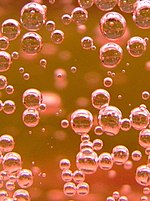

Sparkling wine is a wine that is saturated with carbon dioxide , which makes it effervescent, while carbon dioxide is produced as a result of natural fermentation .
Not to be confused with sparkling wine (carbonated wine), where carbon dioxide is artificially introduced at elevated pressure to impart sparkling properties to the wine.
Sparkling wine contains an excess of carbon dioxide, which is released when the bottle is opened with a solemn “shot” of the cork and an attractive game of bubbles on the walls of the glass with a drink.
Content
Production Methods
The most traditional way to obtain sparkling wine ( French méthode champenoise - “champagne method”) is that the natural fermentation of wine takes place directly in the bottle . For a description of the production of champagne and other wines made by the traditional method, see champagne in the article.
Due to the high cost of using individual bottles for secondary fermentation, many other methods are used in modern winemaking. Wine is often fermented in a large tank designed to withstand internal pressure.
For cheaper sparkling wines, the Sharma method is widely used (it is also acratophore).
History
Antique authors puzzled over the cause of the appearance of bubbles in wine. Medieval winegrowers considered the sparkling wine a serious flaw and fought against it as much as possible. The “eruption” of one of the bottles of wine in the cellar often generated a chain reaction. Many wineries lost up to 20% of their wine reserves due to such incidents. In order to keep the cork in the bottle, a special wire bridle was invented - the muzzle .
This problem was especially relevant for the northern wine regions of France, and especially Champagne , where winter frosts stopped the fermentation of wine in the cellars, and spring heat resumed this process. The monk-winemaker House Perignon (1638-1715), who is sometimes mistakenly called the inventor of champagne, also fought with annoying bubbles.
The inventors of sparkling wine consider their ancestors residents of Lima in the south-east of France. They cite the fact that the Benedictines of the local abbey of Saint-Hilaire mention the manufacture of “outlandish white wine with a natural spark” in a document dated 1531 — long before the start of the production of sparkling wines in Champagne [1] .
The sparkling wine from Champagne was the first to be appreciated by the British, who invented a particularly strong bottle glass and cork that could withstand high pressure in the bottle. They were the first to try to explain the phenomenon of “evil wine” from a scientific point of view. In December 1662, an English physician Christopher Merrett addressed the Royal Society of London with a report on the sparkling properties of wine. He explained the “game of wine” by the presence of sugars in it and argued that any wine would sparkle when sugar was added early.
In the 18th century, Champagne was already shipping tons of sparkling wine to English customers. Although in the era of the Regency, the fashion for sparkling wine also spread at the French court, the inhabitants of Champagne themselves for a long time continued to consider it as a product for export. Only in the middle of the 19th century did sparkling wine supplant traditional wine in this region.
In the 1870s winemakers from other European countries, having completed an internship in Champagne, began to try to establish the production of sparkling wine in their homeland. So, the Italian Carlo Gancha learned to make sparkling Asti from white muscat; later, the equipment was borrowed from Piedmont by the inhabitants of Prosecco in the vicinity of Trieste ( Austria-Hungary ). In Budafok , at that time one of the suburbs of Budapest , the production of sparkling wines was established by Jozsef Turley , who was awarded the high title of supplier of the Habsburg imperial house [2] . Around the same time, Josep Rventos introduced the champagne method in Catalonia [3] .
In the XXI century, the production of high-quality sparkling wines was finally established in the UK , which for centuries remained one of their main consumers. Global warming has made it possible to produce wine in the south of England [4] .
Sparkling Wines in Russia
The production of sparkling wines in Arzamas , in the Sudak Valley, tried to establish another Prince Potemkin [5] . In 1799, the Crimean estate of Academician P. S. Pallas released the first batch of wines in Russia obtained by bottle champagne [5] . In the 1st half of the 19th century, visiting French and Swiss “conjured” the Sudak sparkling wines without much success. Excellent quality stood out sparkling wine "Ai-Danil", released in 1842 by the eponymous estate of Prince M. S. Vorontsov .
Meanwhile, Derzhavin and Pushkin sang the sparkling Tsimlyansky wine produced in the Don according to the “old Cossack method” [6] . This cheap, affordable analogue of imported champagne was widespread during the years of the rise of patriotism caused by the wars with Napoleon . In the novel " Eugene Onegin " there are lines:
Yes, here's a tarred bottle
Between roast and blanmange
Behind him a system of glasses of narrow, long
Like your waist
Zizi, the crystal of my soul.
It is believed that the origin of the industrial production of sparkling wines in Russia was Prince Lev Golitsyn (1845-1915) [7] . Under the leadership of the artisan of French winemakers hired by Golitsyn, the Abrau-Durso estate in 1897 launched a batch of 13,000 bottles of champagne on the market. The main champagne of the farm, Victor Dravigny , was awarded two awards personally from Nicholas II [8] . Sparkling wine from the Golitsyn estate “ New World ” was served at coronation celebrations , which is why it was called “Coronation” [9] .
In the middle of the 20th century, the production of sparkling Tsimlyansk wine was resumed - according to a recipe compiled by A. M. Frolov-Bagreev [6] . On the territory of the USSR, the main experimental site for the production of sparkling wines was the Sevastopol winery . Other major sparkling wine producers in Russia and Ukraine:
- Champagne wine factory "Abrau-Durso"
- Champagne Wine Factory "New World"
- Artyomovsk Champagne Wine Factory
- Rostov Champagne Wine Factory
- Tsimlyansk factory of champagne wines
- Kuban-Vino ( Chateau Tamagne ).
Varieties
A classic example of sparkling wine is champagne . In the former USSR, this word is used as a synonym for sparkling wine, however, according to the rules of the World Trade Organization, this name is reserved for the original sparkling wine from the Champagne region in France . The latter is characterized by intense saturation with carbon dioxide and, accordingly, high pressure in the bottle (5-6 atm. Vs. 2-3 atm. For ordinary sparkling wines such as Crémant ).
Sparkling wine is usually white or pink , but there are several examples of red sparkling wine - such as the Italian Brackettos and Lambrusco . For Australia, traditionally red sparkling wine from Shiraz grapes.
Some wines are only slightly saturated with carbon dioxide (eg, “ green wine ” in Portugal ). Wines with a bottled pressure of less than 3 atmospheres are called fizzy ( Italian frizzante , French pétillant ) or semi- sparkling .
Sparkling wine list
- In France
- Creman (Crémant)
- Limoux
- Champagne
- In Italy
- Asti (Asti)
- Bracchetto
- Prosecco (Prosecco)
- Lambrusco (Lambrusco)
- Franciacorta
- Fragolino (Fragolino) from Isabella grapes
- In Spain
- Cava (Cava) , including Pink Cava (Cava Rosado)
- In Germany
- Zect (Sekt)
- In Moldavia
- Cricova (Cricova)
- In Portugal
- Bairrada
- In Russia
- Tsimlyansk
- Soviet champagne
- Abrau-Durso
- In South Africa
- Cap Classique
Notes
- ↑ The Chemistry and Biology of Winemaking - Ian Spencer Hornsey - Google Books
- ↑ Torley (Turley) - Manufacturers of Hungary - Wine World - a site about wine, beer and other drinks, cocktail recipes, history (Unavailable link) . Date of treatment October 31, 2015. Archived March 4, 2016.
- ↑ A century later, in 1970, Spanish champagne ( Champaña ) changed its name to Cava .
- ↑ However, centuries ago, during the reign of Henry VIII and his confiscation of church property, there were several wineries in the male monasteries of England.
- ↑ 1 2 “Lenta.ru” on the history of champagne in Russia: Regions: Russia: Lenta.ru
- ↑ 1 2 The most literary wine
- ↑ See, e.g.: V.K. Kalugin. A book about wine and winemaking. CultInformPress, 1996. p. 106.
- ↑ Abrau-Durso
- ↑ N.K. Laman, A.N. Borisova. Prince Lev Sergeyevich Golitsyn: an outstanding Russian winemaker. Science, 2000.S. 93.
Links
- A little about the origin of sparkling wines, their appearance in Russia and sparkling wines of Taman
- A sparkling wine. not a single champagne ... // citylady.ru
- GOST 31492-2012 . Sparkling wines and pearl sparkling wines. General specifications.