The Pastor of Erma ( Latin Haermae Pastor ), variants of Pastryr of Erma, Erma, Erma [1] , is an early Christian book found in ancient manuscripts next to the canonical texts of the New Testament . Traditionally dated to the II century . Known in the Greek original and in Latin and Ethiopian translations [2] ; sufficiently voluminous (approximately equal to the Gospels of Matthew and Mark , taken together). Always enjoyed great respect among Christians, but was not accepted by the Church in the canon of sacred books [3] .
| Shepherd Erma | |
|---|---|
| Author | |
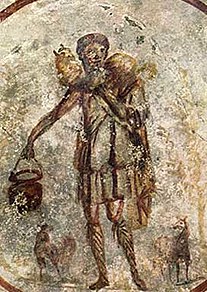
The form of presentation belongs to the apocalyptic literature : the author points to the closeness of the second Christ coming and the general court . According to the text, the author lived in Rome , at the time of Pope Clement , was at first rich, engaged in worldly affairs, did not always observe the truth, had a slandering wife and wicked sons, to whom he was not strict enough, and for that he was punished by God with the loss of wealth. Perplexed about the causes of the disaster that befell him, Erma (Herm) was admonished by a number of visions that happened to him [2] . These manuals and visions written by him form a text of three parts: 1) a description of four visions; 2) twelve moral rules; 3) ten similarities, of which each implies a certain truth [3] . The opinion of Erma is remarkable, that each person, during the whole of his earthly life, is accompanied by one kind and one evil angel [3] .
Translated into Russian by Archpriest Peter Preobrazhensky (1862).
Composition
The book is divided into three parts:
- Visions (Visiones), consists of 4 chapters (visions).
- Commandments (Mandata), consists of 12 chapters (commandments).
- Similarities (Similitudines), consists of 10 chapters (parables-likeness).
Contents
The book begins with the fact that Erma admires the girl bathing in the Tiber , who then appears to him in prayer and exposes his unclean thoughts. After that, he sees an old woman in the pulpit and with a book, which she initially takes for Sibyl , but then she turns out to be the personification of the Church, which existed before the creation of the world. Further Erma sees the construction of a great tower on the waters, composed of brilliant square stones. It is also a metaphor for the Church, as water at base means baptism. The six young men bringing stones are angels. The stones themselves are people. Those who put themselves in the foundation are the righteous, those who are cast aside are sinners. There are 7 women standing around the tower: Faith, Temperance, Simplicity, Innocence, Modesty, Knowledge, Love. At the completion of the tower will come the end of the world.
Apocrypha contains the moral necessity of "living in the world" and "caring for each other."
The apocryphal concludes with a 100 foot long whale . From the mouth of the whale came the fire locust . The beast lay on the ground, and its head was of four colors: black, red, golden and white. The church in the form of a woman explained to Hermes that this beast means impending disasters.
According to some of the fathers of the Church , the “Shepherd” of Erma was once considered a very valuable and useful book. No wonder he was one of the first Christian canons of the holy books. Even if we forget about everything else in its content, the problems that it focuses on overcoming will be extremely relevant to Christianity at all times.
Characters
Protagonists
The main actors, on behalf of which there are many dialogues, are as follows:
- Erma (Germa);
- a certain old woman (the Church);
- Angel of repentance
Other actors
- The maid, the woman (girl) (in the text "Rose Bush");
- Egrin (Angel of the Beasts);
- Angel of pleasure and lies (mentioned in the 6th similarity);
- Angel of Punishment (mentioned in the 6th similarity);
- 12 virgins dressed in white (symbol of 12 good qualities);
- 12 maidens dressed in black (symbol of 12 bad qualities);
- Jesus (not mentioned directly by name, but as the primeval and supreme angel).
- Other six primordial angels (equivalent to Ameshaspentam in Zoroastrianism)
Mentioned Persons
- Grant (or Grappa) (mentioned in Vision Two);
- Clement (mentioned in Vision 2).
Authorship
Different views on the authorship of the book already existed in the first century. There are three versions:
- Herma (or Hermas) is the apostle of the seventy , mentioned in the letter of the Apostle Paul to the Romans ( Rom. 16:14 ). In this case, Clement, also mentioned in the book, is identified with Clement of Rome , one of the first bishops of Rome (died in 101 ). For the first time this opinion was expressed by Origen . A similar opinion was shared by Jerome of Stridon .
- A look at the authorship of the book, as recorded in the quotation from the canon Muratori given below: not Hermes, but Hermius [2] is the brother of the Roman bishop Pius (the bishopric years were 142 through 157).
- Compromise option - Germa, brother of Pius, added or translated into Latin the text written by the apostle Erma.
Text Language
For a long time it was known about the existence of the text only in Latin . However, Peter Preobrazhensky already notes in the comments to the first edition:
The book "Shepherd" was originally written in Greek, it is unanimously recognized by scientists, although antiquity left no evidence of that. But this opinion is favored by the preferential use of the Shepherd in the ancient Greek Church, as well as the quotations cited from him in Greek by Greek church writers: by St. Irenaeus , Clement of Alexandria and Origen, and in the doctrina ad Anthiochum ducem… Pritom the Latin text The shepherd has clear traces of the fact that he is not the original, but a translation from Greek. [four]
In the edition of Min, the book "Shepherd" is referred to Patrologia Graeca and is included in the second volume.
Finally, in the 50s of the XIX century, Tischendorf discovered in the monastery of St. Catherine on the Sinai Peninsula the oldest code of the New Testament , which in addition to the New Testament texts contains extensive fragments of the book "Shepherd" in Greek.
Early mention
"Shepherd" Erma is mentioned in the Muratorium canon - the oldest list of Christian writings. It says:
Of the revelations, we recognize only John and Peter , which some of ours do not want to read in the church. But Herma wrote the "Shepherd" already in our day in Rome, when his brother Pius was the bishop. Therefore, it must be read, but not publicly in the church — neither among the apostles, nor among the prophets [5] .
Translation and editions in Russian
- The translation of the text into Russian from Latin was made by Archpriest Peter Preobrazhensky in 1862 and published in Monuments of Christian Literature. He also wrote the first Russian commentary on the text, which was later used as a preface to the publication.
- The text was later reprinted by the Belgian Catholic publishing house Life with God (1978 and 1988).
- In 1994, the text was reprinted with comments by priest Valentin Asmus and A. G. Dunaev by the Latvian Biblical Society (the old spelling and pagination were preserved in the text).
- Last reprint (using modern spelling): “Scriptures of Apostolic Men”, St. Petersburg, Amfora Publishing House, 2007, ISBN 978-5-367-00559-2 .
- There are at least two audio publications of the book: announcer Valery Shushkevich (2010) and Denis Gavrilov (2011).
- Reading Shepherd Erma was part of a series of programs on the course "Patrology" on the Orthodox TV channel "Union". Issues since the 44th. [6]
Research
- Theophan the Recluse Interpretation on the book of sv. Erma
A list with the "Scientific website on the patrology of theology" A. G. Dunaev: [7]
- Skvortsov K. When is the book "Shepherd" written? - TKDA 1872, Vol.3, No. 10, 205–241.
- En. Theophanes (Govorov), Recluse. Four conversations on the leadership of the book "Shepherd" Erma. M., 1892. Excerpts: ZhMP 1973, No. 2, 32-36; No. 3, 31-32. Reissue [under a different name]: Ep. Theophan the Recluse. Interpretation of the book of sv. Erma "Shepherd". 1908. (Svyato-Vvedensky Monastery of Optina Pustyn 1999, 31 p.) (A summary of the book).
- Theognost (Deryugin), Archim. The Book of the Secret Warrior Erma "Shepherd". - ZhMP 1957, No. 9, 50-53.
- Giet S. Hermas et les Pasteurs: les trois auteurs du Pasteur d'Hermas. Paris: Presses Universitaires de France, 1963.
- Pernveden L. The Concept of the Shepherd of Hermas. Lund: CWK Gleerup, 1966.
- Reiling J. Hermas and Christian Prophecy: A Study of the Eleventh Mandate. Leiden: Brill, 1973 (NT Suppl. 37). X, 197 p.
- Wilson JC Toward a Shepherd of Hermas Its date and its pneumatology. Duke University Durham, NC, 1977 (microfilm). 308 p. [Summary: DA 39, 1978, 326A — 327A].
- Martín Jose (Pablo). Espíritu y dualismo de espíritu en el Pastor de Hermas y su relación con el judaísmo. - Vetera Christianorum 15, 1978, 295-345.
- Folgado Flórez S. Teoría eclesial en el Pastor de Hermas. Madrid: Real Monasterio de El Escorial, 1979. XI, 142 p.
- Hellholm D. Das Visionenbuch des Hermas als Apokalypse. Formgeschichtliche und texttheoretische Studien zu einer literarischen Gattung: Methodologische Vorüberlegungen und makrostrukturelle Textanalyse. Lund: Gleerup, 1980 (Coniectanea Bibl. NT Ser. 131). 212 S.
- Smith MM Feminine images in the shepherd of Hermas. Duke University Durham, NC, 1980 (microfilm). 235 p. [Summary: DA 41, 1980, 704A-705A].
- Mees M. Der Hirte des Hermas und seine Aussagen über den Heiligen Geist. - Lateranum 47, 1981, 343-355 (about the attitude to Old Testament Sofia).
- Osiek C. Rich and Poor in the Shepherd of Hermas. An Exegetical-Social Investigation. Washington, DC: Catholic Biblical Association of America, 1983. XI, 184 p.
- Nijendijk (Lambartus Wilhelmus). Die Christologie des Hirten des Hermas. Exegetisch, religions- und dogmengeschichtlich untersucht. Utrecht, 1986. 239 S.
- Hilhorst A. Hermas. - RAC Bd.XIV, Lief. 108-109, 1988, 682-701.
- Leutzsch M. Die Wahrnehmung sozialer Wirklichkeit im "Hirten" des Hermas. Göttingen: Vandenhoeck und Ruprecht, 1989 (Forsch. Zur Relig. Und Lit. Des alten und neuen Test. 150). 286 S.
- Henne Ph. L'unité du Pasteur d'Hermas. Paris, 1992 (Cahiers de la Revue biblique 31).
- Henne Ph. La christologie chez Clément d'Alexandrie et dans le Pasteur d'Hermas. Friborg, 1992 (Paradosis 33).
- Haas C. Die Pneumatologie des "Hirten des Hermas". - ANRW II.27.1, 552-586.
- Joly R. Le milieu complexe du Pasteur d'Hermas. - ANRW II.27.1, 524-551.
- The Christology of Hermas and the interpretation of the fifth similitude. - Augustinianum 37 (2), 1997, 273-284.
Notes
- ↑ Many variants of the translation of the name arose from the fact that the Roman name Hermas can be translated into Russian as both Erm (Erm, Germ) and Erma (Erm, Germ). Accordingly, the forms of the genitive case are distinguished: “Shepherd” Yerma; “Shepherd” of Erma, etc. Source: “The Scriptures of the Apostolic Men” - St. Petersburg: Amfora, 2007. But Greek
- ↑ 1 2 3 Erm // Encyclopedic dictionary of Brockhaus and Efron : in 86 tons (82 tons and 4 extra). - SPb. , 1890-1907.
- ↑ 1 2 3 Erm // Bible encyclopedia of Archimandrite Nikifor . - M. , 1891-1892.
- ↑ The writings of the husbands of the apostles. - SPb. : Amfora, 2007. - p. 239. - 480 p. - (Library of Alexandria). - ISBN 978-5-367-00559-2 .
- ↑ Sventsitskaya I. S. Early Christianity: pages of history . - M .: Politizdat , 1987. - p. 202. - 336 p.
- ↑ Patrology. Issue number 45, March 31, 2011
- ↑ List from www.danuvius.orthodoxy.ru
Sources
- Saint Erm and his book "Shepherd" // Orthodox Theological Encyclopedia. V. 5. - Petrograd. Supplement to the spiritual journal "Wanderer" for 1904
- "Shepherd" Germa . - Moscow, Prissels, 1997 (text of the 1862 edition, Monuments of Ancient Christian Literature, v.2.). Introductory article and comments I. S. Sventsitskoy .
- "Shepherd" up. Erma. // " Orthodox Encyclopedia " T. 18
- Plot: Apostle from seventy Erma
- "The Shepherd Book" // the Open Orthodox Encyclopedia "The Tree"
- Archimandrite Cyprian (Kern) "Patrology". Chapter V. "Shepherd Erma"
- Alexey Sidorov . Course of patrology. Chapter VI. "Shepherd" Erma.