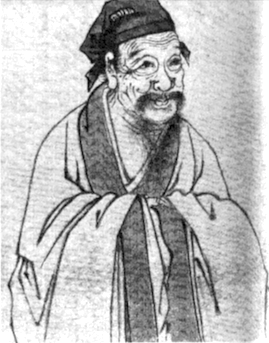
Zhu Xi ( Chinese р п , pinyin : Zhū Xī , also known as Zhu Yuanhui, Zhu Zhonghui, Zhu Huiyan; 1130–1200) is a Chinese philosopher, encyclopedic scholar, writer, text writer and commentator on Confucian canonical works, educator, the main representative of neo-Confucianism , who gave this teaching a universal and systematic form in which it gained the status of orthodox ideology in China and a number of neighboring countries, especially in Japan and Korea [1] .
| Zhu Xi | |
|---|---|
 | |
| Date of Birth | October 18, 1130 |
| Place of Birth | Yuxi County, Fujian Province |
| Date of death | April 23, 1200 (69 years old) |
| A place of death | Kaoting fujian |
| A country | |
| School / tradition | neoconfucianism |
| Period | Song Dynasty |
| Core interests | |
Content
- 1 Biography
- 2 Legacy
- 3 Historical Role: Zhusianism
- 4 Texts and Language by Zhu Xi
- 5 notes
- 6 Sources
- 7 Literature
- 8 References
Biography
Born October 18, 1130 in (Fujian Province) in a family of intellectuals. Grandfather Zhu Xi, a Confucian scholar of modest prosperity, encouraged children to learn and improve, predicting "in the family, for five generations accumulating Confucian virtue," the birth of an outstanding descendant.
Zhu Xi's father, Zhu Song, received his highest degree ( jinshi ) at age 21, at state exams in 1118. While serving in the capital, he witnessed the fall of Northern Song , moved to the South with the court and was an ardent opponent of the peace treaty with Jin ( 1141): as a result, he was demoted by Qin Gui and soon died, having been exiled to the provinces to a minor position.
From childhood, Zhu Xi himself discovered extraordinary abilities and began to receive a classical education at the age of four under the supervision of his mother. He became the holder of the Jinshi degree (giving the right to occupy a leading administrative position) at an unusually young age of 18 years (whereas the average age for such a position was 35 years) [1] [2] .
Zhu Xi's first appointment was Tongan County in the south of Fujian Province (1151-1158). There he changed taxation and the police, improved the library and school, developed a form of ritual that was absent before him [2] . By his service, Zhu Xi at the age of 26 earned such respect from the population that he was erected an altar in a local school [1] .
At 33, Zhu Xi was already awarded the first audience with the emperor and was appointed professor at the military academy, but two years later he left this post. Despite the constant desire of those in power to attract him to public service, he regularly refused such offers, preferring to engage in scientific, literary and pedagogical activities [1] .
The influence on Zhu Xi was made by the thinker Li Tong , whom Zhu Xi visited before his appointment to Tongan . In 1158, he visited Lee Tong again and spent several months learning with him in 1160 [2] . Li Tuna was a follower of Cheng Hao and Cheng Yi (therefore, the intellectual direction founded by Zhu Xi is also sometimes called the Cheng-Zhu school ).
After 14 years of retirement in 1178, Zhu Xi returned to public service. As the head of the Nankang region (Jiangxi province) in 1179–83, Zhu Xi created the then-famous Bai-lu dong school ( ) [3] . After repeatedly, but briefly appointed to high administrative posts. Zhu Xi took an irreconcilable position in politics with respect to the then main enemy of China - the Jurchen state of Jin . This contradicted the mainline of power to pacify a belligerent neighbor. As a result, Zhu Xi spent only 9 years in the service and 46 days at court as a lecturer. In 1195, anticipating the impending troubles after writing another critical report to the throne, he made fortune-telling on “ Zhou I ”, hexagram (gua) No. 33 Dun (Flight) fell out, - he subsequently included it in his pseudonym Dun-wen (The Running Elder) [ 1] .
Most of his life in retirement, he was always in poverty and was forced to earn a living by publishing, which was considered a little respect for the Confucian. However, in this way, Zhu Xi achieved another goal - the maximum popularization of his ideas. Zhu Xi was one of the most prolific authors. He wrote about 80 works, his preserved epistolary heritage includes about 2 thousand letters, and the record of his dialogues, consisting of 140 chapters, is the most extensive in Chinese literature. He had 467 students — more than any other neo-Confucian. He founded a record number of educational institutions and took part in the activities of 21 academies. Zhu Xi left a huge number of calligraphic inscriptions to his descendants and he was imprinted on numerous portraits executed on paper and in stone [1] .
In 1196, Zhu Xi's independent behavior, expressed, in particular, in non-observance of the ritual menu when hosting one high-ranking official, provoked the philosopher to be accused of a dozen crimes at once: from filial disrespect and disrespect to the emperor to the spread of heretical ideas. As a result, he was stripped of all ranks and ranks, and his teaching was banned. However, in 1199, a year before his death, Zhu Xi was rehabilitated, in 1209 he received the honorary posthumous name Wen (Culture), in 1230 the title of Hui-go-gun (sovereign prince), in 1241 he was ranked among the greatest Confucian authorities by establishing a plate with his name in the temple of Confucius [1] .
Zhu Xi died on April 23, 1200 in Kaoting, Fujian Province [4] .
Legacy
In the history of Chinese thought, we often call the second most influential figure after Confucius himself; contemporaries ranked him along with Zhang Shi and Lu Zuqiang as "three wise men from the Southeast."
Zhu Xi left behind an extensive body of essays (300 chapters), including approx. 1000 poems.
Zhu Si's philosophical doctrine identifies the Confucian interpretation of Taiji with the Taoist doctrine of the Infinite, indicating that this knowledge of the nature of the cosmos and man should be used to improve the individual personality (“sincerity of thoughts”, “straightening of the heart”), strengthening the family, streamlining the state and restoring harmony world - "balancing the Celestial Empire."
He affirms opposition to the concepts of qi and li - principles that underlie every “thing”.
Zhu Xi owes the merit of creating the Confucian Four Books : the four books of the Confucian canon (Lunyui, Menzi, Dasyue and Zhongyun) that he singled out and commented on became the basis of classical Confucian education in the Ming and Qing era. Among the students of Zhu Xi were Ke Xue, one of his favorite students, the author of the essay “Chun qiu bo i” (“The broad meaning of“ Chun qiu ””), Chen Chun, the author of the dictionary of Zhusian philosophical terms “Xing Li Tzu”, “The meaning of the terms nature and principle ”, Teng Detsui and others. Among the texts of special social significance for China is the Ji-Li treatise, “Family Ceremonies,” which he himself (or under his leadership) compiled the code of conduct of the rites of adulthood, weddings, funerals, and worship of ancestors. Simplified publications, imitations of this composition became the basis for the subsequent Confucian indoctrination of Chinese society. Among other things, Zhu Xi asserts the subordinate position of women in the family (much more rigidly than was accepted in the Confucian elite of the Sun days): it is assumed that she should not enjoy financial independence, devote herself to sciences and arts, divorce and remarry. Burdensome regulatory obligations are also imposed on young people of both sexes.
Historical Role: Zhusianism
Since 1313, during the rule of the foreign (Mongolian) dynasty of Yuan, his teaching was officially included in the system of state exams for academic degrees and official positions ( ke ju ).
In the XVI - 1 floor. XVII century in China, the school of Lu Juyuan and Wang Yangming (“Xin Xue” - “the doctrine of the heart”) ideologically prevailed, which formed the main theses of anti-Zhusian criticism. However, the ruling Manchu dynasty (1644-1911) supported the teachings of Zhu Xi as an official ideology. In the 30s. XX century Zhu Xi’s teachings were modernized by Feng Yulan in the “new doctrine of principle” (Xin Li Xue). Similar attempts after actively made a number of Chinese philosophers living outside of China and representing the so-called post - Confucianism , or post -neo-Confucianism [4] .
In Japan, the teachings of Zhu Xi spread under the name Shyushigaku (朱子学, Zhu Xi School), the most influential figures of this school were Fujiwara Seika (1561-1619) and his student Hayashi Radzan . Under their influence, the Zhusian education system developed, which existed until the Meiji Revolution of 1867-1868.
In Korea, jusianism was called mijahak ( cor. 주자학 ). His first preachers were students who studied in China in the XIII-beg. XIV centuries.: An Hyan et al. The founder of orthodox Korean Zhusianism is considered Chon Monju (XIV century), the first minister of the state of Koryo . In the XVI century. The largest Zhusian school in Korea, the Sonnyak (also known as the Lihak , tracing paper with Chinese. 理學 Lisue), was formed. At the end of the 19th century, Zhusianism was recognized by its Korean supporters as an important ideological element uniting Korea and China in the partisan struggle against Japanese dominance.
In the 20th century, the historical role of Zhu Xi was periodically rethought along with the entire imperial legacy of China: Zhusian ideology was named among the factors that led China to decline. Such accusations once again testify to its historical significance.
Zhu Xi Texts and Language
Literary monuments of the Song era , depending on the language they use, can be divided into three categories. The first should include those that were created by recording oral histories and stories, that is, using the spoken language of the time of their creation. The second, opposite from the first category, includes works in ancient Chinese . For the most part, works of the second category are philosophical works. In the third category, one can combine such texts in which the use of both colloquial and literary elements is traced. Mainly in the third category are the so-called yulu - “speech recordings” (語錄). Works of this type are records of statements, thoughts, and lectures of Neo-Confucian philosophers made by their students, who later distributed and printed them. The nature of the lecture form involves both operating with rather complex linguistic constructions and the use of colloquial speech, which is reflected in the yule that have survived to our time, although researchers noted that there are more ancient Chinese elements of speech than colloquial ones [5] .
The main source of Zhu Xi’s legacy is the body of his writings, which were compiled and published after the death of the philosopher. One of the earliest such vaults is “The Conversations of Zhu Xi” ( Chinese trade. 朱子 語 類 , ex. 朱子 语 类 , pinyin : Zhūzi yǔ lèi , pall .: Zhu-tzu yulei ). The collection, published in 1270 , was based on conversations of the philosopher with his students, some of which were published during the life of the teacher, others after his death. Conversations were recorded directly by the students of Zhu Xi. The thematic focus of the collection is an exposition of the philosophical system of the thinker. Much later, in 1700 during the time of Emperor Kangxi , a collection of works by Zhu Xi was published ( Chinese trad. 諸子 文集 , ex. 诸子 文集 , pinyin : Zhū zǐ wénjí , pall .: Zhu-tzu wenji ). It contained mainly the epistolary heritage. These two collections served as a source for a monumental edition of 1714 entitled “The Complete Works of Chu-tzu, Compiled by Imperial Order” ( Chinese trad. 御 纂 朱子 全書 , 御 纂 朱子 全书 , pinyin : Yù zuǎn zhūzi quánshū , pall . : Yu zuan Zhu-zi quan ). Created using xylography , the vault consisted of 66 volumes. This publication was printed directly at the behest of Emperor Kangxi, who personally wrote a preface to it. Currently, this relic is stored at the Institute of Oriental Studies of the Russian Academy of Sciences , in the St. Petersburg branch [6] . Despite the name, not all of the philosopher’s legacy was included in the code, in particular, about 70% of the text was included in the collection “Conversations of Zhu Si” But then there appeared such great works as, in particular, comments on the “Four Books” and “Thoughts on the Loved One” ( Chinese trade. 近 思 錄 , ex. 近 思 录 , pinyin : Jìn sī lù , pall .: Jin si lu )
Based on the assumption that the documents included in the “Zhu Xi Conversations” set were written verbatim from the teacher’s words, it becomes possible to evaluate the language he used. Despite a certain heterogeneity of the texts that were created at different times, it is possible to identify common features that are characteristic of them. Researchers agree that Zhu Xi used the inter-provincial spoken language standard, the “Mandarin” language, which was inherent in the educated class of the population. This could be prompted by the nature of the life of a philosopher who had to conduct conversations in different parts of a large country with different people. It is noted that in his speech there is a large number of literary expressions, while there is a lack of characteristic elements characteristic of spoken Chinese, baihua . Leaving aside the fact that during the recording, Zhu Xi's speech could be adjusted by bringing it to a more literary form, linguists suggest that in the time of Zhu Xi, the spoken language was closer to the literary, and the philosopher, when conducting conversations with students, could Do not limit yourself to the complexity of the statements, being sure that it will be understood by its sufficiently educated audience. The authenticity of the text contained in various collections, directly to what Zhu Xi said, can be justified by the extremely high authority of the teacher, the fact that some of the notes came out during his lifetime, as well as the linguistic analysis of texts, which was carried out by some researchers [5] .
Notes
- ↑ 1 2 3 4 5 6 7 Kobzev A.I. Zhu Xi // Spiritual Culture of China: Encyclopedia: in 5 vol . - M .: Publishing House company "Eastern Literature" RAS, 2006. - T. 1. Philosophy. - S. 593-596.
- ↑ 1 2 3 Encyclopædia Britannica Online, sv " Zhu-Xi ", accessed May 17, 2013
- ↑ Kuchera S. Zhu Xi // Great Soviet Encyclopedia .
- ↑ 1 2 Zhu Xi // Encyclopedia of Around the World .
- ↑ 1 2 On Consciousness (Xin): From the Philosophical Heritage of Zhu Xi, p. 176
- ↑ Consciousness (Xin): From the Philosophical Legacy of Zhu Xi, pp. 13-14
Sources
- Zhu-tzu da chuan (Complete [collected works] of Teacher Zhu). T. 1-12. Taipei, 1970;
- Zhu-tzu yu lei (Classified speeches by Teacher Zhu). Prince 1-8. Beijing, 1986;
- Zhu Xi. Natural philosophy. The nature of man, his consciousness, will and feelings. On education and knowledge / Per. M. L. Titarenko // Anthology of world philosophy. T. 1, part 1. M., 1969;
- Zhu Xi. Syn. Ren yi zhi sing (Nature-syn. Nature-syn of man and things / Translated by V.V. Zaitsev) // Man as a philosophical problem: East-West. M., 1991;
- On Consciousness (Xin): From the Philosophical Heritage of Zhu Si / Per. with a whale. A. S. Martynova and I. T. Zograf; Entry Art. and comment. to per. A. S. Martynova; gram essay I.T. Zograf. - M .: Oriental literature, 2002. - 318 p. - (Monuments of the written language of the East. CXXII).
- De harles ch. (tr.). Tchou Hi. La Siao Hio, ou morale de la jeunesse. P., 1889;
- Bruce JP (tr.). The Philosophy of Human Nature by Chu Hsi. L., 1922;
- Graf O. (verdeut.) Tschu Hsi. Djin-si lu, die sungkonfuzianische Summa. Bd 1-3. Tokio, 1953-1954;
- Chan Wing-tsit (tr.). Reflections on Things at Hand: The Neo-Confucian Anthology Compiled by Chu His and Lü Tsu-ch`ien. NY, L., 1967;
- Gardner DK (tr.). Chu Hsi. Learning to be a Sage: Selections from the Conversations of Master Chu, Arranged Topically. Berk., 1990;
- Ebrey PB (tr.) Chu Hsi`s Family Rituals: A Twelfth Century Manual for the Performance of Cappings, Weddings, Funerals and Ancestral Rites. Princ., 1991.
- John Berthrong , Concerning Creativity — A Comparison Of Chu Hsi, Whitehead, And Neville. Albany: SUNY Press, 1998.254 p. ISBN 0-7914-3944-5 .
Literature
- Alekseev V.M. Chinese literature. M., 1978, p. 429—498
- Golygina K. I. The Great Limit. The Chinese model of the world in literature and culture (I — XIII centuries). M., 1995, p. 306—323
- Gusarov V.F. Inconsistency of Confucius and the Dualism of Zhu Xi Philosophy. // Third Scientific Conference "Society and the State in China." T.1. M., 1972.
- Zaitsev V.V. On the formation of the philosophical teachings of Zhu Xi // From the history of Chinese philosophy: formation and main directions (Taoism, Buddhism, neo-Confucianism). M., 1978.
- History of Chinese philosophy. M., 1989, p. 332—349
- Kobzev A.I. Philosophy of Chinese Neoconfucianism. M., 2002, a pointer
- Krasnov A. B. Teaching of Zhu Xi on the nature of man // Confucianism in China. Problems of theory and practice. M., 1982. S. 126-148 ..
- Martynov A. S. Zhu Xi and the official ideology of imperial China // Confucianism in China. Problems of theory and practice. M., 1982. S.111-125.
- Martynov, A.S. Buddhism and Confucians. Su Dong-po (1036–1101) and Zhu Xi (1130–1200) // Buddhism, the state, and society in the countries of Central and East Asia in the Middle Ages. - M .: Nauka, 1982. - S. 206-316.
- Panfilov, S. S. Relation of Zhu Xi to Buddhist tradition // Sixth Buddhist Conference: Abstracts / Comp. S. E. Korotkov, E. A. Torchinov. - SPb .: 1999. - S.38-42.
- Tillman, K.K. Sky Consciousness (Tien) in Zhu Xi's Viewpoint System // Retrospective and Comparative Political Science. Publications and research. Vol. I .: Science. The main edition of oriental literature, 1991. - S.302-319.
- Fitzgerald, S.P. China. A brief history of culture. / Per. from English R.V. Kotenko. - St. Petersburg: Eurasia, 1998. ISBN 5-8071-0010-7 - Chapter XX. Zhu Xi and Neo-Confucianism
- Liu Shu-hsien. Zhu-tzu zhesyue ssysyan dy fakzhan yu wancheng (Development and formation of philosophical thought of Teacher Zhu [Xi]). Taipei, 1986
- Xiong Wan. Zhu-tzu li-xue yu fo-xue (Teaching on the principle of the teacher Zhu [Xi] and Buddhism) // Huagan fo-xue xuebao. Vol. 7. 01.1984, p. 261-285
- Shu-shigaku taikei (General Zhu Xi teachings). T. 1-9. Tokyo, 1974-75
- Fan Shaw-kan. Zhu-tzu ji qi zhesyue (Teacher Zhu [Xi] and his philosophy). Beijing 1983
- Qian Mu. Zhu-tzu xin xue xen (New report on the teachings of Teacher Zhu [Xi]). T. 1-5. Taipei, 1971
- Zhang Li-wen. Zhu Xi xiangxiang yanju (Study of the ideology of Zhu Xi). Beijing 1981
- Chen Lai. Zhu Xi Zheshue Yanju (Study of the Philosophy of Zhu Xi). Beijing 1987
- Adler JA The Inter-penetration of Stillness and Activity in Chu Hsi`s Appropriation of Chou Tun-i // Association for Asian Studies Annual Meeting. Bost., 1999
- Angle SC The Possibility of Sagehood: Reverence and Ethical Perfection in Zhu Xi`s Thought // JCP, No. 25 (3), 09.1998, p. 281-303
- D. Bodde. Philosophy of Chu Hsi, Camb., 1942
- Bruce JP Chu His and His Masters. L., 1923
- Chan Wing-tsit. Chu Hsi: Life and Thought. Hong Kong, 1986
- Chan Wing-tsit. Chu Hsi: New Studies. Honolulu, 1989
- Ch`eng Chung-ying. New Dimensions of Confucian and Neo-Confucian Philosophy. Albany, 1991
- Ching J. The Religious Thought of Chu Hsi. NY 2000
- Chu Hsi and Neo-Confucianism. Honolulu, 1988
- De Bary WT Neo-Confucian Orthodoxy and the Learning of the Mind-and-Heart. NJ, 1981
- Gardner DK Chu Hsi and the Ta-hsueh: Neo-Confucian Reflection on the Confucian Canon. Camb. (Mass.), 1986
- Kim Yung Sik. The Natural Philosophy of Chu Hsi (1130–1200). Phil., 2000
- Le Gall S. Le philosophe Tchou Hi, sa doctrine, son influence. Chang-hai. 1894
- Munro DJ Images of Human Nature: A Sung Portrait. Princ., 1988
- Sargent GE Tchou Hi contre le Bouddhisme. P., 1955
- Tillman HC Utilitarian Confucianism: Ch`en Liang`s Challenge to Chu Hsi. Camb. (Mass.), 1982.
- Tillman HC Confucian Discourse and Chu Hsi's Ascendancy (1992);
Links
- Kobzev A.I. Zhu Xi // Spiritual Culture of China: Encyclopedia: in 5 vol . - M .: Publishing House company "Eastern Literature" RAS, 2006. - T. 1. Philosophy. - S. 593-596.