Primorsky St. Petersburg-Sestroretsk Railway is a standard- gauge private railway in northwestern Russia, built in 1871-1900. Connected St. Petersburg with resorts located on the northern coast of the Gulf of Finland . Currently, as part of the October Railway , part of the St. Petersburg railway junction .
| Seaside Sestroretsk Railway | |
|---|---|
| Full title | Seaside St. Petersburg-Sestroretsk Railway |
| Years of work | 1871 - 1919 |
| A country | Russia |
| City management | St. Petersburg |
| condition | Included in the October Railway |
| Subordination | Joint-Stock Company |
| Length | 39 kilometers |
Content
- 1 Construction History
- 1.1 1871-1886 years. Sestroretsk railway.
- 1.1.1 Beloostrov - Sestroretsk
- 1.1.2 Sestroretsk - Miller Harbor
- 1.2 1889-1919 years. Seaside Sestroretsk railway.
- 1.2.1 Ozerkovskaya line
- 1.2.2 Sestroretsk line
- 1.2.3 Plan for the transfer of the station of the Primorsky Railway. Product line
- 1.2.4 Factory line
- 1.1 1871-1886 years. Sestroretsk railway.
- 2 Rolling stock
- 3 since 1919
- 4 List of historical stations, platforms and junctions of the Primorsky Sestroretsk railway
- 4.1 Sestroretsk line
- 4.2 Ozerkovskaya line
- 4.3 Product line
- 5 notes
- 6 References
Construction History
1871-1886. Sestroretsk railway.
Beloostrov - Sestroretsk
Upon completion of the construction of the St. Petersburg-Riyhimyaki railway in 1870, the need to connect the Sestroretsk arms factory to the railway network became urgent. By order of the Ministry of War, a branch was constructed from Beloostrov station to Sestroretsk , the movement on which opened on November 2, 1871. The path began behind the railway bridge over the Sestra River and went along it, without crossing, to Sestroretsk.
Sestroretsk - Miller Harbor
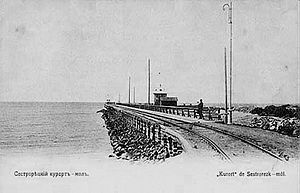
After the first year of operation, it became clear that the road was unprofitable. It was supposed to preserve the line. This did not happen thanks to a proposal from Moritz von Desen and Mikhail Ivanovich Miller, according to which the Sestroretsk branch was purchased from the Finland Railway with the subsequent organization of passenger traffic. It was also planned to build a new sea pier 3 versts from Sestroretsk, on the bank of the Sestroretskaya Bay, as well as an additional branch to the Tarkhov Spit, where the pier existed.
In January 1873, the Sestroretsk Railway Society was established, which took over the branch on April 19, 1875. Rolling stock was leased from the Finland Railway. In the harbor, dubbed Miller Harbor, a 50-meter-high dam was dug from boulders, along which a railway line was laid to the pier . Before the dam, the path ran along the beach itself [1] . On this branch, engineer F. A. Pirotsky in 1876 conducted experiments with electricity.
There were four pairs of passenger trains on the line. The volume of factory transportation turned out to be very small due to a conflicting tariff policy from the Finland Railway. The erected marina was inactive. Most of the plans outlined have not been implemented. In the mid-1880s, the Sestroretsk Railway Society finally went bankrupt, and from January 1, 1886, the road was closed to traffic.
1889-1919 years. Seaside Sestroretsk railway.
At the end of 1889, the Joint-Stock Company of the Primorsky St. Petersburg-Sestroretsk Railway was created, whose chairman was P.A. Avenarius . It was originally intended to build a horse-drawn railway between St. Petersburg and Sestroretsk. On February 11, 1892, new conditions for the construction and operation of the Primorsky Railway were approved, according to which the operation of the railway was allowed with the possible use of steam traction, with a set construction period of 3 years.
Ozerkovskaya line
On July 23, 1893, the Ozerkovskaya road line was opened: from St. Petersburg (Novaya Derevnya) through the Commandant Field, Kolomyagi to Ozerkov (7 km).
Location map of Novoderevensky station
Seaside train at the Glass Mountain
Kolomyagi station at the beginning of the 20th century
Station Ozerki Primorsky Railway at the beginning of the 20th century
Ozerki Finle Station. railroad at the beginning of the 20th century
Sestroretsk line
On July 12, 1894, a section from St. Petersburg to Lakhta took effect. A feature of this section of the road was a 200-meter pile bridge erected through the Lakhtinsky spill , which was located parallel to the Lakhtinsky dam, along which a land road ran.
On October 31, 1894, passenger service was opened from Lakhta to Razdelnaya with the organization of traffic to Steamboat Wharf.
On November 26, 1894, the construction of the fourth section to Sestroretsk was completed.
Primorsky railway was not profitable. The company was forced to issue bonds of its 5% loan with the repayment of coupons twice a year. In addition, P.A. Avenarius asked the government to provide land in the vicinity of the capital for the construction of the Resort (primarily, near Sestroretsk). For this, 64 tithes of land were allocated at the mouth of the Sestra River on the shores of the Gulf of Finland. In 1900, a branch was laid from Sestroretsk to the Kurort junction station.
At the end of the 19th century , development began on the right bank of the Sestra River in the Rusty Ditch area. Many dachas of various charitable organizations were built on the site. In 1903, at the Kurort station, it was first built horse-drawn, and then next - a railway bridge. A new branch with a final destination at the Dune station was laid through it towards the Russian-Finnish border.
In continuation of the railway on the line Sestroretsk - Kronstadt and Lysy Nos - Kronshtadt the steamers Sestroretsk and Lysy Nos, belonging to the Primorsky Railway, went [2] .
Transfer plan of the Primorskaya railway station. Product Line
The inconvenience of the location of the Novoderevensky station on the outskirts of the capital became more and more obvious. In 1898, the Board of the Company applied to the Ministry of Railways with a petition for permission to extend the road within the city to Nizhny Novgorod Street (now Academician Lebedev Street ), and to the north (in the future) - to extend to Kuokkala Station. On May 28, 1899, permission was received to build a line from Kolomyazhskoye Shosse (now Kolomyazhsky Prospekt ) to the station on the corner of Bolshoy Sampsonievsky Prospekt and Samarskaya (now Botkinsky) Street. The continuation of the matter was already in 1903 . Then it was planned to place a new station of the Primorsky Railway near the Liteiny Bridge opposite the Finland Station . The plans were only half implemented. The upper structure of the track was brought to the corner of Flygov Lane (now Kantemirovskaya Street ) and Bolshoi Sampsonievsky Avenue. The opening of the movement on a new urban site took place in May 1904.
The financial position of the Company continued to be unstable. The construction and operation of the Resort did not bring the expected benefits. The Management Board of the Company has developed a project for the transition of the road to electric traction and the reconstruction of the suburban route according to the type of high-speed urban electric railways. Five bonded loans were issued one after another to implement this project. But the proceeds were not applied. In the late 1910s, the Company stopped paying dividends on shares and interest on bonds. It was declared insolvent, and the railway was taken into the administration under the supervision of the treasury. Since that time, the position of the Primorsky Railway began to improve gradually. Its exploitation began to generate income.
Factory Line
With the outbreak of World War I, the Sestroretsk Plant, as the largest arms company, needed to connect direct transport links with the network of Russian railways. Since private railways did not have docking junctions with state ones, in 1915 a connecting line was arranged at the Ozerki station to deliver fuel, metal and billets to the Sestroretsky plant. To provide the plant with convenient transport links, the construction of the state railway (“factory”) from Beloostrov was started. The line of 1871 was rebuilt, and a railway bridge was built across the Sestra River. This branch was commissioned in May 1916.
In 1918, the Primorsky Petrogradsko-Sestroretsk railway was nationalized and cargoes began to be delivered to the plant through it.
Rolling stock
On the Primorsky Railway, only urban-type steam locomotives were allowed to operate ( tank-steam locomotives with an axial formula of 0-2-0 ).
In 1893, for operation on the railway, the Kolomensky Zavod built 5 such steam locomotives of type No. 45 with numbers from 1 to 5. A feature of the locomotives under construction was the installation of steam condensers on the roof, with which the exhaust steam was cooled by a natural air stream. Thanks to these heat exchangers, according to the designers, the mileage of the engine increased without additional refueling with water.
In 1894, Kolomensky Zavod built another 5 steam locomotives for the Primorsky road (No. 6-10).
By 1895, the Primorsky St. Petersburg-Sestroretsk Railway Society had 10 steam locomotives, 31 passenger, 10 luggage and 26 freight cars.
Locomotives manufactured in 1898 at the Motala factory in Sweden received No. 11-16.
By 1899, steam engines No. 6-10 were decommissioned, and they were replaced by 4 locomotives of the Motala plant, with numbers assigned: No. 7-10, and the operating steam engine No. 16 was renumbered as No. 6.
In 1903, the Putilov plant delivered steam engines No. 16 and 17 for the Primorsky Railway.
Two years later, they arrived here after operation on the Circum-Baikal Railway No. 18, 19 and 20.
In 1913 - No. 21 and 22.
The last locomotives of this type, working on the lines of the Petersburg-Sestroretsk railway, were No. 23, 24 and 25.
since 1919
In 1919, the Primorsky Sestroretsk Railway became part of the Nikolaev (now October) Railway . In connection with the declaration of independence of Finland, bridges across the border rivers were blown up. The territory of the Sestroretsk Resort entered the border zone [3] . Traffic along the Sestroretsk branch was extremely limited.
In the early 1920s, the Ozerkovskaya line first became a production line, and then work began on its dismantling (half completed by 1927). On the Sestroretsk branch, patrols were partially eliminated, the second tracks were removed at most stations and on the Sestroretsk-Kurot section. Working tank locomotives of the former Primorsky Railway were gradually transferred to the tram rails of Leningrad, where they were used to transport materials to the lines under construction, as well as for passenger transportation in areas where the contact network had not yet been made.
On September 23, 1924, as a result of the flood, the railway at the Novaya Derevnya station, as well as on the Novaya Derevnya-Lakhta stage, was flooded. The Lakhta dam protecting the canvas, as well as the entire terrain, was destroyed to the ground, and the pile bridge over the Lakhta spill was completely destroyed. To restore the railway, it was required to fill in a new dam in Lakhta.
In 1926, the station on Novaya Derevnya was liquidated, the line from the corner of Flygov Lane and Bolshoy Sampsonievsky Prospect was brought to the Finland Line, and trains to Sestroretsk began to depart from the Finland Station. Earlier, it was decided to extend the route from Kurort station to Beloostrov. In 1925, a notch was dug in a sand dune and connected the Resort with Beloostrov. Around the same time, repair work in Lakhta was also completed. Thus, a circular Sestroretsk branch of the October Railway was obtained.
In 1933 [4] , with the construction of a direct passage to the Lanskaya station, the dismantling of the former Commodity Line was started. By 1938, only a part of it was preserved from Novaya Derevnya to the modern Torzhkovskaya street , as well as the lower structure of the road further to the district of the modern house No. 11 on Beloostrovskaya street .
In 1941-1943, the Sestroretsk line was used to drive an armored train, which made night raids towards Beloostrov to bombard enemy positions. At the end of 1943, the railway connection with Sestroretsky was reopened.
In 1948, the Ozerkovskaya branch was converted into the Small October Railway for children . The railway to Sestroretsk was reconstructed. In 1952 it was electrified and on June 1 the first electric trains went to Sestroretsk [5] .
List of historic stations, platforms, and sidings of the Primorsky Sestroretsk Railway
| Title | Station type | Current state |
|---|---|---|
| New Village | station | liquidated and transferred to New Village |
| Nodal | station | renamed New Village acting |
Sestroretsk line
| Title | Station type | Current state |
|---|---|---|
| Second verst | traveling [6] | eliminated |
| Dam | traveling | eliminated, in its place is the platform Yacht |
| Lakhta | station | acting |
| Olgino | stopping point | acting |
| 13th verst | traveling | eliminated |
| Marine | stopping point | kept in reserve |
| Separate | station | acting, renamed Fox Nose |
| Fox Nose [7] | station | eliminated |
| Kaupilova | stopping point | eliminated |
| Gorskaya | stopping point | acting |
| Alexandrovskaya | stopping point | acting |
| Tarhovka | stopping point | acting |
| Spill | stopping point | acting |
| Sestroretsk | station | acting |
| Ermolovskaya | stopping point | eliminated |
| Resort | stopping point | acting as a stopping point |
| School | stopping point | eliminated |
| Dunes | station | eliminated |
Ozerkovskaya line
| Title | Station type | Current state |
|---|---|---|
| Horse racing | stopping point | eliminated |
| Kolomyazhskaya | stopping point | eliminated |
| Count | stopping point | eliminated |
| Saddles | stopping point | eliminated |
| Lakes | station | eliminated |
Product Line
| Title | Station type | Current state |
|---|---|---|
| Serdobolskaya | stopping point | eliminated |
| Flyugov post | stopping point | eliminated |
Notes
- ↑ Later, in 1900 , at the opening of the esplanade of the Sestroretsk Resort, low fences were installed around the line
- ↑ Peasants V. Ya. Kronshtadt: Fortress, city, port. - SPb .: Island 2002. - S. 70. - ISBN 5-94500-010-8
- ↑ Now, on the site of the Resort - Dunes line, a forest clearing has been preserved, passing from the sanatorium "Children's Dunes" to the channel of the Rusty Ditch.
- ↑ Leningrad from the 1933 guidebook
- ↑ Sequence of electrification of railway sections of the Karelian Isthmus
- ↑ All trips were arranged for technical purposes, and passengers did not land or disembark on them.
- ↑ Arranged on a separate branch