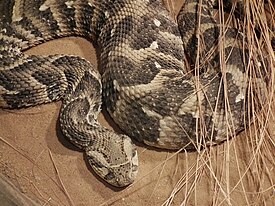
Species of this genus live in South and Southeast Africa, with the exception of a noisy viper , which also includes the northern regions of the continent and the territory of the Arabian Peninsula. They live in various biotopes - from sandy deserts to moist forests [2] . The sizes of different species vary from 28 cm in the African Schneider viper to more than 2 m in the Gabon viper [3] . Active at dusk and at night, ovoviviparous [2] .
The genus contains 16 species [4] [1] :
- Bitis albanica Hewitt, 1937
- Bitis arietans Merrem, 1820 - noisy viper
- Bitis armata (Smith, 1826)
- Bitis atropos (Linnaeus, 1758) - South African mountain viper
- Bitis caudalis (Smith, 1839) - tailed viper
- Bitis cornuta (Daudin, 1803) - tufted viper
- Bitis gabonica Duméril, Bibron & Duméril, 1854 - Gabon viper, or cassava
- Bitis heraldica (Bocage, 1889)
- Bitis inornata (Smith, 1838)
- Bitis nasicornis (Shaw, 1802) - rhino adder
- Bitis parviocula Böhme, 1976
- Bitis peringueyi (Boulenger, 1888) - pygmy African viper
- Bitis rubida Branch, 1997
- Bitis schneideri (Boettger, 1886) - African Schneider viper
- Bitis worthingtoni parker, 1932 - mountain kenyan viper
- Bitis xeropaga Haacke, 1975