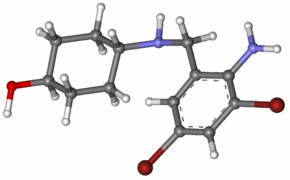
Ambroxol ( Lat. Ambroxolum , Eng. Ambroxol ) - a drug that stimulates mucociliary activity and has an expectorant effect, is a metabolite of bromhexine .
| Ambroxol | |
|---|---|
| Ambroxolum | |
 | |
 | |
| Chemical compound | |
| IUPAC | 4 - [(2-amino-3,5-dibromophenyl) methylamino] cyclohexan-1-ol (as hydrochloride) |
| Gross formula | C 13 H 18 Br 2 N 2 O |
| Cas | |
| PubChem | |
| Drugbank | |
| Classification | |
| Farmakol. Group | secretolytics and stimulators of motor function of the respiratory tract |
| ATX | |
| ICD-10 | |
| Dosage Forms | |
| prolonged-action capsules, solution for intravenous administration, solution for oral administration and inhalation, syrup, tablets, effervescent tablets [2] | |
| Other names | |
| Ambrobene, AmbroGexal, Ambroxol, Ambrosan, Bronchoxol, Bronchorus, Lazoxol baby, Lazolvan, Mucosol, Medox, Suprim-coffee, Thoraxol, Flavamed, Halixol [2] | |

Unlike some other drugs, it has no narcotic effect.
Since 2012, Ambroxol has been included in the list of vital and essential medicines .
Content
Receipt History
The properties of the Adhatoda vasica plant have long been known to thin and promote sputum production. The active substance, vazicin alkaloid, was isolated from the plant, after studying the chemical structure of which its analogue, bromhexine , whose active metabolite is ambroxol, was synthesized. [3] .
General information
Ambroxol is one of the most widely used in clinical practice mucolytics . It activates the movement of cilia, restores mucociliary transport, stimulates the formation of bronchial secretions of low viscosity due to changes in the chemistry of its mucopolysaccharides. It stimulates the production of surfactant , increasing its synthesis, secretion and inhibiting its decay, which prevents the penetration of pathogenic microorganisms into the epithelial cells. Ambroxol also has anti-inflammatory and antioxidant properties.
Since 2010, in a number of European countries (eg France, Italy) expectorant mucolytics (including ambroxol) have been banned for use by children under 2 years of age due to the occurrence of severe complications in the airways and their established connection with the use of this drug . However, this connection has not been fully studied and proven. Therefore, in some countries of the European Union (eg Greece), Ambroxol is allowed for children from birth.
It should be noted that a noticeable clinical effect with oral administration of ambroxol is observed no earlier than 4-6 days of administration [4] .
Ambroxol may be effective in the prevention of upper respiratory tract infections (IVPD). As shown by the results of a randomized controlled trial conducted in Japan in 2006 , prophylactic administration of ambroxol (in a daily dose of 45 mg) significantly reduces the average number of episodes of IVDP (unlike another mucolytic - carbocysteine ) [5] .
In 2007, according to the results of evaluating the effectiveness of ambroxol and other mucolytics ( bromhexine , neltenexin ) prescribed in addition to antibiotics in the treatment of pneumonia in adults and children, there were no sufficient consistent data to draw any conclusions about the appropriateness of their use as auxiliary agents in the treatment of cough associated with acute pneumonia [6] .
Pharmacological action
- Pharmacodynamics
It has a secretory, secretolytic and expectorant effect; stimulates the serous cells of the glands of the bronchial mucosa , increases the content of the mucous secretion and the release of surfactant (surfactant) in the alveoli and bronchi; normalizes the disturbed ratio of serous and mucous components of sputum . By activating hydrolyzing enzymes and enhancing the release of lysosomes from Clara cells, it reduces the viscosity of sputum. Increases motor activity of ciliated epithelium , improves mucociliary transport .
After oral administration, action occurs after 30 minutes. , with rectal administration - after 10-30 minutes. and lasts for 6-12 hours . With parenteral administration, the effect occurs quickly and lasts for 6-10 hours .
- Pharmacokinetics
Absorption is high (for any route of administration), the time to reach the maximum concentration (TC max ) is 2 hours, the connection with plasma proteins is 80%. Penetrates through the blood-brain barrier , the placental barrier , excreted in breast milk .
Metabolism - in the liver , forms dibromanthranilic acid and glucuronic conjugates . The half-life of 7-12 hours . T 1/2 increases in severe chronic renal failure , does not change with impaired liver function.
It is excreted by the kidneys : 90% in the form of water-soluble metabolites, unchanged - about 5%.
Indications for use
Acute and chronic diseases of the respiratory tract, accompanied by the formation of viscous sputum: acute and chronic bronchitis of various etiologies, pneumonia , COPD , asthma with difficulty in sputum discharge, bronchiectasis , cystic fibrosis of the lungs, tracheitis and laryngotracheitis . Inflammatory diseases of the nasopharynx and sinuses, in which liquefaction of the mucus is necessary. Remediation of the bronchial tree in the pre- and postoperative period. Stimulation of prenatal lung maturation, treatment and prevention (with the threat of premature birth and with the indicated artificial premature birth between 28 and 34 weeks of pregnancy , if the clinical picture suggests an extension of the gestational period by 3 days) of respiratory distress syndrome in premature infants and newborns.
Contraindications
Hypersensitivity to ambroxol or auxiliary components of drugs; I trimester of pregnancy; lactation (breastfeeding); congenital intolerance to fructose (for dosage forms containing fructose); children's age up to 6 years (for tablets); children's age up to 12 years (for prolonged action capsules).
- With caution
Impaired bronchial motility and increased secretion of mucus (for example, with a rare syndrome of motionless cilia); renal failure and / or severe liver failure ; peptic ulcer of the stomach and duodenum (including history); II and III trimesters of pregnancy; children's age up to 2 years (oral solution; only as directed by a doctor).
Side Effects
According to the World Health Organization ( WHO ), unwanted effects are classified according to their frequency of development as follows: very often (⩾ 1/10), often (⩾1 / 100, <1/10), infrequently (⩾1 / 1000, < 1/100), rarely (⩾1 / 10000, <1/1000) and very rarely (<1/10000); the frequency is unknown (the frequency of occurrence of the phenomenon cannot be determined based on available data).
Allergic reactions: rarely - skin rash , urticaria , exanthema, swelling of the face, shortness of breath, itching, fever; frequency unknown - anaphylactic reactions, including anaphylactic shock , angioedema , pruritus, allergic contact dermatitis .
From the digestive system: often - nausea; infrequently - vomiting, diarrhea, dyspepsia , abdominal pain.
From the nervous system: often - dysgeusia .
On the part of the skin and subcutaneous tissues: very rarely - toxic epidermal necrolysis ( Lyell syndrome ), Stevens-Johnson syndrome ; frequency unknown - acute generalized eczematous pustulosis .
From the respiratory system: often - decreased sensitivity in the oral cavity or pharynx; rarely - dryness of the mucous membrane of the respiratory tract, rhinorrhea (increased mucus formation in the nasopharynx); in isolated cases - dryness of the mucous membrane of the pharynx
With prolonged use in high doses. Gastralgia , nausea , vomiting .
With rapid intravenous administration. Numbness, adynamia , intense headaches, decreased blood pressure , shortness of breath , hyperthermia , chills .
Overdose
Symptoms Nausea , vomiting, diarrhea, dyspepsia .
Treatment. Artificial vomiting, gastric lavage in the first 1-2 hours after taking the drug; intake of fat-containing products, symptomatic therapy.
Interaction with other drugs
The combined use of ambroxol and antitussive drugs due to suppression of cough leads to difficulty in sputum discharge. In this regard, the combination of ambroxol and antitussive drugs is not recommended.
It increases the penetration into the bronchial secretion of a number of antibiotics : amoxicillin , cefuroxime , erythromycin and doxycycline .
Solution for injection cannot be used with solutions having a pH above 6.3.
Special instructions
It should not be combined with antitussive drugs that make sputum excretion difficult. Inhalation solution can be used using any modern equipment for inhalation (except steam inhalers). Before inhalation, the drug is mixed with a 0.9% NaCl solution (for optimal humidification, it can be diluted 1: 1) and heated to body temperature. Inhalations should be carried out in the usual breathing mode (so as not to provoke coughing tremors). Patients suffering from bronchial asthma, in order to avoid nonspecific irritation of the respiratory tract and their spasm before inhaling Ambroxol, it is necessary to use bronchodilators . Patients with diabetes can be prescribed in the form of a syrup (5 ml of syrup contain sorbitol and saccharin in an amount corresponding to 0.18 XE ). Children under 5 years old are not recommended to use 15 mg suppositories , up to 12 years - 30 mg (15 mg suppositories are used for them).
Dosage Forms
As of April 2018, the following dosage forms of ambroxol have been registered in Russia [2] [7] :
| Dosage form | amount active substance | Trade marks |
|---|---|---|
| solution for oral administration and inhalation | 7.5 mg / ml | common form |
| syrup | 3 mg / ml, 6 mg / ml | common form |
| pills | 30 mg | common form |
| long acting capsules | 75 mg | Ambrobene, AmbroGexal, Lazolvan retard, Lazolvan Max |
| solution for intravenous administration | 7.5 mg / ml | Ambrobene, Ambroxol |
| lozenges | 15 mg | "Lazolvan" |
| lozenges | 15 mg, 20 mg | Lazongin, Neo-Bronchol |
| effervescent tablets | 30 mg, 60 mg | Ambroxol-Hemofarm, Flavamed |
Links
Notes
- ↑ Ambroxol . Register of medicines . ReLeS.ru (05/18/1999). Date of treatment August 30, 2008. Archived March 14, 2012.
- ↑ 1 2 3 Search the database of drugs, search options: INN - Ambroxol , flags “Search in the register of registered drugs” , “Search TKFS” , “Show lexforms” unspecified . The circulation of drugs . Federal State Institution “Scientific Center for Expertise of Medical Devices” of the Russian Healthcare Supervision Service of the Russian Federation (07.24.2008). - A typical clinical and pharmacological article is a by-law and is not protected by copyright in accordance with part four of the Civil Code of the Russian Federation No. 230-FZ of December 18, 2006. Date of treatment August 30, 2008. Archived August 22, 2011.
- ↑ Secretolytics and stimulators of motor function of the respiratory tract . Encyclopedia of medicines and pharmaceutical products . Radar Patent. - Instruction, application and formula.
- ↑ Kozlov S.N., Rachina S.A., Domnikova N.P. Pharmacotherapy of exacerbation of chronic bronchitis in outpatient practice: the results of pharmacoepidemiological studies // Clinical Microbiology and Antimicrobial Chemotherapy: Journal. - M. , 2001. - T. 3 , No. 2 .
- ↑ Nobata K., Fujimura M., Ishiura Y. et al. Ambroxol is effective for the prevention of upper respiratory tract infections = Ambroxol for the prevention of acute upper respiratory disease // Clin Exp Med. - 2006. - No. 6 (2) . - S. 79-83 .
- ↑ Chang C., Cheng A., Chang A. Over-the-counter cough medicines prescribed in addition to antibiotics for acute pneumonia in adults and children = Over-the-counter (OTC) medications to reduce cough as an adjunct to antibiotics for acute pneumonia in children and adults // Cochrane Database of Systematic Reviews. - 2007. - No. 4 . (inaccessible link)
- ↑ State register of medicines . grls.rosminzdrav.ru. Date of treatment June 20, 2018.
Links
- Novikov Yu. K. Mucociliary transport as the main mechanism of lung protection // Russian Medical Journal: Independent publication for practicing doctors. - Moscow, 2007. - T. 15 , No. 5 . - S. 357-361 . Archived on October 4, 2010.
- Butler L.I. Place of mucolytics in the complex therapy of patients with chronic bronchitis // Russian Medical Journal: Independent publication for practicing physicians. - Moscow, 2007. - T. 15 , No. 6 . - S. 450–453 . Archived on March 20, 2015.