Tsarskoe Selo is a museum-reserve in the town of Pushkin ( St. Petersburg ), which includes a palace and park ensemble of the 18th and 19th centuries, a former suburban royal residence, which was turned into a museum after nationalization in March 1918 . The museum got its present name in 1992 .
| Museum Reserve | |
| Tsarskoye Selo | |
|---|---|
| A country |  Russia Russia |
| City | Pushkin |
| Architectural style | |
| Site | |
 World Heritage Site World Heritage Site | |
| Historic Center of Monuments. The Palace of the Town of Pushkin (Tzarskoe Selo) (The historical center of St. Petersburg and related complexes of monuments. The palace and park ensembles of Pushkin (Tsarskoye Selo)) | |
| Link | No. 540-006 in the list of World Heritage Sites ( en ) |
| Criteria | i, ii, iv, vi |
| Region | Europe and North America |
| Turning on | 1990 ( 14th session ) |
The museum-reserve includes: Catherine Park with a palace and pavilions, Alexander Park with a palace and pavilions and Babolovsky Park with a palace [1] .

Content
Catherine Park
It covers an area of 107 hectares. It consists of a regular Old Garden (1717-1720s, garden masters J. Rozen and I. Voght) and a landscape English park (1760-1796 years, garden masters J. Bush, T. Ilyin, architect V. I. Neelov) separated by the Big Pond. Named in honor of Empress Catherine I.
- Grand Catherine Palace
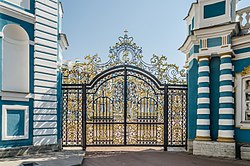
The modern look of the palace was formed as a result of the restructuring of the palace, built in 1717 - 1723 by the architect I. F. Braunstein. In 1743 - 1756, the works were first supervised by architects M. G. Zemtsov , A. V. Kvasov and S. I. Chevakinsky , and then F. B. Rastrelli . Rastrelli is the main author of the architectural design of the building and the magnificent sculptural decoration of its facades in the style of Russian Baroque , as well as the entire interior layout and decoration of the halls of the mid- 18th century . From the west there is an adjacent courtyard, decorated with one-story semi-circular buildings and a wrought fence with gilded details and gates along the central axis of the palace. Buildings built at the end of the 18th century adjoin the side facades of the palace. On the north side, this is a four-storey outbuilding (later it was located in Lyceum , now the Memorial Museum - Lyceum , a branch of the All-Russian Museum named after A. Pushkin ), connected to the palace by an arch above Sadovaya Street (architect I. V. Neelov), from the south - Zubovsky wing (architect Yu. M. Velten ). A set of Cameron Gallery , cold baths , a hanging garden and a ramp adjoin the southeast (1780-1794, architect C. Cameron ). One of the most famous premises of the Grand Catherine Palace is the Amber Room . In June 2019, the Emporium’s Lyon Hall , which had been inaccessible since 1941, was opened to the public [2] .
- The Hermitage is a two-story octagonal pavilion with a dome, columns and stucco decorations (1744-1754, architects M. Zemtsov , F. B. Rastrelli ). Used for summer receptions of the royal guests.
- The grotto is a pavilion with azure walls and white columns, decorated with stucco décor dedicated to the maritime theme (1749-1761, architect FB Rastrelli).
- The Admiralty is a group of buildings made of loose brick with white cornices and lancet windows, topped with Gothic stepped towers and spitz (1773–1777, architect IV Neelov).
| Catherine Palace | Pavilion "Grotto" | Cameron Gallery | Admiralty |
Alexandrovsky Park
It covers an area of 188 hectares. Consists of the regular part (New Garden, 1740s, author of the project N. Girard) and Landscape Park (1790s) with three ponds and mounds of hills. In the western part of the park the Kuzminka River flows, blocked by a dam.
- Alexander Palace
Built in 1792 - 1796 by the architect J. Quarenghi in the classical style for Grand Duke Alexander Pavlovich, the future Emperor Alexander I. The palace is a two-story building stretched in length with double wings on the sides. In the center of the main northern facade of the two rows of columns make up the magnificent through the colonnade of the Corinthian order. From the side of the regular part of the Alexander Park, the facade of the building is designed in the form of a semi-rotunda, covered with a spherical dome. It is being restored.
- The children's house is a small pavilion built next to the Alexander Palace for the games of the children of Emperor Nicholas I (1830, architects A. M. Gornostayev ).
- The Chinese Theater is the ruined building of the court summer theater (1778–1779, architects A. Rinaldi , I. V. Neyelov). It burnt down during the shelling of the city in 1941 and has not been restored since then.
- Chinese Village - a complex of 12 one-story houses in the Chinese style (1782-1798, architects C. Cameron, I. Neelov). Currently - hotel.
- The White Tower is a pavilion in the style of a medieval knight’s castle, surrounded by a moat (1821–1827, architect A. A. Menelas ). Restored in 2012.
- Arsenal - a pavilion in the Gothic style (1819-1834, architect A. A. Menelas). Built on the site of the Barbeque Pavilion Monbiju . Currently - a museum.
- Grotto spring . Architect S. Danini. The end of the 90s of the XIX century.
- Chapelle ( Fr. Chapelle - chapel) - Gothic chapel (1825–1828, architect A. A. Menelas). Restored.
- The Chamber of Commerce is a complex of buildings in the neo-Russian style (1913–1917, architect S. Yu. Sidorchuk ). Restored in 2014, the centenary of the outbreak of the First World War. The building has a museum dedicated to Russia's participation in this war.
| Alexandrovsky Park | Chinese village | "Arsenal" | Pavilion "White Tower" |
Toponymy and etymology
The settlement, nowadays called the Tsarskoye Selo, was first mentioned in 1502 as Saritsa - in the "Census Salary Book for Novgorod Vodskaya Pyatina". On maps made for Boris Godunov , the estate has a similar name. In 1617, the Swedes took away this territory from Novgorod and renamed it to Saritshof. Among the lands is the Swedish manor - in the language of the indigenous population of Saari-Mois (a place on the hill) [3] . Due to this, in Russian - by the time the lands are approved, Russia and Alexander Menshikov specifically - is assigned the toponym Sarskaya manor. Here in 1711 - after the announcement of Catherine the "True Empress" - the formation of a palace-like residence, Tsarskoye Selo began.
It is not known when exactly the usual variant of pronunciation and spelling has become the norm. At the beginning of the 19th century there was an obsolete name (including in official documents). In the decree of Emperor Alexander I of 1808, we read [4] : “From now on, this city is called Sarskoye Selo or Sofia”. This name is present in the poems of Derzhavin and Lomonosov, in the letters of Turgenev and the Minister of Justice, in combination with the poet I. I. Dmitriev. And even his protégé, the author of the famous "October 19" [5] A. Pushkin - in letters and draft satire.
Organizational issues
From 1987 until the sudden death on August 1, 2008, the museum director was I. P. Sautov . On September 23, 2008, Olga Taratynova, the widow of I. P. Sautova , was appointed head of the museum [6] .
As of 2016, the museum leads the restoration of the Alexander Palace , the Chapelle pavilion , the Imperial Farm, metal bridges in the Alexander Park and the Church of the Resurrection of Christ in the Catherine Palace.
Literature
- Vilchkovsky S.N. Tsarskoye Selo. Guide. 1710-1910. . - 2nd ed, reprint 1992. - SPb. : Partnership R. Golike and A. Wilborg, 1911. - 278 p.
- Petrov A.N. Pushkin. Palaces and parks. L.-M., 1964.
- Schwartz V. Suburbs of Leningrad. - L .; M .: Art, 1967. - p. 123-189. - 320 s. - 50 000 copies
- Monuments of architecture of the suburbs of Leningrad. L., 1983.
- Voronov M. G., Kuchumov A. M. The Amber Room. L., 1989.
- Tsarskoye Selo arsenal. / Comp. and enter. article: L.V. Bardovskaya, V.M. Faibisovich. SPb., 2000.
- Bardovskaya L.V. Masterpieces of painting in the Tsarskoye Selo meeting. SPb., 2008.
- Bredikhina I.I. Court crews. Tsarskoye Selo meeting. SPb., 2008.
- Bott IK Tsarskoye Selo furniture and its crowned owners. SPb., 2009.
- Serpinskaya T. V. Artistic Bronze of the Tsarskoye Selo Assembly of St. Petersburg, 2009.
- Architects of Tsarskoye Selo: from Rastrelli to Danini. / Authors: L. V. Bardovskaya, I. K. Bott. SPb., 2010.
- Catherine Palace. Parade halls. Residential rooms. / Authors of the text: L. V. Bardovskaya, G. D. Khodasevich. SPb., 2010.
- Alexander Palace. / Authors of articles: L. V. Bardovskaya, V. F. Plaude, I. G. Stepanenko. SPb., 2010.
- Kedrinsky A. A. The Great Tsarskoye Selo (Catherine) Palace: from the suburban estate to the main residence. 1710-1760. SPb., 2013.
- Plaude V.F. Photography. 1850s - 1917./ State Museum-Reserve "Tsarskoye Selo". Catalog collections. Volume XVII. Book I. St. Petersburg., 2013.
- Stepanenko IG. Venetian decorative sculpture of the first Thu. XVIII century. / State. Tsarskoye Selo Museum-Reserve. Catalog collections. Volume IX. Book I. SPb., 2015.
Notes
- ↑ Schwartz, 1967 .
- 6 The Tsarskoye Selo Museum on June 6 will open the recreated Lyon Hall of the Catherine Palace . TASS Culture (06/05/2019).
- ↑ Tsarskoe Selo. Palaces and parks; N. Popova, A. Raskin, 2009, publishing house P-2, St. Petersburg
- The complete collection of laws of the Russian Empire, 1st edition, volume 30, p.565, law 23.257
- ↑ https://ru.wikisource.org/wiki/19_October_ (Pushkin)
- ↑ A new director of the Tsarskoye Selo Museum-Reserve appointed in St. Petersburg . REGNUM (September 23, 2008). The appeal date is February 22, 2017.