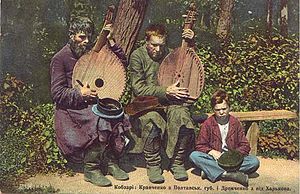
Kobzar ( Ukrainian: Kobzar ) - Ukrainian folk singer, representative of the epic genre, usually accompanying himself on one of three instruments - kobze , bandura or wheeled lyre .
Content
- 1 Kobzarstvo as a phenomenon
- 2 Kobzar workshops
- 3 Performances and Repertoire
- 4 History
- 4.1 First references
- 4.2 Kobzarism in the XVI-XVIII centuries
- 4.3 XIX century
- 4.4 Kobzari and Bandurists in the 20th Century
- 5 Modern Traditional Kobzarism
- 5.1 Revival of tradition
- 6 See also
- 7 Literature
- 8 Notes
- 9 References
Kobzarism as a phenomenon
Kobzars, first of all, were moral authorities in the people [1] . In popular beliefs, the kobzar was a character "from beyond the river" (that is, "from the other side"). And along with the characters of the ritual of the matchmaking, as well as the rituals of Kolyada and Malanka, he, as several centuries earlier than the magician, came into the family to “test” three generations for the correct education of their ancestors and the correct education of their descendants. To offend a kobzar meant to incur the wrath of heaven "upon the dead, the living, and still unmarried." Therefore, the poorest peasant in Ukraine has always kept part of the field “on an old man’s wedge” - to give alms to the kobzar (in Belarus there was a similar tradition with respect to shingles). The training of the kobzar began with the singing of psalms and asking for alms without an instrument. And only after passing this stage, the student began to study kobza, bandura or lyre. Kobzars were zealous Orthodox Christians, celebrated holidays, had psalms and numerous religious moralizing songs in their repertoire, and during the “struggle against religion” in 1920-1930 they even passed in official documents as “non-state priests” (spelling of the original) and “amateur monastic element ” [2] .
Kobzar workshops
Kobzari, as well as representatives of many other crafts of Ukraine, according to Magdeburg Law (with which most of the inhabitants of the Ukrainian lands were familiar from 1324 to 1835 ) united in workshops. The Kobzar workshops had their own strict hierarchy - from the student to the “panmeister” or “panotz” (workshop head). Each workshop had its own area, as a rule, some city or 5-6 villages. I chose a workshop and my church, where, among other things, new tools were consecrated and the beginning and end of the “cob-brewing” season were celebrated, outside of which street singing of kobzars was not a tradition. The season began for Trinity in the northern regions of Ukraine and for Easter in the southern. Ending kobzavanie everywhere on Pokrov (October 14). The Kobzars themselves called the "elders" and referred themselves to the "asking brotherhood." Socially, the Kobzar industry has always been an honorable "niche" for talented and wise people of advanced age and disabled people. The people believed, for example, that only the blind can "look into the soul."
Performances and Repertoire
The repertoire of the kobzars included religious psalms (or psalms) and editions, moralizing songs, epic ballads or “thoughts” (including those related to the era of Kievan Rus, the Cossacks), humorous as well as the so-called. "Household" songs and dances. The composition of the repertoire was determined by the place and time of execution. The main forms of “concert activity” of kobzars were street and home (in families) singing. The same forms are found in many other traditional singers of the world. Coming to the family, the kobzar first of all talked with children, telling them tales, singing children's songs; then with boys and girls for whom the moralizing repertoire was in store. And only at the end he sat up with the older generation of the family, telling songs about antiquity in songs, performing ancient psalms and editions, mournful and humorous songs. The traditional places of kobzarezvanie include the church (at the entrance, never in the church itself), a market, a shinok (tavern) and a wedding, where the appearance of the kobzar was considered a good omen for the young. Each of these places had its own repertoire: psalms and pipes for the church, humorous songs and dances for the shink, moralizing songs for greeting young people, etc.
History
First Mention
The first references to Kobzar "thoughts" (historical songs) as "songs about the death of heroes" are in Polish sources, in particular, in the "Annals" of Sarnitsky (1587).
Kobzarism in the XVI-XVIII centuries
During the time of the Zaporizhzhya Sich among the kobzars there were many blind Cossacks who were crippled in battle. After the destruction of the Zaporizhzhya Sich and the departure of some Cossacks over the Danube, some of them blinded themselves, took up the instrument and returned to their native lands with kobzars (this was the only possible way to return home).
As a rule, copyright for kobzars was "corporate". None of the authors were distinguished or remembered with rare exceptions. Those whose authorship was nevertheless recognized by kobzars, include only two people - the poet and philosopher Grigory Skovoroda (who signed his poems “The Elder Warsaw”) and Taras Shevchenko (later the Great Kobzar). Among the authors, whose texts were used without mentioning them, there were also quite famous Ukrainian classical poets of the Baroque era - Feofan Prokopovich and Dmitro Tuptalo (aka Dimitri Rostovsky) .
XIX century
In the 19th century ethnographers begin to study kobzarei, the interest of the musical public awakens to them. Among ethnographers who studied kobzarism as a phenomenon, we find many prominent figures of Ukrainian culture - these are T. G. Shevchenko himself , a graduate of the Imperial Academy of Arts and the Geographical Department of St. Petersburg Imperial University (as a free listener), and Nikolai Vitalyevich Lysenko , who presented “The Mighty Handful” Kobzar Ostap Veresay , which, in turn, introduced his chants royal family (gifted with O. Veresay famous silver snuff box with a gold dedicatory inscription), and Lesia Ukrainka , Vo ice avshaya with her husband Clement Kvitka extensive repertoire Kobzarska the wax rollers first phonographs Edison (now these records are stored in Library of Congress [3] ).
"Zaporizhzhya Cossacks"
L. Zhemchuzhnikov. Kobzar on the road (1854)
S. Vasilkivsky. Bandura player with a guide boy / Watercolor, 1900 g
In the photo of the nineteenth century. Ostap Veresay (1803-1890)
Kobzar Ivan Kuchugura-Kucherenko, photo of the 1900s.
Kobzari and Bandurists in the 20th Century
Given the religiosity of a significant part of the repertoire, kobzars in Soviet times were repeatedly subjected to public criticism. Kobzu was called the "musical plow" and urged to "eradicate the psyche". But, given the enormous popularity of kobzars among the people, the authorities had to work hard to distort kobzarism as a phenomenon and reduce its "corrupting religious influence" on the "working masses". The bandura began to "improve" by the proletcultists and reached such a degree of difficulty that it was simply impossible to learn how to play it independently. At least 10 years passed from the first lesson to fluency in a rather complex instrument. The modern “academic” bandura has reached a weight of 8-12 kg, a significant part of the mass is made up of metal parts of switches, which have become even more complicated than that of an orchestral harp. The repertoire of the graduate of the conservatory at the beginning of the 2000s. was almost entirely from the works of Bach, Mozart and Beethoven. There were no epic works in the program of students of conservatories and music schools at all. In connection with this, another term arose - “Kobzar art” ( Ukrainian Kobzarske mystestvo ), or “bandurism” ( Ukrainian Ukrainian bandurnitsvo ), which means performing on a bandura without reference to the traditional Kobzar repertoire.
In recent years, the previously irreconcilable camps of “traditionalists” and “academics” have begun to find common ground. In 1996, at the kobzar congress, the Kiev kobzar shop joined the National Kobzar Union, and its representatives entered its governing bodies.
Modern Traditional Kobzarism
Kobzari today is one of the most fully studied epic singers in Europe. A significant part of the traditional repertoire has been recorded, workshop traditions have been studied, tools have been well described, and there are even world-famous audio recordings of the most famous kobzars of the beginning of the 20th century, which, unfortunately, could not be done by researchers of many other epic traditions - troubadours, skalds, minstrels and minnesingers.
Revival of Tradition
All this made possible the revival of the Kobzar tradition as a phenomenon by enthusiasts of the 1960-1980s. The person who started the revival of the Kobzar tradition was a former Moscow architect (the author of the projects of famous Moscow and Moscow parks and government buildings [4] [5] [6] , and in the past also a teacher at the Moscow Architectural Institute) Georgy Tkachenko . In his youth, studying at the Kharkov Architectural College, he took lessons from the famous Kharkiv kobzars Petro Drevchenko and Gnat Goncharenko (recorded at the time by the first phonographs by Clement Kvitka ). Having retired in the 1960s, he returned to Ukraine, settled with his niece in Kiev and began giving lessons in playing the traditional (“old-world”) bandura - a simple and accessible tool for independent study. His students subsequently founded the Kiev Kobzar workshop [7] , engaged in the study of the Kobzar tradition, the reconstruction of instruments and repertoire.
Mykola Budnik became the first pan-master (“panotse”) of the revived Kobzar workshop. He alone reconstructed 17 types of Kobzar instruments. Among them: Veresaevskaya kobza, Kobza according to Rigelman, various types of banduras, a torban ("pansky kobza"), etc. [8] .
In 2002, the Kobzar workshop released a CD-album of psalms and editions "Who is trustworthy in God." Some of his representatives also have musical (including CD) albums: Taras Silenko , Taras Kompanichenko , Eduard Drach , Vladimir Kushpet and his students.
Since 2008, the Kobzar workshop annually organizes the Trinity festival “ Kobzarska Trinity ” ( Kobzarsky Trinity ), which reconstructs the traditional opening of the Kobzar season.
Since 2011, blind musicians have been involved in the work to revive the Kobzar tradition.
In the village of Stretovka, Kagarlyksky district of the Kiev region, in 1989 the only college in Ukraine was opened, where they teach kobzarism [9] .
M. Tovkaylo, head of the Kiev Kobzar workshop, opens the first festival "Kobzarska Trіytsya" ( Kobzarskaya Trinity ) in 2008
Lyrek Yarema at a street performance of the first festival. 2008 year
Prof. M. Hai opens a scientific conference on traditional Kobzarism. 2012 year
The heads (panmeisters) of the Kobzar workshops (upper row from left to right) are M. Khai (Lvovsky), M. Tovkaylo (Kiev) and K. Cheremsky (Kharkov workshop) with the first blind performers Oleksandr Trius and Lajosh Molnar (lower row, from left to right)
See also
- Kobza
- Bandura
Literature
- Lysenko N.V. Description of musical features of Little Russian thoughts and songs performed by Kobzar Veresay. - K .: 1874.
- Kushpet, V. G. Traditions and new concert forms for mysterious bandurists // Get to the scientific-practical conference: “Ukrainian Kobzarism in musical society: traditions and accords”. - K .: 1997. - S. 22-23.
- Kushpet, V.G. Self-proprietor of gris on old musical instruments. Kobza O. Veresay, bandura G. Tkachenko, turban F. Vidorta. - K .: 1997. - 148 p.
- Kushpet, V. G. Another friend of the kobzi // Bandura, No. 65-66, 1998
- Kushpet Volodimir : Starchy | Starchy: mandra old-musicians in Ukraine (XIX - poch XX century): Naukova vidannya. - K .: Tempora, 2007 .-- 592 p.: Il. ISBN 966-8201-18-3
- Tovkaylo M. T. The word on the zahist of the national (old-school) banduri // Get to the scientific-practical conference: “Ukrainian co-patronage in musical society: tradition and social wisdom”. - K .: 1997. - S. 38-39.
- Tovkaylo, M. Bandura Gnata Goncharenka from the National Historical and Ethnographic Reserve “Pereyaslav” // Traditions and Ukrainian Culture. These are the representatives of the International Science-Practical Conference, awarded 125th anniversary of Gnat Khotkevich. - X .: 2002. - S. 4-75.
- High M. Y. Lirnitska Tradition as a Phenomenon of Ukrainian Spirituality. - Rodovid. - 1993.— No. 6. - S. 37-43.
- Hai M. Y. Taras Shevchenko in the context of a realistic and romanticized look at kobzarism // Taras Shevchenko and kobzarism. - Lviv, 2010. - P. 39-50.
- Hai M. Y. Kliment Vasilovich Kvitka - an accomplice of the Kobzarsko-Lirnitsky and instrumental traditions of Ukraine // Studios of mystical transport - Number 4 (8). Theatre. Music. Kino. - K .: 2004. - S. 38-43.
- Cheremsky, K.P. Turn of the tradition. - X .: Center of Les Kurbas, 1999 .-- 288 p.
- Cheremsky, K.P. - X .: Glass, 2002 .-- 444 p.
- Khotkevich, G - Musical Instruments of the Ukrainian People - Kh .: 1930
- Gumenyuk, A - Ukrainian folk musical instruments - K .: 1968
- Cherkassky, L. M. - Ukrainian folk musical instruments - K. Tekhnika, 2003
- Mizynec V. - Ukrainian Folk Instruments - Melbourne: Bayda books, 1984
Notes
- ↑ Cushpet Volodimir Starchy: mandra old-musicians in Ukraine (XIX - poch XX century): Naukove vision. - K .: Tempora, 2007
- ↑ Cheremsky, K.P. Turn of the tradition. - X .: Center of Les Kurbas, 1999 .-- 288 p.
- ↑ [1] Library of Congress website
- ↑ Works of the Architectural and Planning Workshop No. 5 of the Moscow City Council. Head V.I. Dolganov // Architectural newspaper (Moscow). - 1936. - No. 46. - Appendix. - Page 1-4 [Reproductions of G. Tkachenko's projects: the second version of the plan of the Central Park on the Lenin Hills in collaboration with V. Dolganov; General plan of Leninsky (former Tsaritsinsky) and Kolomensky parks; The perspective of the stalls in Luzhniki Central Park on the Lenin Hills].
- ↑ [Photo of a decorative park vase designed by G. Tkachenko] // Moscow construction. - 1940. - No. 16. - Page 20, ill. one.
- ↑ Korzhev M.P. (arch.), Prokhorova M.I. (arch.). Park TsDKA Pervomaisky district (Lefortovsky) // Construction of Moscow. - 1937. - No. 10. - Page 10-16 [Reproductions of graphic works by G. Tkachenko: sketch of organizing on Naberezhnaya Yauza (p. 14), view of the reading room from behind the pond (p. 16)].
- ↑ Workshop video blog on YouТube
- ↑ Site of Kiev Kobzar workshop
- ↑ What lives the only school of kobzars in the world: unique lyres and lack of children . The newspaper " Today " (April 8, 2019).