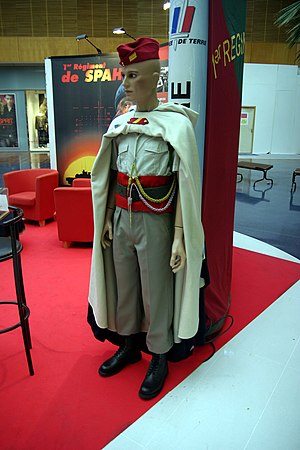

Spagi ( fr. Spahi ) - a kind of light cavalry that was part of the French army .
The picking came mainly from the local population of Algeria , Tunisia and Morocco . The term is a French transcription of the name of the Turkish cavalrymen - " sipahi ".
Content
- 1 History
- 2 Senegalese spagi
- 3 Italian spagi
- 4 notes
- 5 Literature
- 6 References
History
For the first time, detachments of spaghetti were formed under Louis Philippe , at the very beginning of the French colonization of Algeria ( 1831 ), as irregular cavalry . Since 1834, the native cavalry of spaggi received regular status. On June 2, 1845, the spagi detachments were reorganized into three regiments , each of which was deployed in one of the three Algerian provinces: ( Algeria , Oran and Constantine ) - and in 1886 (after the occupation of Tunisia ), the 4th regiment, formed in Tunisia. They participated in the French occupation of Algeria, Morocco and Syria , in the Crimean War , the Franco-Prussian War and in both world wars.
Shelves of spagi were usually equipped with Arabs and Berbers for ordinary posts , under the command of French officers . At the same time, there were a small number of French volunteers in the regiments, and some sergeant posts were replaced by Muslims.
During World War II, most of the spaghey regiments were mechanized, but some remained cavalry, both for patrolling in North Africa and for performing ceremonial duties in the metropolis. The Bastille Day parade in Paris includes the ceremonial passage of the spaghetti squadron in its traditional form, on white Arabian horses .
After the end of the Algerian war ( 1962 ), all but one of the spagi regiments were disbanded.
Currently, there is one regiment - the 1st spaghey regiment in Valence , as part of the 6th light tank brigade (until 2015 it was part of the 1st mechanized brigade ), which is an infantry unit that took part in the Gulf War . The armament of the regiment consists mainly of armored personnel carriers VAB , light armored vehicles VBL and BMW AMX-10RC [1] .
Senegalese Spagi
In addition to the Maghreb spaghey regiments, two spaghetti squads were formed in French West Africa . The rank and file was recruited from the indigenous population of Senegal and French Sudan (modern Mali ), and officers were seconded from units of North African spagi. In 1928 , Senegalese spagi were reorganized into equestrian gendarmerie . The modern National Gendarmerie of the Republic of Senegal includes a ceremonial squadron, the traditions and form of which date back to the Senegalese spagi of the colonial period.
Italian Spagi
Between 1912 and 1942 , the Italian colonial administration in Libya recruited, according to the Franco-Algerian model, several cavalry units of the spaga, which were used to patrol the rural and desert areas. Despite the presence of Italian officers, these units were less regular than the native Libyan cavalry formations (savari). The spagi form was developed on the basis of the traditional clothing of the tribes from which they were recruited.
Notes
Literature
- Spagi, in the French army // Brockhaus and Efron Encyclopedic Dictionary : in 86 volumes (82 volumes and 4 additional). - SPb. , 1890-1907.