The 240 mm M-240 mortar of the 1950 model ( GRAU index - 52-M-864 ) is a model of the 240 mm mortar manufactured in the USSR .
| 1950 mm M-240 mortar | |
|---|---|
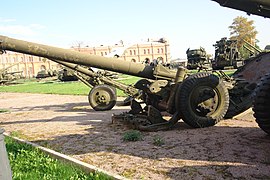 240 mm mortar M-240 52-M-864 at the Artillery Museum of St. Petersburg | |
| Type of | mortar |
| A country |  the USSR the USSR |
| Service History | |
| Adopted | 1950 year |
| Wars and conflicts | |
| Production history | |
| Constructor | B. I. Shavyrin , SKB GA , Kolomna |
| Designed by | 1944 - 1945 |
| Manufacturer | Plant number 75 , Yurga |
| Years of production | 1951 - 1958 |
| Total released | 329 |
| Options | 2B8 |
| Specifications | |
| Weight kg | fighting position: 3610, marching: 4230 |
| Type of tractor | MT-LB , AT-T , AT-S , AT-L , Ural-375D |
| Carriage speed on the highway, km / h | 40 |
| Length mm | 6510 |
| Barrel length mm | 5340 (20.8 klb) |
| Width mm | 2430 |
| Height mm | 2210 |
| Crew (calculation), people | 11 (9) |
| Shell | high-explosive mines 53-F-864 and 53-F-865 (130.7 kg), active-reactive 3F2 (228 kg), managed 3F5 complex 1K113 "Daredevil" (134.2 kg), 3BV4 nuclear mine (2 ct) [1] |
| Caliber mm | 240 |
| Gate | piston, with a plastic shutter of the Banja system |
| Recoil device | without recoil devices (spring-type shock absorber) |
| Carriage | two-wheeled carriage |
| Elevation angle | + 45 ... + 80 ° |
| Angle of rotation | elevation 45 °: 16 ° 52 ″, elevation 80 °: 78 ° |
| Rate of fire rounds / min | one |
| starting speed projectile, m / s | 158-362 |
| Maximum range, m | for F864: 800–9650, for 3F2: 19,690 |
| Aim | panoramic MP-46 (MP-46M) |
Content
Development
The task of developing the reinforcement mortar was issued to the Main Artillery Directorate ( GAU ) in 1944, the mortar was developed in the design bureau under the guidance of B. I. Shavyrin . The tests took place in 1944-1945 and then in 1947-1949.
In 1950, the mortar was put into service, mass production was started in 1951 at the plant number 75 (now Yurginsky machine-building plant ) in the city of Yurg, Kemerovo region.
Design
The mortar is charged from the breech , for which the barrel is lowered to a horizontal position.
Firing range from 800 to 9650 m. The mortar fires a high - explosive mine F-864 weighing 130.7 kg with an explosive charge of 32 kg.
The value of the recoil force on the ground is 4300 kN. [2]
Modifications
2B8
The 2B8 mortar is the artillery unit of the 2C4 Tulip self-propelled mortar, developed on the basis of the towed M-240 mortar in the late 1960s. The tests were carried out at the GNIAP (Rzhevsky training ground, St. Petersburg) in the period 1969-1974. It has identical ballistic characteristics with the M-240. Unlike the M-240 mortar, where all operations are performed manually, a hydraulic system has been introduced in the artillery unit of the 2B8 self-propelled mortar, which performs the following functions:
- transfer of mortar from traveling to combat and vice versa,
- pointing the mortar in elevation,
- the withdrawal of the barrel 2B8 to the mine sending line and the opening of the shutter,
- the supply of mines from a mechanized warhead to the ram rails located on the base chassis body (above),
- loading the mortar, closing the shutter and lowering the barrel into the breech.
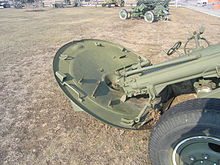
In the stowed position, the mortar barrel is mounted on the roof of the hull, and in the combat position it rests on a plate mounted on the ground.
For firing from a 2B8 mortar, high-explosive steel mines F-864 of the M-240 mortar are used (length 6.4 klb, weight 130 kg, mass of explosives 31.95 kg, shell thickness 0.062 klb, filling factor 23.3%). For firing at a range of up to 19 km, the 3F2 active-reactive high-explosive mine was developed , and for the destruction of protected small-sized observable targets, the 3F5 corrected mine of the 1K113 Smelchak guided artillery system can be used.
Armed
- Iraq - some, as of 2016 [3]
- Syria - a certain amount, as of 2016 [4] . [five]
Combat use
The towed mortar M-240 was baptized in combat operations in Afghanistan in 1985 . The D-30 howitzer battery of the 1074th artillery regiment 108 msec in the second half of 1984 was re-equipped with 4 M-240 mortars. Mortar towing was carried out by MT-LB tractors. The entire personnel of the battery was urgently sent for retraining to the territory of the USSR in a special center, where he was trained in the use of 3F5 Smelchak mines. Upon returning to Afghanistan in the Charikar Valley area, the first successful test of the Smelchak mine was carried out under combat conditions. The M-240 battery from that moment actively participated in almost all army operations. In 1985, during the operation to destroy the Ahmad Shah Masoud group in the Panjshir gorge, the battery was tasked with destroying the strengthening of the Mujahideen , which impeded the advancement of our units. Turning around from the march and making one sighting shot with a standard high-explosive mine, the battery then fired a 3F5 Smelchak shot. With an accurate hit, the target was completely destroyed. Due to the fact that the mortar has a slight left-to-right turn, it was necessary to direct all four guns in different directions. The target could appear on either side, therefore the task was carried out by the weapon that was directed towards the target. With such firepower, one mortar was enough. Often, due to lack of time, firing was carried out according to topographic data, without taking into account weather conditions, nevertheless, targets were hit, as a rule, with one or two shots.
Subsequently, there were many other operations, and everywhere towed mortars proved to be only the best. Later they were replaced by self-propelled 2C4 Tulip mortars. [6]
M-240s were actively used against terrorists during the Damascus Steel operation, in the spring of 2018 in the suburbs of Damascus East Guta, by artillerymen of the Syrian armed strike unit Tiger Forces [7] .
Where can I see
Russia - Museum of military equipment of the UMMC in the city of Verkhnyaya Pyshma, Sverdlovsk region [8] .
Russia - Artillery Museum in St. Petersburg .
Notes
- ↑ 1. Battalion, regiment and division mortars - Military parity .
- ↑ KALACHNIKOV and modern artillery . - "For engineering personnel." Newspaper BSTU "VOENMEH" them. D.F. Ustinova, No. 5 (22503), April, 2004.
- ↑ International Institute for Strategic Studies. The Military Balance 2016 / James Hackett. - London: Taylor & Francis, 2016 .-- S. 332. - 504 p. - ISBN ISBN 9781857438352 .
- ↑ International Institute for Strategic Studies. The Military Balance 2016 / James Hackett. - London: Taylor & Francis, 2016 .-- S. 354. - 504 p. - ISBN ISBN 9781857438352 .
- ↑ In Syria, M-240 super-mortars will bombard militants with 230 kg mines // RG, Feb 17, 2018
- ↑ Shcherbakov. To the combat use of M-240 mortars in Afghanistan. http://otvaga2004.ru/boyevoe-primenenie/boyevoye-primeneniye02/primenenie-minometov-m240/
- ↑ The heavy-duty M-240 turned into the rubble the positions of militants near Damascus , Rossiyskaya Gazeta (April 19, 2018). Date of appeal April 20, 2018.
- ↑ Ruzaev S.V. Artillery systems from the collection of the museum of military equipment of the UMMC. - Yekaterinburg: Ural Worker, 2017 .-- 80 p. - 1000 copies. - ISBN 978-5-85383-687-7 .
Literature
- Karpenko A.V., Ganin S.M. Domestic bomb and mortars. - SPb. : Gangut, 1997 .-- 53 p. - 500 copies. - ISBN 5-85875-123-7 .