Binny Pooh [К 1] ( eng. Winnie-the-Pooh ) - a teddy bear , a character in two novels and two collections of poems by the English writer Alan Milne , first appeared in print in 1926.
| Winnie the Pooh | |
|---|---|
| Winnie-the-pooh | |
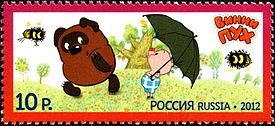 Postage stamp with the image of Winnie the Pooh | |
| Creator | Alan Alexander Milne |
| Artworks | "Winnie the Pooh" (1926), "House on the Edge of the Down" (1928), "When we were very small" (1924), "We are already six" (1927) |
| Floor | |
One of the most famous heroes of children's literature of the XX century. In the 1960-1970s, thanks to the retelling of Boris Zakhoder , and then the films of the Soyuzmultfilm studio , where the bear was voiced by Yevgeny Leonov , Winnie the Pooh became very popular in the USSR .
Biography
Like many of Milne’s other characters, Winnie the Bear was named after one of the toys of Christopher Robin , the writer's son. In turn, the teddy bear Winnie the Pooh was named for the mother bear named Winnipeg (Winnie), who lived in the 1920s in the London Zoo .

Winnipeg was the mascot of the Canadian Army Veterinary Corps. In 1914, she was bought by Lieutenant Harry Colborn from a Canadian hunter- trapper for twenty dollars. In October of the same year, the bear was brought along with the troops to Britain, and since the regiment was to cross into France during the war , it was decided to leave her in December until the end of the war in the London Zoo. The bear fell in love with Londoners, and the military did not object to leaving her in the zoo for good [1] . According to the memory of an employee of the zoo, Vinnie was “the only bear whom they fully trusted,” which allowed children to play and even ride on it [2] .
When Christopher Robin was 4 years old, he and his father first came to the zoo, where the boy met a bear. After this event, the teddy bear, presented to Christopher on his first birthday, was also given the name Winnie. Later, the bear was a constant companion of Christopher: “every child has a favorite toy, and especially it needs a child who is the only one growing in the family” [3] .
Books about Winnie the Pooh were created by Milne from oral stories and games with Christopher Robin; Oral origin is also characteristic of many other famous literary tales [4] . “Actually, I didn’t invent anything, I could only write,” Miln said later [5] .
Name
The name Winnie ( Eng. Winnie ) in English is perceived as characteristically feminine, diminutive of the female name Winifred ( Eng. Winifred ) [6] [7] ; “And I thought it was a girl,” Father says to Christopher Robin. In the English tradition, teddy bears can be perceived as either “boys” or “girls”, depending on the choice of owner. Milne more often calls Pooh the masculine pronoun ( English he ), but sometimes leaves his gender undefined ( English it ). Name Pooh [K 2] ( eng. Pooh ) [6] ) was called a swan , who lived with friends of the Milnov family. Pooh is a character in Milne’s poems collection “When We Were Very Young” [K 3] . In the original, between the name of Winnie and the nickname Pooh is an epic article of the ( English Winnie-the-Pooh ), often used in the names of monarchs and literary-historical characters. The comic of the name of a bear cub as a whole consists not only in the change of gender , but also in the inconsistency of the epic form with the content [7] .
Winnie the Pooh initially had a different name - Edward Bear (Edward Bear), which his little owner changed under the impression from the acquaintance in the zoo with Winnie the bear (Winnipeg) [6] [8] . The name of Winnie the Pooh is Bear [6] . After being knighted, he receives the title of Sir Pooh de Bear ( Sir Pooh de Bear); the combination of the Norman old French preposition de with the originally English word [6] .
Character
Winnie the Pooh, aka D. P. (Friend of Piglet), P. K. (Buddy Rabbit), O. P. (Discoverer of the Pole), William I.-I. (Comforter Ia-Ia) and N. H. (Tail Finder) - a naive, good-natured and modest Bear with Very Little Brains; in the translation of Zakhoder, Winnie repeatedly says that there is sawdust in his head, although in the original ( eng. pulp ) this is mentioned only once. Favorite things Pooh - writing poems and honey . Pooh "scare long words," he is forgetful, but often brilliant ideas come into his head. The nature of Pooh, suffering from the "lack of reason", but at the same time, "the great naive sage," a number of researchers attributed to the archetypes of world literature. So, Boris Zakhoder compares him with the images of Don Quixote and Schweik [9] . Liliana Lungin believes that Pooh is reminiscent of Dickensian Mr. Pickwick . His features are the love of food, interest in the weather, an umbrella, “unselfish travel passion.” She sees in him “a child who knows nothing, but wants to know everything” [4] . In English-language literature, he is also close to the Scarecrow the Wise from the story The Wizard of Oz by Lyman Boum [10] .
In Pooh, several images are combined at once - a teddy bear, a lively teddy bear and a formidable Bear to which he wants to appear [10] . The character of Pooh is independent and at the same time depends on the character of Christopher Robin. Pooh is what a little owner wants to see [5] .
The image of the Pooh is central to all twenty stories. In a number of initial stories (the story of the burrow, the search for Buka, the capture of the Elephant), Pooh falls into this or that “stalemate” and often gets out of it only with the help of Christopher Robin. In the future, comic features in the image of Pooh recede into the background before the "heroic." Very often plot twist in the story - this or that unexpected decision of Pooh. The culmination of the image of the Pooh Hero falls on chapter 9 of the first book, when Pooh, proposing to use Christopher Robin’s umbrella as a vehicle (“We sail on your umbrella”), saves Piglet from inevitable death; the whole tenth chapter is dedicated to the great feast in honor of Pooh. In the second book, the feat of Pooh compositionally corresponds to the Great Feat of Piglet, who saves the heroes trapped in the collapsed tree where Owl lived.
In addition, Pooh is the creator, the main poet of the Wonderful Forest. He constantly composes poems from the noise that sounds in his head [4] . About his inspiration, he says: "After all, Poetry, chants are not the things that you find when you want, these are the things that find you." Thanks to the image of Pooh, another character is included in the tale - Poetry, and the text takes on a new dimension [4] .
Winnie the Pooh cycle
In total, Alan Miln wrote two prose books with teddy bears: “Winnie the Pooh” (1926) (“Winnie-the-Pooh”) and “House on the Down Edge” (1928) (“The House at Pooh Corner”). Both books were devoted to “Her” [Q 4] . In the collections of poems "When We Were Very Small" (1924) ("When We Were Very Young") and "Now We Are Six" (1927) ("Now We Are Six") there are also several poems about a bear cub, although in the first of them he is not called yet by name. In the preface to the first prose book, Milne calls the collection “another book about Christopher Robin” [6] .
Christopher Robin's toys also included Piglet, whom the boy was presented by neighbors, donkey Eeyore, presented by his parents, Kanga with Tiny Roux in a bag, and Tiger, also donated to his son by parents, especially for the development of fairy tale scenes for the night [K 5] . In the stories, these characters appear in that order [3] . Owl and Rabbit Milne came up with himself; in the first illustrations of Ernest Shepard, they do not look like toys, but like real animals. The rabbit says to Sove: “Only you and I have brains. The rest have sawdust. ” During the game, all these characters received individual habits, habits and style of conversation [4] . The world of animals created by Milne was influenced by Kenneth Graham 's story “ Wind in the Willows ”, which he admired and which Shepard [5] illustrated earlier, and there is also a hidden controversy with Kipling's “The Jungle Book ” [5] .
Prose books constitute a dilogy , but each of these Milne books contains 10 short stories with their own stories, which exist almost independently of each other:
- The first book is Winnie-the-Pooh :
- We Are Introduced to Winnie-the-Pooh and Some Bees (... in which we get to know Winnie the Pooh and a few bees).
- Pooh Goes Visiting and Gets Into a Tight Place (... in which Winnie the Pooh went to visit, and fell into a stalemate).
- Pooh and Piglet Go Hunting and Nearly Catch a Woozle (... in which Pooh and Piglet went for a hunt and almost caught Buku).
- Eeyore Loses A Tail and Pooh Finds One (... where Ia-ia loses tail and Pooh finds).
- Piglet Meets a Heffalump (... in which Piglet meets the Elephant ).
- Eeyore Has A Birthday And Gets Two Presents (... in which Eeyore had a birthday, and Piglet almost flew to the Moon).
- Kanga And Baby Roo Come To The Forest And Piglet Has A Bath (... in which Kanga And Little Roo Appear In The Forest, And Piglet Takes A Bath).
- Christopher Robin Leads An Expotition To The North Pole (... in which Christopher Robin organizes an “expedition” to the North Pole).
- Piglet Is Entirely Surrounded By Water (... in which Piglet is completely surrounded by water).
- Christopher Robin Gives Pooh A Party and We Say Goodbye (... in which Christopher Robin arranges a solemn Pirgora, and we say to All-All-All-Goodbye).
- The second book is The House at Pooh Corner :
- A House Is Built At Pooh Corner For Eeyore (... in which they build a house on the edge of the forest for Eeyore).
- Tigger Comes to the Forest and Has Breakfast (... in which the Tigger comes to the forest and has breakfast).
- A Search is Organdized, and Piglet Nearly Meets the Heffalump Again (... in which searches are organized, and Piglet again almost got the Elephant).
- What is Christopher Robin Does in the Mornings (... in which Rabbit is very busy, and we first meet with Spotted Schasvirnus).
- It is a Shown That Tiggers Don't Climb Trees (... in which it turns out that the Tigers do not climb trees).
- Pooh Invents a New Game and Eeyore Joins In (... in which Pooh invents a new game, and it includes Ia-Ea).
- Tigger Is Unbounced (... in which they decided to tame the Tigger).
- Piglet Does a Very Grand Thing (... in which Piglet performs a great feat).
- Eeyore Finds the Wolery and Owl Moves Into It (... in which Ea finds the same person, and the Owl moves).
- Christopher Robin and The Leave Them There (... in which we leave Christopher Robin and Winnie the Pooh in an enchanted place).
In the wake of the great success of the books about Pooh, a whole series of publications appeared: “Stories about Christopher Robin”, “A book for reading about Christopher Robin”, “Stories for the birthday of Christopher Robin”, “Primer of Christopher Robin” and a number of picture books. These editions did not contain these editions, but included a reprint from previous books [4] .
World of art
The action of the books about the Pooh takes place in the Stoacrow Forest ( eng. The Hundred Acre Wood , translated from Zakhoder) - the Wonderful Forest. It is believed that the prototype is Ashdown Forest, near Milch in 1925, the Cochford farm in East Sussex . The stories also include Real Six Pines and a brook, which was found in the North Pole, as well as the vegetation mentioned in the text, including the prickly grove ( English gorse-bush , translated by Zakhoder - thistle ) [3] . Little Christopher Robin climbs into the hollows of trees and plays there with Pooh, and many book characters live in hollows. A significant part of the action takes place in such dwellings or on the branches of trees [3] .
Pooh's best friend is the piglet Piglet . Other characters:
- Christopher Robin
- Eeyore
- Kanga (Kanga)
- Baby Roo (Little Roo)
- Owl (Owl), originally male, [7] ; This image is associated with an English-speaking reader with wisdom and ingenuity [6] .
- Rabbit
- Tigger
- Buka (Woozle) - mentioned in the text, but does not participate in the plot as an actor
- Heffalump - mentioned in the text, but does not participate in the plot as an actor
The action takes place simultaneously in three plans - this is the world of toys in the nursery, the world of animals “on its territory” in the Stoaquire forest and the world of characters in the father’s stories to his son (this is most clearly shown at the very beginning) [10] . Later, the narrator disappears from the narration (small dialogues between father and son appear at the end of the sixth and tenth chapters), and the fairy-tale world begins its own existence, expanding from chapter to chapter [4] . It was noted the similarity of space and the world of the characters "Winnie the Pooh" with the classical ancient and medieval epos [4] . Promising epic undertakings of characters (travels, feats, hunts, games) turn out to be comically insignificant, while real events take place in the inner world of the characters (help in trouble, hospitality, friendship) [4] .
The book recreates the atmosphere of universal love and care [4] , of a “normal”, protected childhood, without pretending to solve adult problems [5] , which largely contributed to the later popularity of this book in the USSR [10] , including influencing Boris’s decision Zagrader translate this book [9] . Winnie the Pooh reflected the family life of the British middle class of the 1920s, later resurrected by Christopher Robin in his memoirs to understand the context in which the fairy tale originated [3] .
Language
Milne’s books are imbued with numerous puns and other types of language games , they typically play around and distort “adult” words (clearly shown in the scene of the Owl’s dialogue with Pooh), expressions borrowed from advertisements, educational texts, etc. (numerous specific examples are collected in the comments of A. I. Poltoratsky) [6] . Sophisticated play on phraseology, linguistic ambiguity (sometimes more than two meanings of a word) is not always available to children's audiences, but is highly valued by adults [10] .
Among the typical methods of Milne’s dilology is the reception of “significant emptiness” and games with various fictions: in “Contradiction” (preface to the second part), it is stated that the forthcoming events dreamed the reader; Pooh comes to mind "great thoughts about anything," Rabbit answers him that there is no "absolutely no one at home", Piglet describes the Elephantfish - "a big thing, like a huge nothing." Such games are designed for an adult audience as well [10] .
Both books are full of poems embedded in the mouth of Pooh; these poems are written in the English tradition of nonsense children's absurd poems, continuing the experience of Edward Lear and Lewis Carroll [10] . Samuel Marshak , the first translator of children's poems Milne, in a letter to Galina Zinchenko called Milne "the last <...> direct heir of Edward Lear" [11] .
From the point of view of Liliana Lungin , “Winnie the Pooh” combines the features of a children's fairy tale, a novel of upbringing , a popular heroic epic and poetic prose [4] .
Place in the work of Milna
The cycle of Winnie the Pooh eclipsed all the rather diverse and popular at one time adult work of Milne: “he cut off his way back into the“ adult ”literature. All his attempts to escape from the paws of a toy bear were unsuccessful ” [5] . Milne himself experienced such a confluence of circumstances, did not consider himself a children's writer, and claimed that he wrote for children with the same responsibility as for adults [10] .
Philosophy
Like “ Alice in Wonderland ” by Lewis Carroll , “Winnie the Pooh” throughout the 20th century was the subject of various philosophical, psychoanalytic and satirical variations. Benjamin Hoff in his books (now published in Russian) The Tao of Pooh (“ Tao Pooh”) and The Te of Piglet (“ Dae Piglet”) with the help of Milna's heroes explains the philosophy of Taoism in a popular way. The text of Milna is altered with this [12] . J. T. Williams used the image of a bear for satire on philosophy ( Pooh and the Philosophers , “Pooh and the Philosophers”), and Frederick Crews - on literary criticism ( The Pooh Perplex , “ Pooh confusion” and Postmodern Pooh , “Postmodernist Pooh”). In the “Fluffy confusion” a comic analysis of “Winnie the Pooh” was made from the point of view of Freudianism , formalism , etc.
These English-language works influenced the book of semiotics and the philosopher V. P. Rudnev "Winnie the Pooh and the Philosophy of an Ordinary Language." The text of Milne is prepared in this book with the help of structuralism , the ideas of Bakhtin , the philosophy of Ludwig Wittgenstein and a number of other ideas of the 1920s, including psychoanalysis . According to Rudnev, “aesthetic and philosophical ideas always float in the air ... VP appeared in the period of the most powerful prosperity of prose of the XX century, which could not but affect the structure of this work, could not, so to speak, not throw its rays onto it” [13 ] . This book also contains a complete translation of both Milne’s books about Pooh (see above, in the “New Translations” section).
Publications
The first chapter of Winnie the Pooh was published on Christmas Eve on December 24, 1925 in the London newspaper The London Evening News, the sixth in August 1928 in the magazine Royal Magazine. The first separate edition was published on October 14, 1926 in London. The overall cycle does not have a name, but is usually called Winnie the Pooh, in the first book.
Все эти четыре книги были проиллюстрированы Эрнестом Шепардом, карикатуристом и коллегой Алана Милна по журналу « Панч ». Графические иллюстрации Шепарда тесно связаны с внутренней логикой повествования и во многом дополняют текст, в котором, к примеру, не сообщается, что Слонопотам (Heffalump) похож на слона [6] ; Шепарда нередко называют «соавтором» Милна [10] . Иногда иллюстрации Шепарда соответствуют значимому расположению текста на странице [10] . Мальчик был срисован непосредственно с Кристофера Робина, и образ мальчика — в свободной блузе поверх коротких штанишек, — повторяет действительную одежду Кристофера [6] , — вошёл в моду [5] .
В 1983 году под редакцией и с примечаниями филолога-англиста А. И. Полторацкого в Москве в издательстве «Радуга» были изданы в одном томе все четыре прозаические и стихотворные книги о Пухе [14] и, в приложении к ним, шесть эссе Милна. Предисловие к книге написал советский литературовед Д. М. Урнов: эта работа содержала один из первых серьёзных разборов текста милновского цикла в России. Интерес Полторацкого (инициатора издания) к Винни-Пуху пробудили студенты Отделения структурной и прикладной лингвистики (ОСиПЛ) филологического факультета МГУ , предложившие разбирать английский текст «Винни-Пуха» во время занятий на спецкурсе [15] .
Continued
В 2009 году в Великобритании вышло продолжение книг о Винни-Пухе « Возвращение в зачарованный лес », одобренное организацией Pooh Properties Trust . Автор, Дэвид Бенедиктус, стремился подражать стилистике и композиции оригинала. Иллюстрации к книге также ориентированы на сохранение стиля Шепарда. «Возвращение в зачарованный лес» переведено на несколько языков [16] .
За рубежом
Книги о Винни-Пухе, несмотря на сложности с переводом на другие языки, неоднократно публиковались за рубежом. В большинстве переводов «женская» семантика имени Winnie не передаётся, однако в переводе 1986 года Моники Адамчик-Гарбовской на польский язык , медведь носит женское имя Fredzia Phi-Phi (при этом он всё же мужского рода). Но этот перевод не завоевал всеобщего признания [17] и в Польше классическим считается перевод 1930-х годов Ирены Тувим, где имя медведя однозначно мужское — Kubuś Puchatek [К 6] [18] . В русском переводе Руднева и Михайловой имя Winnie используется в оригинальном написании; по замыслу переводчиков, это должно намекать на гендерную неоднозначность этого имени [19] .
Так же, как оригинальное имя (с артиклем посередине), переведены, например, нидерл. Winnie de Poeh , эспер. Winnie la Pu [20] и идиш װיני-דער-פּו ( Вини-дэр-Пу ), почти так же — лат. Winnie ille Pu [К 7] [20] . Иногда медвежонка зовут каким-то одним из его двух имён. Например, «Медведем Пухом» ( нем. Pu der Bär , чеш. Medvídek Pú , болг. Мечо Пух , «Пу а-Дов» ( ивр. פו הדוב )) или «Медвежонком Винни» ( фр. Winnie l'ourson ); к этой же категории относится упомянутое польское имя Kubuś Puchatek. Встречаются также имена, где нет оригинальных имён, например, венг. Micimackó , дат. Peter Plys , норв. Ole Brumm или Мишка-Плюх в первоначальной редакции перевода Заходера (1958) [19] .
На немецком, чешском, латыни и эсперанто имя Pooh передаётся как Pu, в соответствии с английским произношением. Тем не менее, благодаря Заходеру в русскую (а затем и украинскую, укр. Вінні-Пух ) традицию весьма удачно вошло естественно звучащее имя Пух (обыгрывание славянских слов пух , пухлый очевидно и в польском названии Puchatek ). В белорусском переводе Виталя Воронова — белор. Віня-Пых , вторая часть имени переведена как «Пых», что созвучно с белорусскими словами пыха (высокомерие и гордость) и запыхацца [19] .
В СССР и России
Впервые русский перевод «Винни-Пуха» был напечатан в журнале « Мурзилка », № 1 за 1939 год, в котором были опубликованы две главы: «О медведе Винни-Пу и пчёлах» и «О том, как Винни-Пу пошёл в гости и попал в беду» в переводе А. Колтыниной и О. Галаниной. Имя автора указано не было, стоял подзаголовок «Английская сказка». В этом переводе используются имена Винни-Пу, Пиглет и Христофор Робин [21] . Иллюстратором первой публикации был график Алексей Лаптев , главу в № 9 за 1939 год иллюстрировал Михаил Храпковский .
Первый полный перевод «Винни-Пуха» в СССР вышел в 1958 году в Литве ( лит. Mikė Pūkuotukas ), его выполнил 20-летний литовский писатель Виргилиюс Чепайтис , пользовавшийся польским переводом Ирены Тувим [22] . Впоследствии Чепайтис, познакомившись с английским оригиналом, существенно переработал свой перевод, который затем неоднократно переиздавался в Литве.
В том же году с книгой познакомился Борис Владимирович Заходер . Знакомство началось с энциклопедической статьи. Вот как рассказывал он сам об этом [9] :
Наша встреча произошла в библиотеке, где я просматривал английскую детскую энциклопедию. Это была любовь с первого взгляда: я увидел изображение симпатичного медвежонка, прочитал несколько стихотворных цитат — и бросился искать книжку. Так наступил один из счастливейших моментов моей жизни: дни работы над «Пухом».
В № 8 журнала «Мурзилка» за 1958 год вышла одна из глав в пересказе Бориса Заходера: «Как Мишка-Плюх пошёл в гости и попал в безвыходное положение» [К 8] . Издательство « Детгиз » отвергло рукопись книги (её сочли «американской»), но 13 июля 1960 года «Винни-Пух и все остальные» была подписана к печати в новом издательстве «Детский мир». Тираж в 215 тысяч экземпляров с иллюстрациями Алисы Порет . Художница иллюстрировала и ряд последующих публикаций в издательстве « Малыш ». Наряду с небольшими чёрно-белыми картинками, Порет создала и цветные многофигурные композиции («Спасение Крошки Ру», «Савешник» др.), а также первую карту Стоакрового леса на русском языке. Со временем утвердилось название книги — «Винни-Пух и Все-все-все». В 1965 году, уже ставшая популярной книга, вышла и в «Детгизе». В выходных данных нескольких первых изданий автором был ошибочно указан «Артур Милн». Хотя в 1957 году в издательстве «Искусство» уже выходила одна книга Алана Александра Милна («Мистер Пим проходит мимо»), и при жизни автора печатались его стихи в переводе Самуила Маршака. В 1967 году русский Винни-Пух был издан в американском издательстве «Даттон», где выпускалось большинство книг о Пухе и в здании которого в то время хранились игрушки Кристофера Робина [9] .
Хорошо живёт на свете Винни-Пух!
Оттого поёт он эти Песни вслух!
И неважно, чем он занят,
Если он толстеть не станет,
А ведь он толстеть не станет,
А, наоборот,
по-
ху-
деет!
Композиция и состав оригинала в пересказе Заходера были соблюдены не полностью. В редакции 1960 года присутствуют только 18 глав, десятая из первой книги и третья из второй — пропущены (точнее, десятая глава сокращена до нескольких абзацев, добавленных в конец девятой) [К 9] . Только в 1990 году, к 30-летию русского Винни-Пуха, Заходер перевёл обе пропущенные главы. Третья глава второй книги публиковалась отдельно в журнале « Трамвай », в февральском выпуске 1990 года [23] . Обе главы вошли в окончательную редакцию заходеровского перевода в составе сборника «Винни-Пух и многое другое», вышедшего в том же году и в дальнейшем переиздававшегося неоднократно. В этой редакции, как и в первой, отсутствуют предисловия и посвящения, хотя деление на две книги («Винни-Пух» и «Дом на Пуховой Опушке») восстановлено, а сквозная нумерация глав заменена на отдельную для каждой книги. Фрагмент в конце девятой главы о празднике в честь Винни-Пуха, теперь фактически дублирующий текст десятой главы, в полном тексте сохранён. Сам факт существования более полной редакции заходеровского перевода сравнительно малоизвестен; в культуру текст уже успел войти в сокращённом виде [К 10] .
Заходер всегда подчёркивал, что его книга — не перевод, а пересказ , плод сотворчества и «пересоздания» Милна по-русски. Действительно, его текст не всегда буквально следует за оригиналом. Ряд находок, отсутствующих у Милна (например, разнообразные названия песен Пуха — Шумелки, Кричалки, Вопилки, Сопелки, Пыхтелки, — или вопрос Пятачка: «Любит ли Слонопотам поросят? И как он их любит?»), удачно вписывается в контекст произведения [10] [24] . Не имеет полной параллели у Милна и широкое употребление прописных букв (Неизвестно Кто, Родные и Знакомые Кролика), частое олицетворение неодушевлённых предметов (Пух подходит к «знакомой луже»), большее количество «сказочной» лексики, не говоря уже о немногочисленных скрытых отсылках к советской действительности [10] . Неоднозначно воспринял стиль заходеровского «Пуха» Корней Чуковский : «Его перевод Винни Пуха будет иметь успех, хотя стиль перевода расшатанный (в английской сказке батюшки [К 11] , пятачок и т. д.)» [25] . ().
В то же время ряд исследователей, включая Е. Г. Эткинда , относят это произведение всё же к переводам [10] . Текст Заходера также сохраняет языковую игру и юмор оригинала, «интонацию и дух подлинника» [24] и «с ювелирной точностью» передаёт многие важные детали [10] . К достоинствам перевода относится также отсутствие излишней русификации мира сказки, соблюдение парадоксальной английской ментальности [10] .
Книга в пересказе Заходера с 1960—1970-х годов была исключительно популярна не только как детское чтение, но и среди взрослых, в том числе научной интеллигенции [10] . В постсоветский период продолжается традиция присутствия заходеровского «Винни-Пуха» в устойчивом кругу семейного чтения [10] .
С первой, сокращённой редакции пересказа Бориса Заходера, а не с английского оригинала, выполнены некоторые переводы «Винни-Пуха» на языки народов СССР: грузинский (1988) [К 12] , армянский (1981), одна из украинских версий (А. Костецкого [К 13] ).
В иллюстрировании советских изданий участвовал Виктор Чижиков . Более 200 цветных иллюстраций, заставок и рисованных заголовков к «Винни-Пуху» принадлежит Борису Диодорову [26] . Б. Диодоров и Г. Калиновский являются авторами чёрно-белых иллюстраций и цветных вкладок в издании «Детской литературы» 1969 г.; цикл цветных диодоровских иллюстраций создан в 1986—1989 г. и появлялся в нескольких изданиях. Первое издание украинского перевода Леонида Солонько [27] иллюстрировал Валентин Чернуха .
В 1990-е — 2000-е годы в России продолжают появляться новые серии иллюстраций: Евгения Антоненкова ; Борис Диодоров продолжил свой цикл иллюстраций для расширенного издания перевода Заходера [28] .
The 1990s became the time for creating new Winnie the Pooh translations into Russian. Zakhoder's retelling is no longer the only one. Victor Weber's translation became the most famous of the alternatives to Zaudera and was published several times by the publishing house EKSMO ; In addition, it was printed parallel to the original in a bilingual, commented edition that was published in 2001 by Raduga Publishing House. In the Weber version, the division into two parts, as well as the prefaces and poetic initiations in each of them [29] , are preserved, all 20 chapters are completely translated. Nevertheless, according to a number of critics [24] , L. Bruni), this translation is not as valuable from an artistic point of view as Zauder's, and in some places too literally conveys the original, neglecting the language game; the translator consistently seeks to avoid Zakhoder’s decisions, even where they are indisputable. Translations of poetry were also criticized (made not by Weber, but by Natalia Rein ) [24] . Weber has Piglet - Oink, Elephant Mouth - Hobotun, and Tigger - Tiger.
The translation of Vadim Rudnev and Tatiana Mikhailova (“Winnie Pooh. House in Bear Corner” [30] ) was first published as part of Rudnev’s work “Winnie the Pooh and the Philosophy of Everyday Language”, and then withstood several separate editions. Chronologically, this is the second translation after the Zaudera [31] . The translators set themselves the goal of creating an “adult”, “intellectual” Pooh, associated primarily with the literature and philosophy of the 1920s. They went to this goal through conscious eclecticism, largely moving away from the original. The titles of the chapters and partly the text on the installation of Rudnev and Mikhailova are stylized as Faulkner (which is motivated by the similarity of the Pooh art space and Faulkner's yoknapatho saga) [32] , the style of the poems and part of the dialogues under Russian and Soviet mass poetry, a number of proper names ( for example, Winnie or Heffalump - for a peculiar interpretation of this image, see. Elephant Drugs ) and common nouns left without translation for appropriate perception and so on [33] . In Rudnev and Mikhailovskaya Piglet - Piglet, Owl - Sych (masculine, as in the original), Keng - Kang, Ia-Ea - Io-Yo (according to Eeyore pronunciation; according to autocomment, this Russian record gives him the features of a “Chinese sage "). From the point of view of A. Borisenko, “the translation leaves the impression of some kind of literary mystification, where one text stands out for another ... is neither accurate, nor scientific, nor educational. Strictly speaking, it is not a translation at all. This is a kind of game with the dominant tradition, deconstruction, the arbitrary selection of one (imaginary!) Part of the whole in violation of all proportions ” [24] . According to M. Elifёrova, Rudnev “saturates the text with obscenities that are not in the original” [7] .
There was a transformation of the names of the characters in the translations of Disney cartoons, although this has nothing to do with the translation of the text of Milne. Since the names Piglet, Tigra, Eeyore, and Ea Ia were invented by Zakhoder, these names were changed to others (Khryunya, Tigrulya, Ushastik [K 14] ).
In 1996, the publishing house Moimpex issued a parallel English text, “for the convenience of learning languages”, translated by T. Vorogushin and L. Lissitzkaya, who, according to A. Borisenko, “responds well” to the word-subscript task [24] , but according to M. Elifёrova, "is full of unmotivated deviations from the original, as well as such errors against the Russian stylistics, which are not justified by reference to the tasks of the interlaced" [7] . The names are the same as those of Zakhoder, but the Owl in accordance with the original is made by a male character, which with such a name in Russian looks like an error [7] .
Screenshots
United States
In 1929, Milne sold the rights to commercial exploitation ( merchandising right ) of the image of Winnie the Pooh to American producer Stephen Schlesinger. During this period, several records-plays on Milne’s books, very popular in the USA, were released. . In 1961, these rights were purchased from Schlesinger’s widow by Disney’s studio . . The Disney company also acquired the copyrights to Shepard’s drawings, his image of a bear cub referred to as “Classic Pooh” [34] .
In total, in the 1960s, the Disney company based on the plot of some chapters of the first book released short cartoons - “ Winnie the Pooh and the Honey Tree ”, “ Winnie the Pooh and A Day of Cares ”, “ Winnie the Pooh, and with it the Tiger! "And" Winnie the Pooh and a holiday for Eeyore . "
In Disney films and publications, the character's name, unlike Milne’s books, is written without hyphens ( Winnie the Pooh ), which may reflect American punctuation, unlike British. Starting in the 1970s, Disney’s studio has been releasing cartoons on newly-invented plots that are no longer associated with Milne’s books. Many fans of the works of Milne believe that the plots and style of Disney films have little in common with the spirit of books about Vinnie. The Milnov family, in particular, Christopher Robin , spoke very negatively about Disney products [10] .
American researcher Milna Paola Connoli states: “Promoted, parodied and modified in commercial products, the characters of the tale became a cultural myth, but a myth very far from the author. Especially this process of alienation intensified after the death of Milne " [35] . The appearance of the cartoon characters, in general, goes back to Shepard's illustrations, but the drawing is simplified, and some memorable features are exaggerated. Winnie the Pooh Shepard wears a short red blouse only in winter (search for Buki), while Disney walks in it all year round.
Winnie the Pooh and the Blustery Day received the second Oscar award for the best animated short film in 1968 [36] .
A television puppet show was also produced ( Welcome to Pooh Fringe ).
A distinctive feature of the Americanization of the plot was the appearance in the full-length film “The Many Adventures of Winnie the Pooh ” (1977), which includes along with new scenes three previously released short animated films [37] , a new character named Gopher (in Russian translations he is called Gopher). The fact is that the animal gopher is found only in North America. The appearance of the Gopher has become a program - he exclaims: "Of course, I am not in the book!".
The copyright on the image of Winnie the Pooh and his friends - one of the most profitable in the world, in any case, as regards literary characters. Now the Disney company makes money by selling video and other products related to Pooh, $ 1 billion a year - as much as the famous images created by Disney itself, Mickey Mouse , Minnie Mouse , Donald Duck , Goofy and Pluto combined. According to a survey of the population of Hong Kong in 2004, Winnie was the favorite character of Disney cartoons of all time. In 2005, similar sociological results were obtained in the Philippines. .
In 1991, Schlesinger's widow, Shirley Lasswell , filed a lawsuit against Disney, claiming that she had been deceived thirty years earlier when she sold copyright to Disney. Although Ms. Laswell had already earned $ 66 million at Pooh, she demanded in addition 200 million. The case ended only 13 years later, in March 2004 , with the victory of Disney [38] .
In the course of this struggle, Disney took a reciprocal step, uniting (on financial grounds) with Milne's heirs, despite their opposition to Disney cartoons. After the adoption of the 1998 US law on the expiration of copyright, Clara Milne, the daughter of Christopher Robin , made an attempt to stop the copyright of the Schlesinger company to create its grandfather, by filing a joint lawsuit with Disney. But this time the court supported Schlesinger, this decision was confirmed by the US Court of Appeals for the Ninth Circuit [39] . On Monday, June 26, 2006, the US Supreme Court refused to hear the case, thereby supporting the decision of the Court of Appeal. .
In countries where copyright terms do not exceed those required by the Berne Convention , all copyright on Milne’s texts ceased at the end of 2006 , that is, after half a century (50th anniversary of Milne’s death - January 31, 2006 ) plus the end of the calendar year. The copyright to the illustrations of Shepard will last twenty years longer, since he died in 1976 .
USSR
Three cartoons were created at the Soyuzmultfilm studio under the direction of Fyodor Khitruk :
- Winnie the Pooh (1969) - based on the first chapter of the book
- Winnie the Pooh goes on a visit (1971) - based on the second chapter of the book
- Winnie the Pooh and Day of Cares (1972) - is based on the fourth (about a lost tail) and sixth (about a birthday) chapters of the book.
The script was written by Hitruk in collaboration with Zakhoder; the work of the co-authors did not always go smoothly, which was ultimately the reason for the termination of the release of cartoons (originally it was planned to release the series throughout the book [9] ). Some episodes, phrases and songs (first of all, the famous "Where are we going with Piglet ...") are missing in the book and are composed specifically for cartoons; Subsequently, Zakhoder published these songs in a separate edition in a separate edition [40] and included as an appendix in the collection “Winnie the Pooh and many other things”. On the other hand, Christopher Robin is excluded from the plot of the cartoon (contrary to the will of Zakhoder); in the first two cartoons, his plot role was given to Piglet.
While working on the film, Khitruk wrote to Zakhoder about his concept of the main character:
I understand him this way: he is constantly filled with some ambitious plans that are too complicated and cumbersome for those trivial matters that he is going to undertake, so plans fall apart when in contact with reality. He constantly gets trapped, but not because of stupidity, but because his world does not coincide with reality. In this I see the comic of his character and action. Of course, he likes to eat, but this is not the main thing [9] .
Famous actors were involved to sound the series: Yevgeny Leonov (Winnie the Pooh), Iya Savvina (Piglet), Erast Garin (Eeyore).
The cartoon cycle has gained a lot of popularity. Quotes from it became the common property of Soviet children and adults and formed the basis for creating an image of Winnie the Pooh in Soviet humorous folklore (see below). A total of 21 quotations from the film were included in the conversational speech of citizens, half of which fall on the film “Winnie the Pooh and Day of Cares” [41] . For this cycle, among other works, Khitruk received the State Prize of the USSR in 1976.
While working on the film, the director did not know about the existence of Disney’s cartoons about Winnie the Pooh. Later, according to Khitruk, the Disney director Wolfgang Raiterman liked his version [42] [43] . However, the fact that Soviet cartoons were created without taking into account the exclusive rights to the film version belonging to the Disney studio made it impossible to show them abroad and participate in international film festivals [44] .
Eduard Nazarov , one of the animators involved in creating cartoons, drew graphic black-and-white illustrations very close to the images of the cartoon and also received popularity [45] . Some of them feature Tiger, Little Roo , Rabbit's relatives and acquaintances who are not in cartoons.
Folk art
Winnie the Pooh and Piglet became the characters of a cycle of Soviet and post-Soviet jokes , usually referred to as "children's jokes" [41] . This cycle is also evidence of the popularity of cartoons among adults, as jokes go far beyond the limits of “children's humor”, and many are emphasized “non-child”. “The popularity of Winnie the Pooh and the company was also supported by their functioning in the book environment, although, of course, cartoons played the main role in the formation of anecdotes: firstly, phrases and stories from cartoon films parodied in the anecdotes, and secondly, many children telling jokes have not yet read these books (or they have not read them), but they have watched cartoons ” [41] .
In them, the brutality and straightforwardness of the image of Pooh, evident already in the Hitruk film, comes to the fore. As the researcher notes, “F. The cunning one had to make Winnie the Pooh himself more mature and aggressive, putting the burden of infantilism entirely on Piglet ” [7] . In anecdotes, the bear also attributes “adult” traits - in addition to the “lover to devour,” Pooh becomes an amateur for drinking and letting go of the sharpness with sexual overtones. The object of the parody is the friendship between Pooh and Piglet, which turns into a rivalry: “big and strong” Pooh shows aggression towards the defenseless and independent Piglet [41] . Often in the anecdotes in the spirit of "childish cruelty" [41] and black humor, the "gastronomic" qualities of Piglet are beaten up. The comic effect often arises due to the inconsistency between the communicative situation of Pooh (“adult” and cynical) and Piglet (infantile and naive) [41] . Finally, the jokes about Pooh and Piglet, as well as the cycle about Stirlitz , contain elements of the language game (in particular, puns ).
Winnie the Pooh is also a character in online humor. These are not only jokes, but also stories by different authors. The most popular topic is Winnie the Pooh as a hacker and sysop [46] .
Games
There are several desktop [47] [48] [49] and computer online games [50] [51] [52] with Winnie the Pooh [53] .
Christopher Robin Toys
Christopher Robin's toys, which became the prototypes of the book’s heroes (except Little Roo , which was not preserved), have been in the USA from 1947 (they were given there by Milne-father to the exhibition, and after his death they were acquired by the Dutton publishing house), and until 1969 currently on display at the New York Public Library [54] . Many Britons believe that this most important part of the country's cultural heritage should return to their homeland. The question of the restitution of toys was raised even in the British Parliament (1998 [55] ). The matured Christopher Robin did not like them and did not miss them [10] .
Monuments
- In September 1981, 61-year-old Christopher Robin Milne unveiled a monument to Winnie the Bear (life-size) at the London Zoo (sculpted by Lorne Mackin). In 1999, Canadian cavalrymen from Fort Harry Horse opened the second monument there (sculptor Billy Epp), depicting Lieutenant Harry Colborn with a bear cub. A copy of the last monument was also erected in the Asiniboine Park in the Canadian city of Winnipeg [56] .
- In 2005, in the town of Ramenskoye near Moscow, near Victory Square, on Krasnoarmeyskaya Street, a monument to Winnie-the-Pooh and his friend Piglet (sculptor Oleg Ershov) was erected [57] .
Facts
- Winnie the Pooh is depicted on postage stamps of at least 18 states, including USSR mail. The Canadian four-mark series depicts Lieutenant Harry Colborn with Winnipeg Bear, the other is little Christopher Robin with the teddy bear, the third is the heroes of Shepard's illustrations, and the Fourth is Disney's Pooh against the backdrop of Walt Disney World in Florida [58] .
- One of the most famous translations of Pooh books into foreign languages is the translation of Alexander Lenard into Latin under the name Winnie ille Pu [59] . The first edition was published in 1958, and in 1960 the Latin Pooh became the first book not in English, included in the New York Times bestseller list. On the cover of a number of editions, Winnie is depicted in the robe of a Roman centurion with a short sword in his left paw [9] . The release of this edition coincided with the crisis of classical education in the United States and provoked a growing interest in the Latin language [10] .
- Olga Petrova ’s Winnie-the-Pooh opera (1982; parallel libretto in Russian and English languages by O. Tsekhnovitser and M. Karp, clavier published: Leningrad, Soviet Composer, 1990) was written on the plot of Milne’s books. Партии Винни-Пуха, Пятачка и Кролика в опере Петровой написаны для женских голосов, Иа-Иа и Совы — для мужских. Опера с успехом шла в шести музыкальных театрах. В рецензии на оперу отмечалось: «В неё тактично введены элементы современной эстрадной музыки… Композитор пользуется чисто комедийными приёмами, иногда с юмором напоминая взрослым слушателям хорошо известные оперные мотивы» [60] .
- Игра в Пустяки (Poohsticks), в которой соревнующиеся бросают палочки в текущую реку с моста и ждут, чья палочка первой пересечёт финишную прямую (Кристофер Робин действительно играл в эту игру [6] ), со страниц книг Милна шагнула в действительность. Каждый год в Оксфордшире проводятся чемпионаты по Пустякам.
- Днём рождения Пуха считается:
- либо 21 августа 1921, то есть день, когда Кристоферу Робину Милну исполнился год. В этот день Милн подарил сыну плюшевого медведя (который, правда, получил имя Пуха только через четыре года). В последней главе «Дома на пуховой опушке» Кристофер Робин говорит, что, когда ему будет сто лет, Пуху будет девяносто девять;
- либо 14 октября 1926, когда вышла в свет первая книга о Винни-Пухе (хотя отдельные её фрагменты появлялись в печати и раньше) [61] .
- Плюшевый медведь Винни-Пух, принадлежавший Кристоферу Робину, сейчас находится в детской комнате Нью-Йоркской библиотеки [62] . Он не очень похож на медведя, которого мы видим на иллюстрациях Шепарда. Моделью иллюстратору послужил «Growler» (Ворчун), плюшевый мишка его собственного сына. К сожалению, он не сохранился, став жертвой собаки, жившей в семье художника .
- Первые иллюстрации и эскизы были сделаны известным карикатуристом Эрнестом Шепардом. Аукционный дом Sotheby's неоднократно пускал с молотка рисунки Шепарда к сказке Алана Милна. Так, 10 июля 2013 года шесть эскизов (первоначально предполагалось реализовать восемь работ) были проданы почти за полмиллиона фунтов стерлингов [63] .
- По утверждению Ж. С. Куйота, «Пух стал самым знаменитым и любимым медведем в литературе». По словам другого критика, «это высказывание часто повторяли, но никто ещё его не опроверг» [10] .
Comments
- ↑ В переводе Заходера и в титрах советских мультфильмов имя Пуха пишется, как и в оригинале Милна, через дефис : Винни-Пух . В 1990-е годы распространение получил вариант Винни Пух (так, например, в работах Руднева и Михайловой; в одних изданиях перевода Вебера дефис есть, в других — нет). В Русском орфографическом словаре РАН под редакцией В. В. Лопатина имя пишется через дефис. В Грамматическом словаре русского языка А. А. Зализняка, издание 2003 г., также дано Винни-Пух .
- ↑ Английское междометие, примерно означающее «ух!» или «фу!».
- ↑ В английском языке «h» в имени Pooh не произносится, это имя рифмуется с who или do.
- ↑ Дафне Селенкур — жене Алана Милна и матери Кристофера Робина.
- ↑ Здесь и далее, имена собственные и названия произведений даны в переводе Бориса Заходера, кроме особо указанных случаев.
- ↑ Kubuś является уменьшительным от имени Jakub.
- ↑ От местоимения ille («он» или «тот») произошёл артикль в романских языках.
- ↑ В тексте имя медвежонка написано без дефиса.
- ↑ Отсутствуют предисловия и стихотворное посвящение Ей в обеих книгах, как и само авторское разделение на две книги; фрагменты предисловия к первой части использованы в тексте первой главы, а фраза из пропущенной третьей главы второй книги (о том, что «Пятачок решил навсегда уйти из дома и стать моряком») перенесена в пятую главу первой книги, также посвящённую поискам Слонопотама.
- ↑ Редакция 1990 г., в отличие от первой, отсутствует в Интернете. В. П. Руднев вообще не упоминает о существовании позднейшего перевода пропущенных глав, считая себя первым их переводчиком; А. Борисенко приняла этот перевод за стилизацию под Заходера, сделанную другим автором.
- ↑ В редакции 1965 года Заходер заменил «батюшки» на «караул».
- ↑ В грузинском переводе, выполненном с первого издания 1960 г., сохранены первоначальное название «Винни-Пух и все остальные» и даже ошибка в имени автора «Артур Милн».
- ↑ Первый украинский перевод, сделанный Л. Солонько в 1963 году, делался с английского языка и включал полностью все 20 глав, однако в нём учитывался и текст Заходера, особенно в переводе стихов.
- ↑ Не Кролик.
Notes
- ↑ «Winnie». Архивная копия от 30 декабря 2010 на Wayback Machine Historica Minutes , The Historica Foundation of Canada.
- ↑ The story of how Winnie the Pooh was inspired by a real bear – in pictures
- ↑ 1 2 3 4 5 Christopher Robin Milne. The Enchanted Places, L., Penguin Books, 1976
- ↑ 1 2 3 4 5 6 7 8 9 10 11 Л. З. Лунгина . Братья по сказке // Р. Киплинг. Маугли. А. Линдгрен. Карлсон, который живёт на крыше. А. А. Милн. Винни-Пух и все-все-все. М., «Правда», 1985, с. 3-14.
- ↑ 1 2 3 4 5 6 7 Урнов Д. М. Мир плюшевого медведя // Alan A. Milne. Winnie-the-Pooh. М., «Радуга», 1983, с. 9-22.
- ↑ 1 2 3 4 5 6 7 8 9 10 11 А. И. Полторацкий. Комментарии // AA Milne. Winnie-the-Pooh. М., Радуга, 1983, с. 391—446
- ↑ 1 2 3 4 5 6 7 М. Елифёрова. «Багира сказала…» Гендер сказочных и мифологических персонажей англоязычной литературы в русских переводах Архивная копия от 2 августа 2018 на Wayback Machine // «Вопросы литературы», 2009, № 2
- ↑ Paul Brody. In Which Milne's Life Is Told: A Biography of Winnie the Pooh Author AA Milne . — BookCaps Study Guides, 2014-01-06. — 46 с. — ISBN 9781629172040 .
- ↑ 1 2 3 4 5 6 7 Заходер Б. Приключения Винни-Пуха (Из истории моих публикаций) // Вопросы литературы. 2002, № 5. С. 197—225
- ↑ 1 2 3 4 5 6 7 8 9 10 11 12 13 14 15 16 17 18 19 20 21 Наталия Смолярова. Детский «недетский» Винни-Пух // Кукулин И., Липовецкий М., Майофис М. Веселые человечки: Культурные герои советского детства. Digest of articles. — Новое литературное обозрение, 2008. — 544 с. — ISBN 978-5-86793-649-5 .
- ↑ Маршак С. Я. Стихи и поэмы. М.: Советский писатель, 1973. С. 849
- ↑ Руднев, с. 7
- ↑ Руднев, с. 9
- ↑ Milne A. Winnie-the-Pooh; The House at Pooh Corner; When we were very young; Now we are six . M., 1983
- ↑ Винни-Пух и я
- ↑ Винни-Пух вернулся к британцам в сиквеле книги
- ↑ Кто такой Винни-Пух и откуда он взялся . РИА Новости (21.08.2006). The appeal date is March 11, 2015.
- ↑ Nona Stopka. Kubuś Puchatek czy Fredzia Phi-Phi? dlastudenta.pl (25 июля 2012). The appeal date is September 16, 2013.
- ↑ 1 2 3 Дмитрий Сичинава. Винни-Пух от Западного до Восточного полюса . Горький (26 октября 2016). Дата обращения 27 октября 2016.
- ↑ 1 2 Humphrey Tonkin. chapter 10. The semantics of invention Translation into Esperanto // The Translator as Mediator of Cultures. — Amsterdam / Philadelphia: John Benjamins Publishing Company. — С. 169-190. — (Studies in World Language Problems). — ISBN 978-90-272-2834-5 .
- ↑ [shkolazhizni.ru/archive/0/n-62913/ Сергей Курий. Как Уинни-Фу превратился в Винни-Пуха]
- ↑ Lietuviškajam «Mikei Pūkuotukui» — 40 metų! «Lietuvos žinios» 1998 gruodžio 31 d. Архивная копия от 8 февраля 2009 на Wayback Machine (лит.)
- ↑ Борис Заходер. Новая история, в которой огрызуются поиски, а Пяточок (sic) опять чуть-чуть не встретил Слонопотама // Трамвай, 1990, № 2
- ↑ 1 2 3 4 5 6 Александра Борисенко. Песни невинности и песни опыта. О новых переводах «Винни-Пуха» // «Иностранная литература», 2002, № 4
- ↑ К. И. Чуковский. Дневник: в 3 т. Т. 3: 1936—1969. М., ПРОЗАиК, 2011, с. 307.
- ↑ Иллюстации Бориса Диодорова
- ↑ Вінні-Пух та його друзі, К.: Дитвидав УРСР, 1963
- ↑ Милн, А.А.; Заходер, Б.В. Винни-Пух и Все-Все-Все. — М. : Астрель. — 384 с. — (Золотая библиотека). — ISBN 5-8161-0073-4 .
- ↑ Алан Милн (Перевод Виктора Вебера). Винни-Пух Архивная копия от 9 января 2006 на Wayback Machine , Дом в Пуховом углу Архивная копия от 9 января 2006 на Wayback Machine
- ↑ Winnie Пух. Дом в Медвежьем Углу
- ↑ Винни Пух и философия обыденного языка… Перевод с английского Т. Михайловой и В. Руднева, статьи и комментарии В. Руднева, М., 1996, с. 7
- ↑ Руднев, с. 32
- ↑ Руднев, с. 34
- ↑ Poohs Corner
- ↑ Paola Connolly. Winnie-The-Pooh And The House At Pooh Corner: Recovering Arcadia. P. 10; цит. по ст. Смоляровой «Детский „недетский“ Винни-Пух»
- ↑ The Oscar Site
- ↑ The Many Adventures of Winnie The Pooh (недоступная ссылка) . Дата обращения 16 ноября 2010. Архивировано 19 ноября 2010 года.
- ↑ Nelson, Valerie J. . Shirley Slesinger Lasswell; fought over Pooh royalties , The Los Angeles Times , Boston Globe (21 июля 2007). Дата обращения 7 августа 2007.
- ↑ http://www.seattlepi.com/national/1154AP_Scotus_Pooh.html (недоступная ссылка)
- ↑ «Песенки Винни-Пуха», К., «Веселка», 1987
- ↑ 1 2 3 4 5 6 А. С. Архипова. Ролевые структуры детских анекдотов
- ↑ Liz Faber, Helen Walters. Fedor Khitruk // Animation unlimited: innovative short films since 1940 (неопр.) . — London: Laurence King Publishing, 2004. — P. 154. — 192 p. — ISBN 1856693465 .
- ↑ Юрий Михайлин, Фёдор Хитрук. О зарождении идеи фильма. Интервью // Киноведческие записки : журнал. — М. , 21.04.2006. — № 73 .
- ↑ Sergey Kapkov . Фёдор Хитрук и Фильмы, фильмы, фильмы… . Аниматор.ру . — авторская версия статьи в журнал « Time out Москва ». Дата обращения 18 июля 2009. Архивировано 18 августа 2011 года.
- ↑ Иллюстрации Эдуарда Назарова
- ↑ Сетевые пародии о Винни-Пухе
- ↑ Настольная игра «Экспедиция медвежонка Винни»
- ↑ Настольная игра «Винни и Слонотоп»
- ↑ Медвежонок Винни. Викторина для малышей
- ↑ disney.go.com
- ↑ fredscorner.nl
- ↑ zianet.com (недоступная ссылка) . Дата обращения 19 ноября 2007. Архивировано 23 ноября 2007 года.
- ↑ Винни Пух для iPhone, iPod touch и iPad в iTunes App Store
- ↑ Приключения с реальным Винни-Пухом (англ.)
- ↑ BBC: Нью-Йорк удерживает Винни-Пуха и его друзей (англ.)
- ↑ http://www.winnipegfreepress.com/local/Statue-of-Winnie-the-Bear-has-new-home-165586696.html .
- ↑ http://foretime.ru/vinnie-poo/ Памятники всего мира
- ↑ Winnie-the-Pooh.ru: Почтовые марки Стоакрового леса
- ↑ Winnie ille Pu, сайт о латинском переводе (недоступная ссылка) . Дата обращения 29 января 2006. Архивировано 10 декабря 2004 года.
- ↑ Личности Петербурга — Петрова Ольга Андреевна
- ↑ An Enchanted Page: FAQ (недоступная ссылка) . Дата обращения 22 сентября 2010. Архивировано 31 августа 2010 года.
- ↑ Children's Center at 42nd Street
- ↑ Иллюстрации к «Винни-Пуху» продали за полмиллиона фунтов . The appeal date is November 29, 2017.
Literature
- Paula T. Connolly. Winnie-the-Pooh and The House at Pooh Corner: Recovering Arcadia . — Twayne Publishers, 1995. — 142 с. — ISBN 9780805788105 .
- Заходер Б. Приключения Винни-Пуха (Из истории моих публикаций) // Вопросы литературы. 2002, № 5. С. 197—225
- Руднев В. П. Винни Пух и философия обыденного языка . — М., 1994, 1996, 2000, 2002.
- Смолярова Н. Детский «недетский» Винни-Пух // Веселые человечки: Культурные герои советского детства. Сборник статей / Кукулин И. , Липовецкий М. , Майофис М. . — Новое литературное обозрение, 2008. — 544 с. — ISBN 978-5-86793-649-5 .
- Matthew O Grenby, Kimberley Reynolds. 5 Research and Theory → Case Study: The International Reception of Winnie-the-Pooh // Children's Literature Studies: A Research Handbook . — Palgrave Macmillan, 2011. — С. 248. — 248 с. — ISBN 9780230343801 .
- Shirley Harrison. Life and Times of the Real Winnie-the-Pooh, The: The Teddy Bear Who Inspired AA Milne. — Pelican Publishing, September 27, 2011. — 192 p. — ISBN 978-1455614820 .
- Christopher Robin Milne . The Enchanted Places, L., Penguin Books, 1976
- Сергей Курий. Как попасть в Зачарованное Место (Винни-Пух и всё-всё-всё) // Твоё время. — Киев, 2003. — № 4 .
- Александра Борисенко. Песни невинности и песни опыта. О новых переводах «Винни-Пуха» // « Иностранная литература ». — 2002. — № 4 .
- Дмитрий Сичинава. Винни-Пух от Западного до Восточного полюса . Горький (26 октября 2016). Дата обращения 27 октября 2016.
- Василькова А. Н. Кто живет в Зачарованном лесу // Феномен виртуальности: О переходе между мирами — на материале книг, спектаклей и фильмов, которые читали и смотрели дети второй половины ХХ и начала XXI века . — М. : ГИИ , 2016. — С. 82-91. — 200 с. — ISBN 978-5-98287-097-1 .
- Василькова А. Н. Зачарованный лес // Ракурсы. Альманах о проблемах массмедиа. Выпуск 10 / А. С. Вартанов , Д. А. Журкова . — М. : ГИИ , 2014. — С. 295-303. — 200 с. — ISBN 978-5-98287-097-1 .
Links
- Винни Пух Вики — Вики на Викии , полностью посвященная миру Винни Пуха
- Официальный сайт Винни Пуха
- Медведица Винни : фотоальбом из канадских архивов.
- Медведь по имени Винни — игровой фильм о судьбе медведицы Виннипег.
- Русский сайт о Винни-Пухе: оригинальный текст, перевод Заходера, собрание иллюстраций, библиотека литературы о Винни-Пухе, фрагменты фильмов и аудиозаписей
- О судебном деле относительно авторских прав на Пуха
- «Патология в Стоакровом лесу»: медицинское исследование «Винни-Пуха» (pdf)
- Официальный сайт последнего диснеевского фильма о Пухе «Пухов Слонопотам»
- Винни-Пух и все-все-все на сайте «Аниматор.ру»
- Фоторепортаж с открытия выставки «Винни-Пух и всё-всё-всё», Москва,19 октября 2005 г.
- Ирина Линкова. «Герой нашего времени»
- Пух Райтермана и Пух Хитрука: сравнительная характеристика персонажей оригинал
- Памятник Винни-Пуху в Москве
- Winnie the Pooh In the Classroom , Elisabeth M. Knudsen, Master's Thesis in English and Education Faculty of Humanities, Social Sciences and Education University of Tromsø . Spring 2012