Great Celandine ( Latin Chelidónium május ) is a species of dicotyledonous plants of the genus Celandine ( Chelidonium ) of the poppy family ( Papaveraceae ). The taxonomic name was given by Carl Linnaeus in 1753 [2] .
| Celandine big | |||||||||||||||||||||||||
|---|---|---|---|---|---|---|---|---|---|---|---|---|---|---|---|---|---|---|---|---|---|---|---|---|---|
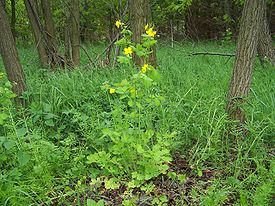 Celandine is big. General view of a flowering plant | |||||||||||||||||||||||||
| Scientific classification | |||||||||||||||||||||||||
| |||||||||||||||||||||||||
| International scientific name | |||||||||||||||||||||||||
Chelidonium majus L. [2] , 1753 | |||||||||||||||||||||||||
| Synonyms | |||||||||||||||||||||||||
| |||||||||||||||||||||||||
Content
- 1 Biological Description
- 2 Distribution
- 3 Economic value and application
- 4 Chemical composition
- 5 notes
- 6 Literature
- 7 References
Biological Description
Plants of large celandine have a straight, branched stem 50-100 cm high, at the break they release droplets of thick milky juice, which immediately turns orange-red in air.
The basal leaves are petiolate, deeply pinnate, have three to five pairs of rounded or ovoid lobes. The upper lobe is larger, usually three-lobed; the leaves are green above, bluish below. The upper leaves are sessile.
The flowers are regular, golden yellow, collected in a simple umbrella , each flower consists of four petals about 1 cm long. The celandine has no nectaries , but attracts insects with an abundance of pollen. It blooms from May to August.
Flower formula : [3] ( ) [4] .
The fruit is a multi-seeded pod- shaped box . The seeds are small, black, shiny with a white crest-like appendage, similar to eliosomes , which attracts ants spreading these seeds ( myrmecochoria ).
Distribution
It grows in nature in Europe and the Mediterranean , and is also common in America , where it was introduced in 1672 by the colonialists as a medicine for warts .
Naturalized throughout the world in a temperate zone .
In Russia, like a weed, it grows throughout the territory except the Arctic .
Economic Significance and Application
Celandine was considered a medicinal plant by the ancient Romans [5] . As a medicinal raw material , celandine grass ( lat. Herba Chelidonii ) is used, which is harvested in the flowering phase and quickly dried at a temperature of 50-60 ° C. Raw materials are used in the form of a 5% aqueous infusion as a choleretic and bactericidal agent for diseases of the liver and gall bladder [6] .
Celandine juice in folk medicine is used to remove warts , calluses , papillomas and some other skin formations. On the basis of juice, drugs with the same properties are made.
Based on a mixture of celandine alkaloids, the cytotoxic drug “ Ukraine ” is manufactured, which is used in the treatment of malignant diseases in the CIS countries [7] .
Ibn Sina wrote that celandine is great to chew with toothache, "... squeezed juice helps to sharpen vision and reduce water (cataracts) and an eyesore in front of the pupil" [8] . In modern medicine, celandine is not used for these diseases, since it is very toxic.
In homeopathy, the essence of fresh roots is used to treat diseases of the liver, kidneys and lungs [5] .
Powder and infusion of herbs are used as an insecticide [5] .
Elevated organs are used in veterinary medicine for the treatment of wounds and skin diseases [5] .
Celandine seed oil protects the metal from corrosion . Grass juice is used for blackening [9] and metal etching [5] .
Yellow grass is obtained from grass [9] . Celandine with alum dyes wool in red-yellow color [5] .
It is believed that celandine can be a source of a luminescent dye of biological objects. Thus, the extract from it surpasses the dyes primulin and erythrosine , which are used in the microbiological industry [10] .
In Ukraine , jugs and pots soared with celandine grass — so that milk would not sour. At the same time, the bactericidal and fungicidal effect of the herb on microorganisms was manifested, therefore, there were assigned names for celandine - glekopar, gledishnik, sour cream [10] .
Chemical Composition
The plant is poisonous , contains isoquinoline alkaloids , benzophenanthridine derivatives: homochelidonin , cheleritrin , helidonin , sanguinarine , protopine and others (over 20 alkaloids). Helidonin is an alkaloid that is close in structure to papaverine and morphine . Homochelidonin is a convulsive poison , a strong local anesthetic . Cheleritrin has a locally irritating effect; sanguinarine has a short-term narcotic effect with the subsequent development of strychnine-like seizures, excites intestinal motility and secretion of saliva, and locally causes irritation with subsequent anesthesia . Protopin reduces the reactivity of the autonomic nervous system , tones the smooth muscles of the uterus .
Traces of essential oil , a lot of ascorbic acid (up to 1000 mg% ), carotene , flavonoids , saponins , bitterness , organic acids: chelidonic , malic , citric and succinic , resinous substances were also found in the celandine. The grass has bactericidal properties.
On pastures, celandine is not eaten by cattle: it causes poisoning, severe inflammation of the stomach and intestines. For example, pigs , eating celandine, not only lose strength, but also noticeably stall. Celandine is harmless only for sika deer .
Drying does not destroy the toxic properties of large celandine, which cause depression and paralysis of the central nervous system. Isolated cases of poisoning of goats and pigs with celandine were observed [11]
General form | Milky juice on | Leaves | Flowers | Fruits - Podiform |
Notes
- ↑ For the conventionality of indicating the class of dicotyledons as a superior taxon for the plant group described in this article, see the APG Systems section of the Dicotyledonous article .
- ↑ 1 2 Sp. Pl., 1753 , p. 505-506.
- ↑ Andreeva I.I., Rodman L.S. Botanika. - 3rd ed., Revised. and add. - M .: Kolos, 2005 .-- S. 399 .-- 528 p. - ISBN 5-9532-0114-1 .
- ↑ Barabanov E.I. Botany: a textbook for students. higher textbook. institutions. - M .: Publ. Center "Academy", 2006. - S. 241. - ISBN 5-7695-2656-4 .
- ↑ 1 2 3 4 5 6 Gubanov I.A. et al. Wild useful plants of the USSR / ed. ed. T.A. Rabotnov . - M .: Thought , 1976. - S. 136. - 360 p. - ( Reference guides to the geographer and traveler ).
- ↑ Blinova K.F. et al. Botanical-Pharmacognostic Dictionary: Ref. allowance / Ed. K.F. Blinova, G.P. Yakovleva. - M .: Higher. school, 1990. - S. 258. - ISBN 5-06-000085-0 .
- ↑ Semenov A. A., Kartsev V. G. Fundamentals of the chemistry of natural compounds. - M .: ICSPF, 2009. - T. 2. - S. 115-116. - ISBN 978-5-903078-13-4 .
- ↑ Prince 2 .-- S. 489.
- ↑ 1 2 Zhurba O. V., Dmitriev M. Ya. Medicinal, poisonous and harmful plants. - M .: KolosS, 2005 .-- S. 167-168. - 512 s. - 1,500 copies - ISBN 5-9532-0209-1 .
- ↑ 1 2 Matsyutsky S.P. Treasured herbsː popular science book. - Dnepropetrovsk: Promin, 1990. - S. 24-37. - 254 p. - 25,000 copies. - ISBN 5-7775-0251-2 .
- ↑ Dudar A.K. Poisonous and harmful plants of meadows, hayfields and pastures: characteristics, measures for destruction. - M .: Rosselkhozizdat, 1971. - S. 13. - 95 p. - 44,000 copies.
Literature
- Caroli Linnaei . Species Plantarum . - 1753. - Vol. 1. - P. 505-506 .
- Gubanov I.A. et al. 621. Chelidonium majus L. - Great Celandine // Illustrated identifier of plants in Central Russia. In 3 t . - M .: T-in scientific. ed. KMK, Institute of Technology. ISS., 2003. - T. 2. Angiosperms (dicotyledonous: dicotyledonous). - S. 247. - ISBN 9-87317-128-9 .
- Encyclopedic Dictionary of medicinal plants and animal products: Textbook. allowance / ed. G.P. Yakovleva and K.F. Blinova. - 2nd ed., Rev. and add. - SPb. : Special Lite; SPKhFA, 2002 .-- S. 306. - ISBN 5-299-00209-2 .
Links
- Chelidonium majus (English) : taxon information on the Tropicos website.