
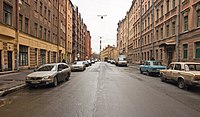
Lane is a small street , usually a transverse connection of two larger longitudinal streets [1] [2] .
Content
- 1 Description
- 2 Lanes in various cities
- 3 notes
- 4 Literature
Description
According to the historian S. K. Romanyuk , “ bizarre ligature of the alleys ” is inherent in the historical centers of old cities with chaotic buildings: small paths or alleys were laid out to separate sections, which later became known as alleys [3] . In cities, alleys often received names by the names of homeowners [4] .
Lanes in various cities
In Moscow, until the mid-20th century, the lane was the most common address facility. At the beginning of the XIX century, the city had 142 streets and 518 lanes, and at the beginning of the XX - 404 streets and 936 lanes and thoroughfares [5] . The name of the lane in the XX century began to become obsolete. New lanes in Moscow are now called either driveways or streets [3] .
In St. Petersburg, not all lanes are narrow and short. For example, Vyazemsky Lane has a greater width than some avenues, and the Laminate Lane is longer than other streets. On a number of short side streets there are only two houses (for example, Prudkovsky side street ). The most common name for an alley in St. Petersburg is Deaf . Throughout the history of the city, there are 44 Deaf Alleys. Some lanes did not have a name for some time, and they were called Nameless . Part of the side streets of St. Petersburg subsequently changed their status, becoming streets. And Geslerovsky and Porokhovskaya lanes even became avenues - Chkalovsky and Piskaryovsky, respectively [6] .
In Krasnoyarsk, before the revolution, all streets running perpendicular to the Yenisei were called lanes (and those parallel to the streets ) [7] . In the pre-revolutionary Rostov-on-Don, the streets were also located along the Don , and the alleys - across [8] . In Novokuznetsk , small streets were called lanes and driveways. But unlike the passage along the lane, transport could not move [9] .
Notes
- ↑ Lane // Explanatory Dictionary of the Living Great Russian Language : in 4 volumes / auth. V.I. Dahl . - 2nd ed. - SPb. : Printing house of M.O. Wolf , 1880-1882.
- ↑ Lane // Explanatory dictionary of the Russian language of Ushakov (inaccessible link from 06/14/2016 [1181 days])
- ↑ 1 2 Romanyuk S.K. From the history of Moscow lanes. - M .: Moscow Worker, 1988. - S. 3-4. - 304 p. - 100,000 copies. - ISBN 5-239-00018-2 .
- ↑ Gorbanevsky M.V. Russian urban toponymy . - OLRS, 1996 .-- S. 136. - 303 p.
- ↑ Lanes // Moscow. Encyclopedic reference book. - Moscow: Big Russian Encyclopedia, 1992.
- ↑ Levina N. R. In one of the distant lanes ... . Publishing House "Papyrus". Date of treatment August 5, 2012. Archived on August 18, 2012.
- ↑ Kadash T.V. Hodonymous terms of Krasnoyarsk at the end of the XIX - beginning of the XX centuries The official website of the library of Krasnoyarsk State University. Date of treatment July 27, 2012. Archived on August 7, 2012.
- ↑ Belenky G.L. Rostov-on-Don. The city at the Quiet Don. - Rostov-on-Don: Sigma, 2005 .-- S. 63. - ISBN 5-944-67005-3 .
- ↑ Google books // Linguistic Yearbook of Siberia, Volumes 1-5. - Krasnoyarsk State University, 1999.
Literature
- Lanes // Moscow. Encyclopedic reference book. - Moscow: Big Russian Encyclopedia, 1992.
- Levina N. R. In one of the distant lanes .... - Papyrus, 2012 .-- 272 p. - ISBN 978-5-91987-017-3 .