Harshad numbers , or Niven numbers , are natural numbers divisible entirely by the sum of their numbers [1] [2] [3] [4] . Such a number is, for example, 1729 , since 1729 = (1 + 7 + 2 + 9) × 91 .
Obviously, all numbers from 1 to 10 are Harshad numbers.
The first 50 numbers of Harshad, not less than 10 [3] :
- 10 , 12 , 18 , 20 , 21 , 24 , 27 , 30 , 36 , 40 , 42, 45, 48, 50, 54, 60, 63, 70, 72, 80, 81, 84, 90, 100, 102, 108, 110, 111, 112, 114, 117, 120, 126, 132, 133, 135, 140, 144, 150, 152, 153, 156, 162, 171, 180, 190, 192, 195, 198, 200.
It also makes sense to consider Harshad numbers in other number systems . Numbers that are Harshad numbers in all number systems are called generalized Harshad numbers . There are only four of them: 1, 2, 4, 6.
History
The Harshad numbers were investigated by the Indian mathematician Dattaraya Ramchandra Kaprekar . The word “Harshad” comes from the Sanskrit harṣa IAST “great joy” [4] .
Harshad number density distribution estimate
Let be 

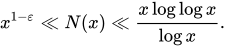
Jean-Marie de Koninck, Nicholas Doyon [5] and Katai [6] showed and proved that
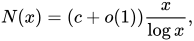
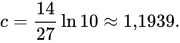
Where
See also
- Niven, Ivan
Notes
- ↑ Weisstein, Eric W. Harshad Number on the Wolfram MathWorld website.
- ↑ Harshad numbers unopened . Numbers Aplenty.
- ↑ 1 2 A005349 sequence in OEIS = Niven (or Harshad) numbers: numbers that are divisible by the sum of their digits
- ↑ 1 2 JJ O'Connor, EF Robertson. Dattatreya Ramachandra Kaprekar . MacTutor History of Mathematics archive (08-2007).
- ↑ De Koninck, Jean-Marie & Doyon, Nicolas (November 2003), "On the number of Niven numbers up to x ", Fibonacci Quarterly T. 41 (5): 431-440 .
- ↑ De Koninck, Jean-Marie; Doyon, Nicolas & Katái, I. (2003), " On the counting function for the Niven numbers ", Acta Arithmetica T. 106: 265–275 , DOI 10.4064 / aa106-3-5 .