
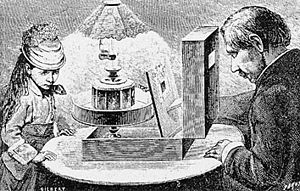

Praxinoscope ( Greek πράξιν - “action” and σκοπέω - “look”) is an optical device for demonstrating moving pictures, patented by Emile Reynaud on August 30, 1877 [1] . Created on the basis of the zootropa and phenacystiscope , the praxinoscope has become yet another cinematic technology .
Content
Principle of Operation
The device consists of an open cylinder with a wall height of about 10 centimeters. On the inside of the cylinder there is a strip with 8 or 12 miniatures. In the center of the cylinder there is a mirror prism , the number of sides of which corresponds to the number of miniatures. The inner radius of the prism is half the radius of the cylinder. Moreover, each miniature is reflected in the corresponding face of the prism in such a way that the deviation of the face during rotation compensates for the displacement of the image, ensuring its stillness between shifts. Due to such optical compensation during the rotation of the cylinder, an animated effect of smooth movement occurs.
A special wooden casing with a viewing window and a decorative panel with theatrical scenes depicted on it enhances the effect and is called the “optical theater”.
Use of praxinoscope in films
- In the film “ Oz: The Great and Terrible ”, a praxinoscope was used as a means of transmitting images into space in order to frighten Theodora ( Mila Kunis ) and Evanor ( Rachel Weiss ) by the fact that Oscar ( James Franco ) was still alive and was not present in the air wounded by the Evil Witch balloon.
See also
- Raynaud, Emil
- Cinema
- Magic lantern
- Pinhole camera
- Lucida chamber
- Kaleidoscope
- Slide projector
- Diascope
Notes
- ↑ Invention of equipment. Excerpts from the book "Invention of Motion Picture Arts" (inaccessible link) . "Cinema roads." Date of treatment March 29, 2015. Archived April 2, 2015.
Literature
- Georges Sadoul . The General History of Cinema / V. A. Ryazanov. - M.,: "Art", 1958. - T. 1. - 611 p.