Mark of Ephesus (in the world Manuel Eugenicus , Greek Μανουήλ Ευγενικός ; 1392 - June 23, 1444 ) - bishop of the Orthodox Church of Constantinople , Metropolitan of Ephesus , an Orthodox theologian, member of the Ferraro-Florentine Council , who did not accept the Union of Florence.
| Mark of Ephesus | |
|---|---|
| Μάρκος Ευγενικός | |
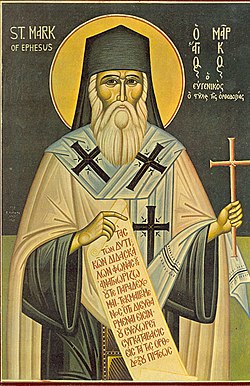 | |
| Name in the world | Manuel Eugenic |
| Birth | 1392 Constantinople |
| Death | June 23, 1444 Constantinople |
| Is revered | in the Orthodox church |
| Glorified | in 1734 |
| In the face | saints |
| Day of Remembrance | January 19 ( Julian calendar ) |
| Asceticism | fight with unity |
In 1734, canonized in the face of the saints , the memory is committed on January 19 (according to the Julian calendar ).
Content
Biography
Youth and Monasticism
Mark was born in Constantinople , his father was a deacon and sakellariy at the church of St. Sophia , his mother was the daughter of a doctor. About the origin of Mark in his synaxar, his younger brother John Eugenics writes:
His parents were George, deacon and sackellarius of the Great Church - in those days the great city was doubly rich, having him as a mentor in the Church of Christ, to which many young people flocked - and Mary, a certain respectable and god-loving doctor, was a daughter. The clan of both is perfectly seen in all the nobility combined with godliness to God and decorated with virtue. [one]
- John Eugenics. Sinaxar
Mark received a home education, studied rhetoric and mathematics . At the age of 13, he lost his father and continued his studies with two famous professors of that time: he studied rhetoric with John Hortasman , and philosophy with George Gemist Plifon . At an early age, Mark took up the post of father at the Hagia Sophia, and at the age of 24 he received the title of Votaria Ritorov .
From his youth, Mark had a penchant for theology and ascetic life. In a tombstone, Gennady Scholarius writes about his teacher:
I can say about the righteousness of our deceased father, that as a young man and before he put to death his flesh about Christ, he was already more righteous than desert-living hermits, and that, casting aside all worldly things for Christ and accepting the yoke of obedience to God ... [1]
As the spiritual son of the Patriarch of Constantinople Euthymius , Mark became close to the imperial court and attracted the attention of Emperor Manuel II , who made him his adviser. In 1418, Mark leaves Constantinople and takes monastic tonsure in the monastery on the island of Antigonos . [2] Soon, fearing the Turkish conquest, the monks left the cloister, and Mark returns to Constantinople and settles in the Mangan cloister , where, according to John Eugenic, “he devoted himself to extreme work and fasting and fasting and sleeping on earth and standing all-night, and especially then , when he was left alone, often adding: “God pleases nothing from all that as an endure to evil” ... ”. [one]
Ferraro Florence Cathedral
Emperor John VIII , who succeeded Manuel, also highly appreciated Mark, as evidenced by a number of writings of the hierarchs, written at the request of the emperor to answer questions of a theological and philosophical nature. In 1437, by the will of the emperor, Mark becomes Metropolitan of Ephesus and on November 24, together with him and the patriarch, as part of a delegation of Orthodox bishops, goes to the church cathedral with Catholics in Ferrara , which lasted two years and was called the Ferraro-Florentine Cathedral . According to researchers, the elevation of Mark to the rank of bishop was done so that he would not represent Byzantium at the cathedral as a high-ranking church hierarch. [3] This is also confirmed by the fact that prior to Mark's return from Italy, nothing was known about his affairs in managing the diocese.
The Greek delegation arrived in Ferarra on March 4, 1438, and the Cathedral was opened on April 9 . It was decided to create a commission to study the dogmatic differences between the two Churches and to develop the conditions for concluding a union. From the Orthodox part of the commission, only Mark of Ephesus and Vissarion of Nicaea were authorized to speak publicly in discussions with Catholics. The great rhetor Manuel writes about the position of Mark at the Florence Cathedral: “The Tsar ... took with him (to Italy) the well-remembered blessed Mark, who was already there when the Council was held, decently set his exarch ... ”. [one]
At the beginning of the Council’s work, Mark was positive about the adoption of the union. This is evidenced by his speech addressed to Pope Eugene IV :
The Holy Father, accept your children, those who come from afar from the East: embrace them, who have been in separation for a long time; heal the embarrassed. All thorns and stumbling blocks threatening the cause of peace were ordered to be removed from the midst; say to your Angels yourself, as an imitator of God: “ Create the way by My people, and repent the hedgehog on the way ” ( Isa. 62:10 ).
- Mark of Ephesus. Word before the opening of the Florence Cathedral
During the commission’s work, Mark wrote a number of theological works: “ Ten Arguments Against the Existence of Purgatory ”, “ Summation of the Sayings of the Holy Spirit ”, “ Chapters against the Latins ”, “ Confession of Faith ” and “ On the Time of Transmission ”. During this time, he departed from the idea of adopting a union, finding the teachings of the Western Church contrary to the dogmas of Ecumenical Councils (in particular, the question of the filioque ). In his essay On the Florence Cathedral , Mark wrote:
... some words were replaced by others, and speech gave rise to speech, as is customary in them; and their truth didn’t prove anything stronger by anything greater, although they poured a lot of ink for themselves and covered it with verbosity ... I, having since dissociated myself from them, went into myself in order to constantly agree with my holy Fathers and by the Teachers, to make known to everyone my view through this my scripture, so that it would be possible for (anyone) who wishes to weigh: ... I did not accept the concluded Union.
- Mark of Ephesus. About Florence Cathedral
Despite this, during the Council, Orthodox hierarchs, having familiarized themselves with the teachings of the Roman Church, under the pressure of the emperor [4] and patriarch [5] came to the conclusion that it was based on Holy Scripture and Holy Tradition . After some hesitation, all of them, except Metropolitan Mark, recognized the innovations of the Roman Church as eligible, but with the proviso that the Eastern churches would not introduce them at home. On July 6, 1439, the Greek delegation, including the emperor, signed the resolution of the council, bull “ Laetentur coeli ”.
Mark became the only one among the Greek hierarchs who did not recognize the union. In his “District Message Against the Greco-Latins and Decisions of the Florentine Council,” he wrote: “ So, brethren, flee from them and from communion with them; for they are "lie the apostles, the laborers of wickedness, being transformed into the apostles of Christ" ... ". [6]
When Pope Eugene IV was solemnly presented with the Act of Union signed by the Greek representatives, he asked: “Did Mark sign it?” And when he found out that Mark was not signed, he exclaimed bitterly: “So, we did nothing!” [7 ]
The last years of life
On February 1, 1440, the Greek delegation returned to Constantinople. According to the historian Duki, their meeting was joyless and to the question “ Have we won?” "They answered:" We sold our faith, exchanged piety for wickedness; having betrayed the Holy Gifts, they became azimat-unleavened bread . ” The Patriarch of Constantinople Joseph II died in 1439 in Florence , and upon the emperor's return to Constantinople, Mark was offered the position of primate, but he refused to accept the patriarchal dignity. Mitrofan II , who was a supporter of the union, was elected patriarch. Byzantologist G.A. Ostrogorsky writes: “The decisions adopted at the Council in Florence did not matter. "The Byzantine people opposed the decrees of Ferrara and Florence with passionate fanaticism, and while all the admonitions of the Unia supporters were ignored, the fiery sermons of Mark Eugenicus everywhere found an enthusiastic response ." [1] A large party rallied around Mark who did not recognize the union; many of the bishops who signed the bulla took their signatures back. [8] Mark's negative opinion of the union was supported by monasteries, which had a great spiritual influence on the Orthodox population. [9]
After a short stay in Constantinople, Mark May 15, 1440 leaves for his metropolis in Ephesus. From there, he sent numerous messages against the union, which set Emperor Manuel against him. The saint also began to restore the church life of the city, which was under the rule of the Turks. Life in Ephesus was not calm for Mark, and he decided to leave the city. In his letter to Hieromonk Theophanes of June 16, 1441, he wrote:
... there I did not find any reassurance and was seriously ill, and in poverty from the wicked and undergoing misfortunes for the reason that I did not have a mandate from the authorities, I left there with the intention of going to the Holy Mountain . [ten]
- Mark of Ephesus. Message to Hieromonk Theophanes on the Ebey Island .
According to the syntax of John Eugenics, when the ship on which Mark sailed docked on the island of Lemnos , the metropolitan was arrested at the direction of the emperor and imprisoned in the local fortress of Mundros, in which he spent two years. During this period, he did not stop correspondence, in which he still sharply criticized the union and urged believers to adhere to Orthodoxy.
In August (or October), 1442, Mark was released from the fortress and returned to Constantinople, where he continued his struggle with the unity. Gregory III Mamma , who was the Patriarch of Constantinople in the last years of Mark's life, adhered to the union and was an opponent of Mark. Despite this, according to the testimony of the great rhetorician Manuel, " ... he took up many works and, of those who were deceived there, turned again, including the most memorable king ... ". Mark himself writes about a change in the views of the emperor: "The emperor ... openly says that he repents of what has been accomplished and lays the blame on those who submit and sign the Union ." [ten]
... just as throughout my whole life I was separated from those, so - and during my departure, and even after my death, I turn away from conversion and union with them and swear oaths that none (of them) come close to to my burial, not to my grave ...
Mark died on June 23, 1444 in Constantinople. According to the testimony of John Eugenics, death was preceded by a 14-day agony:
He fell ill for 14 days, and the disease itself, as he himself said, had the same effect on him as the iron instruments of torture, which were used by the executioners in relation to the holy martyrs, and which, as it were, encircled the ribs and entrails, squeezed them and remained attached in this state and caused completely unbearable pain.
Dying, Mark turned to those present with a parting word written by George Sholariy, in which even at the time of death he manifests himself as an implacable fighter with unity. In the same word, Mark admonishes the future patriarch Gennady Scholarius to become a fighter for faith instead. The saint was buried in the Mangan monastery in Constantinople.
Theological Heritage
The theological legacy of Mark of Ephesus consists of the writings he wrote during his work at the Ferraro-Florentine Cathedral, and subsequent messages explaining his rejection of the union. In his writings, as a member of the council committee, Mark sets out his analysis of Catholic theology in relation to the Orthodox. Mark of Ephesus pointed out that in the Catholic Church a number of dogmas (e.g. filioque , purgatory ) are contrary to scripture and tradition .
According to contemporaries, Mark was a brilliant speaker, but the texts of his sermons were not preserved. His attempts to write an autobiography are known (“A summary of how he accepted the bishop's dignity, and an explanation of the cathedral that was in Florence ,” “ Message to Hieromonk Theophanes on the Ebey Island ”). The works of Mark of Ephesus are included in the 160th volume of Patrologia Graeca .
Honoring and Canonization
In 1734, under the Patriarch of Constantinople, Seraphim I was canonized by the definition of the Holy Synod of the Orthodox Church of Constantinople:
The Holy Mark, called Eugenicus, a former primate and pastor and bishop of Ephesus Church, is universally recognized as a saint in our Eastern Church of Christ and is undoubtedly accepted and revered as the holy father of the Church . Our Holy Christ East Church of this holy Mark of Ephesus, Eugenics, knows and honors and joyfully accepts this holy husband and the God-bearing and reverend and fiery jealous of Piety and our Sacred Dogmas and righteous thinking, Orthodoxy champion and valiant defender and before ancient conquests in ancient times theologians and governor of the Church of the copycat and competitor [1] .
His name was finally included in the clergy of other local Orthodox churches, including the Russian at the end of the 20th century.
In October 2012, he was canonized by the Russian Orthodox Old Believer Church at the consecrated cathedral [11] .
Notes
- ↑ 1 2 3 4 5 6 Quoted from Archimandrite Ambrose (Pogodin) . Saint Mark of Ephesus and Florence Union. Holy Trinity Monastery, Jordanville, NY 1963.
- ↑ Mark of Ephesus
- ↑ Archimandrite Ambrose (Pogodin). Saint Mark of Ephesus and Florence Union
- ↑ Sylvester Syrup . Memoirs of the Ferraro-Florentine Cathedral (1438-1439). In 12 parts. - SPb. : Publishing House of Oleg Abyshko, University Book, 2010. - S. 241-242. - ISBN 978-5-903525-49-2 .
- ↑ Sylvester Syrup . Memoirs of the Ferraro-Florentine Cathedral (1438-1439). In 12 parts. - SPb. : Oleg Abyshko Publishing House, University Book, 2010. - P. 253. - ISBN 978-5-903525-49-2 .
- ↑ St. Mark of Ephesus. District Epistle against the Greco-Latins and the ordinances of the Florence Council
- ↑ Florence Union. Saint Mark of Ephesus
- ↑ Vasiliev A.A. History of the Byzantine Empire. T.2. Chapter 3. The fall of Byzantium. The Age of Paleologists (1261-1451)
- ↑ John Meyendorf. Did a meeting between East and West take place in Florence?
- ↑ 1 2 Mark of Ephesus. Message to Hieromonk Theophanes on the Ebey Island
- ↑ The Consecrated Cathedral completed work